Rust tops 2026 pay rankings as adoption and security guidance rise
Rust's pay premium is looking less like hype and more like a market signal. Production use, memory-safe guidance, and scarce systems work are driving the money.
1. Rust is the salary chart's loudest signal
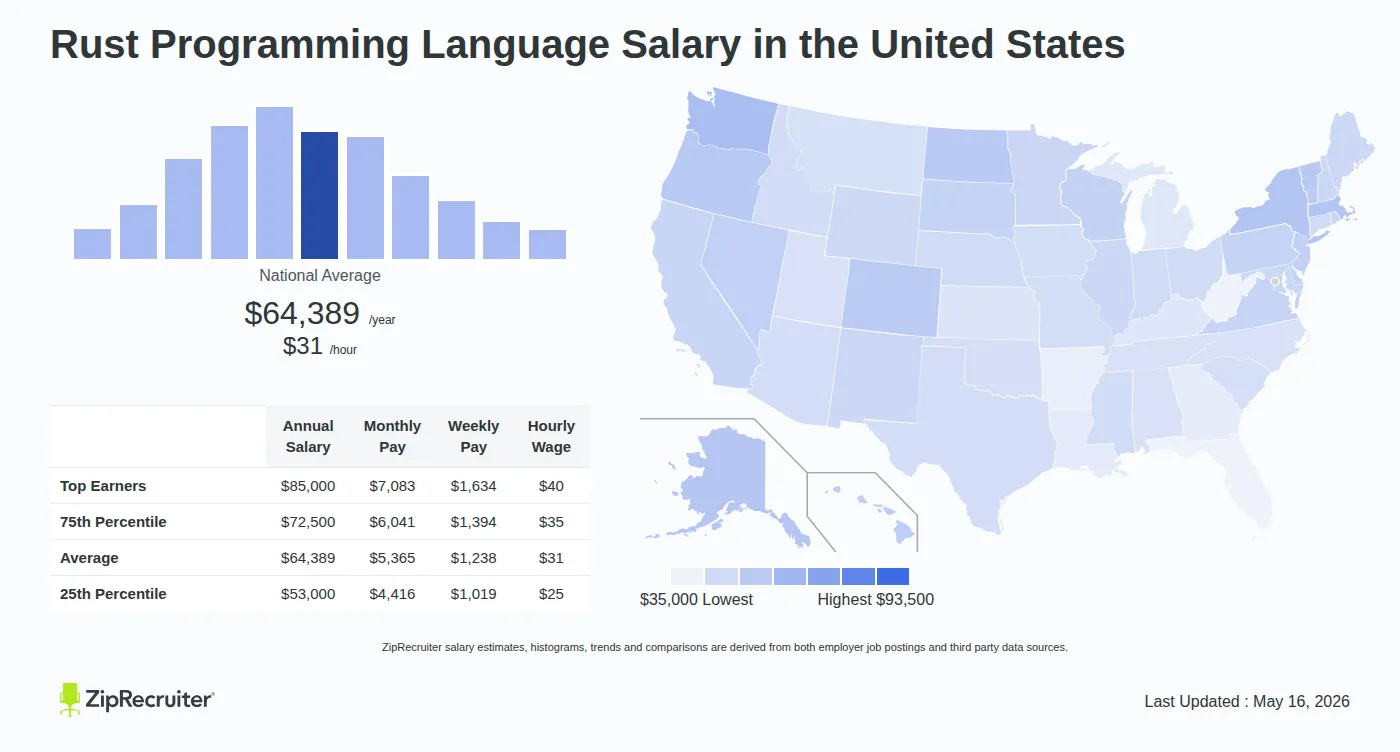
Rust sitting at the top of the 2026 pay rankings, ahead of Go, Scala, and the rest, is not just a bragging-rights stat, especially with the post already clearing 500 likes. The better read is that Rust gets paid when the work is hard, close to the metal, and expensive to get wrong: systems code, performance-sensitive backend services, infrastructure, and security-sensitive software.
2. Production use has moved Rust out of the enthusiast lane
The Rust Project's 2025 State of Rust Survey, which ran from November 17 to December 17, 2025 and pulled in 7,156 responses, shows real adoption depth, not just forum enthusiasm. In that survey, 48.8% of organizations reported non-trivial use of Rust, up from 38.7% in 2023, which is the kind of jump that turns a niche skill into a hiring signal. A separate Stack Overflow survey added broader labor-market context by drawing more than 49,000 responses from 177 countries across 62 questions on 314 technologies, underscoring how competitive the developer market is around languages that solve expensive production problems.
3. Daily Rust work is where the premium gets earned
The same Rust survey found that 55.1% of respondents use Rust daily and 56.8% say they are productive Rust writers, which tells you where the highest-value work sits. If you are already past the toy-project stage and shipping Rust every day, you are in the part of the market that employers pay for, because teams do not hire Rust just to admire borrow-checker theory.

4. Security guidance is now pushing Rust into the center of the conversation
The pay story gets stronger when you put it next to the security guidance. The White House Office of the National Cyber Director urged a move toward memory-safe programming languages in a February 26, 2024 report, and CISA plus the NSA followed on June 24, 2025 with a guide saying memory-safe languages are the most comprehensive mitigation against memory safety vulnerabilities; NIST also lists Rust among its safer languages. That is why so many of the best-paying Rust jobs cluster around infrastructure, embedded work, and security-heavy backends: organizations are willing to spend to reduce memory-risk exposure.
5. Solidity shows that specialization still commands a premium
Rust is not the only language on the high-pay end of the table, and that matters because it explains the shape of the market rather than just the headline. The Solidity language team's sixth annual developer survey, run in February and March 2026, collected 1,095 usable responses from 87 countries, showing a global but still specialized user base for smart-contract work.
That is the same pattern Rust is riding: a smaller talent pool, technical problems that punish mistakes, and employers who pay up when the code has to be fast, safe, and production-ready. The ranking is not saying every Rust job is golden, but it is saying the market pays most when Rust is the answer to a painful implementation problem, not just a trendy language choice.
Know something we missed? Have a correction or additional information?
Submit a Tip