Rust Tutorial Builds JSON Parser to Teach Structs, Enums, Pattern Matching
A JSON parser turns Rust’s type system into something concrete, and this guide shows why structs, enums, and pattern matching suddenly feel obvious.
Why this parser project lands so well
A JSON parser is one of the fastest ways to understand why Rust feels different from other languages. The latest installment in Mrsheerluck Blog’s learning-rust series uses exactly that kind of project to pull structs, enums, and pattern matching into one compact build, instead of treating them as separate language features floating in isolation.
That choice matters because JSON is not a toy format. It is a real, standardized data shape, and it forces you to deal with nested values, recursive structures, and variant-heavy control flow all at once. In a small enough project, you still get the core Rust experience: types that model the problem directly, ownership that shapes how data moves, and matching that makes every branch explicit.
Structs set the stage
The tutorial starts with structs for a reason. Rust structs give a value a clear shape, and the language expects that shape to be defined up front with named fields. Field names follow PascalCase conventions for the type itself, while the fields stay comma-separated inside the definition, which keeps the data model readable even as it grows.
The key lesson here is that Rust does not let you hand-wave structure. When you construct a struct value, you provide all of its fields, and when you read or update one, you do it by name. That makes the syntax feel strict at first, but it pays off quickly when you are building something like a parser, where every piece of data needs to be predictable and explicit.
The tutorial also leans into field access, mutability, and shorthand initialization. One small but important point stands out: if any field will change, the binding itself has to be mutable. That detail trips up a lot of beginners, but it also shows how Rust ties mutation to the variable binding, not just the field itself. Before the parser logic even begins, the lesson is already teaching data ownership and change in a way that is central to the language.
Enums are the real unlock
Once the article shifts from structs to enums, the project starts to look like a Rust-native solution rather than a generic programming exercise. Rust’s official book describes enums as a way to define a type by enumerating its possible variants, and JSON is almost tailor-made for that idea. A JSON value can be null, a boolean, a number, a string, an array, or an object, so each case can become a variant in a single type.
That is where the parser becomes more than a parsing exercise. It becomes a lesson in modeling reality with the type system. Arrays and objects are especially useful here because they are recursive: an array can contain more JSON values, and an object maps strings to more JSON values. That recursion is exactly why JSON makes enum-based design click so well in Rust.
Serde’s `serde_json::Value` is the canonical reminder of how common this pattern is across the ecosystem. Its recursive enum model includes variants for `Null`, `Bool`, `Number`, `String`, `Array(Vec<Value>)`, and `Object(Map<String, Value>)`, which shows how naturally JSON fits Rust’s data modeling style. Even if the tutorial is building its own parser rather than leaning on that type directly, the shape is the same for a reason: it is a clean match between the format and the language.
Pattern matching turns the model into control flow
If enums define the data, pattern matching is what makes the parser feel powerful. Rust’s `match` construct compares a value against patterns and runs the first matching arm, and the language’s pattern system can destructure structs, enums, and tuples. That means the parser can examine each JSON value precisely, branch by branch, without resorting to vague condition chains.
This is where the “aha” moment usually happens. A parser is full of decisions, and `match` makes every one of them visible. You can see the shape of the value, take it apart safely, and handle each variant in a way the compiler can check exhaustively. That combination is a big reason Rust developers like to use parser projects as learning tools: the control flow is not just logic, it is a direct reflection of the data model.
Exhaustiveness matters here, too. With JSON, you are not guessing what values might show up. You are telling Rust exactly which cases exist, then letting the compiler help ensure that no branch gets forgotten. That is a very different feeling from languages where variant handling is looser and the gaps only show up at runtime.
Why JSON is such a strong teaching target
The format itself is part of the lesson. RFC 8259, published by the Internet Engineering Task Force and issued in December 2017, identifies JSON as a lightweight, text-based, language-independent data interchange format. That description explains why JSON has remained such a reliable teaching target: it is simple enough to build in a tutorial, but universal enough to matter outside the tutorial.
The tutorial’s structure makes that usefulness even clearer. Instead of starting with parser theory and drifting into abstractions, it uses JSON to force you to confront nested data, variant handling, and ownership in one place. You are not just memorizing syntax. You are seeing how Rust wants you to think about data that changes shape as it moves through a program.
That is especially valuable for self-taught developers and students who want practical fluency. A JSON parser is small enough to finish, but real enough to expose the parts of Rust that matter in production code: explicit data modeling, careful mutation, and exhaustive handling of cases. The payoff is not just understanding one parser, it is understanding why Rust’s type system feels so opinionated and so useful at the same time.
A series built for momentum
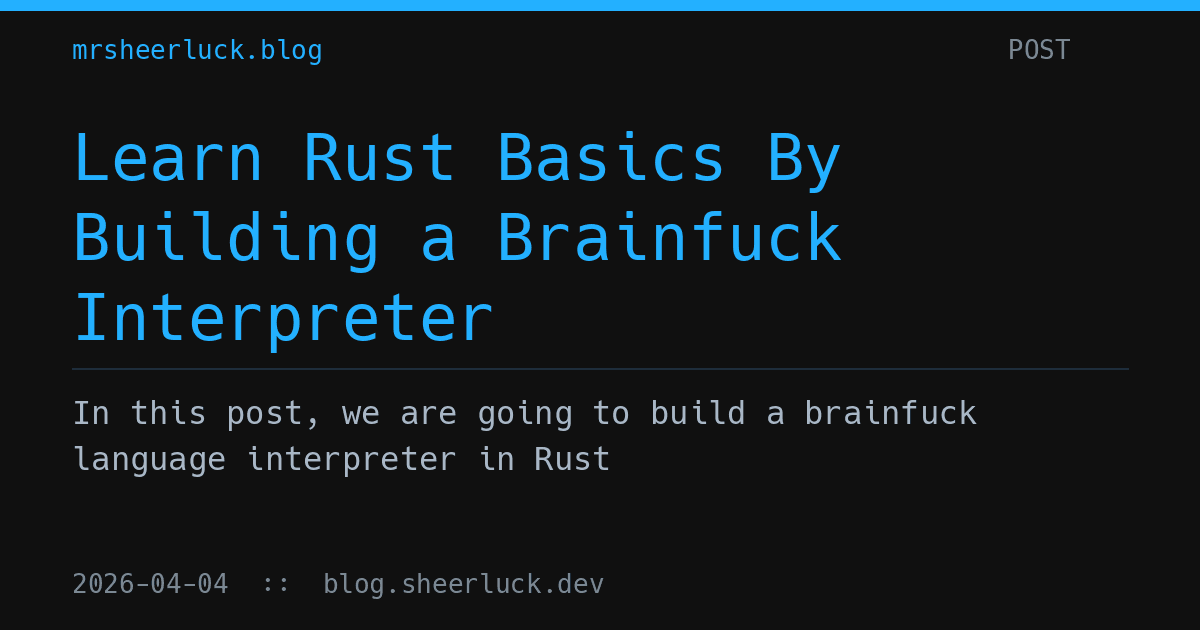
The parser tutorial also fits into a deliberately paced series. Mrsheerluck Blog has been moving readers through learning-rust in stages, first with a Brainfuck interpreter and then with mini grep before arriving at JSON parsing. That progression is smart because it keeps each project just hard enough to teach a new idea without burying the reader in scale.
By the time you reach the parser, the earlier lessons have already established a rhythm: build something small, learn a Rust concept that matters, then move to the next layer of complexity. The JSON project adds a fresh challenge because it ties the previous ideas together. Structs provide shape, enums provide the variants, pattern matching provides the branches, and recursion ties the whole thing together.
That is why the tutorial stands out as more than another syntax walkthrough. It gives Rust learners a finished project that mirrors how the language is used in the wild, and it does so through one of the most recognizable data formats in software. The result is a lesson that feels immediate, practical, and deeply Rust at the same time.
This article was produced by Prism’s automated news system from verified source data, official records, and press releases, then run through automated quality and moderation checks before publishing. The system is built and supervised by the people who set the standards it runs under. Read our full AI policy.
Did this article answer your question?