A Go Developer Finds Rust Clarifying Through Tokio Chat Server Work
A Go developer’s first Tokio chat server turns Rust’s strictness into a feature: enums, `?`, and async/await start feeling like guardrails.
A chat server is a good stress test
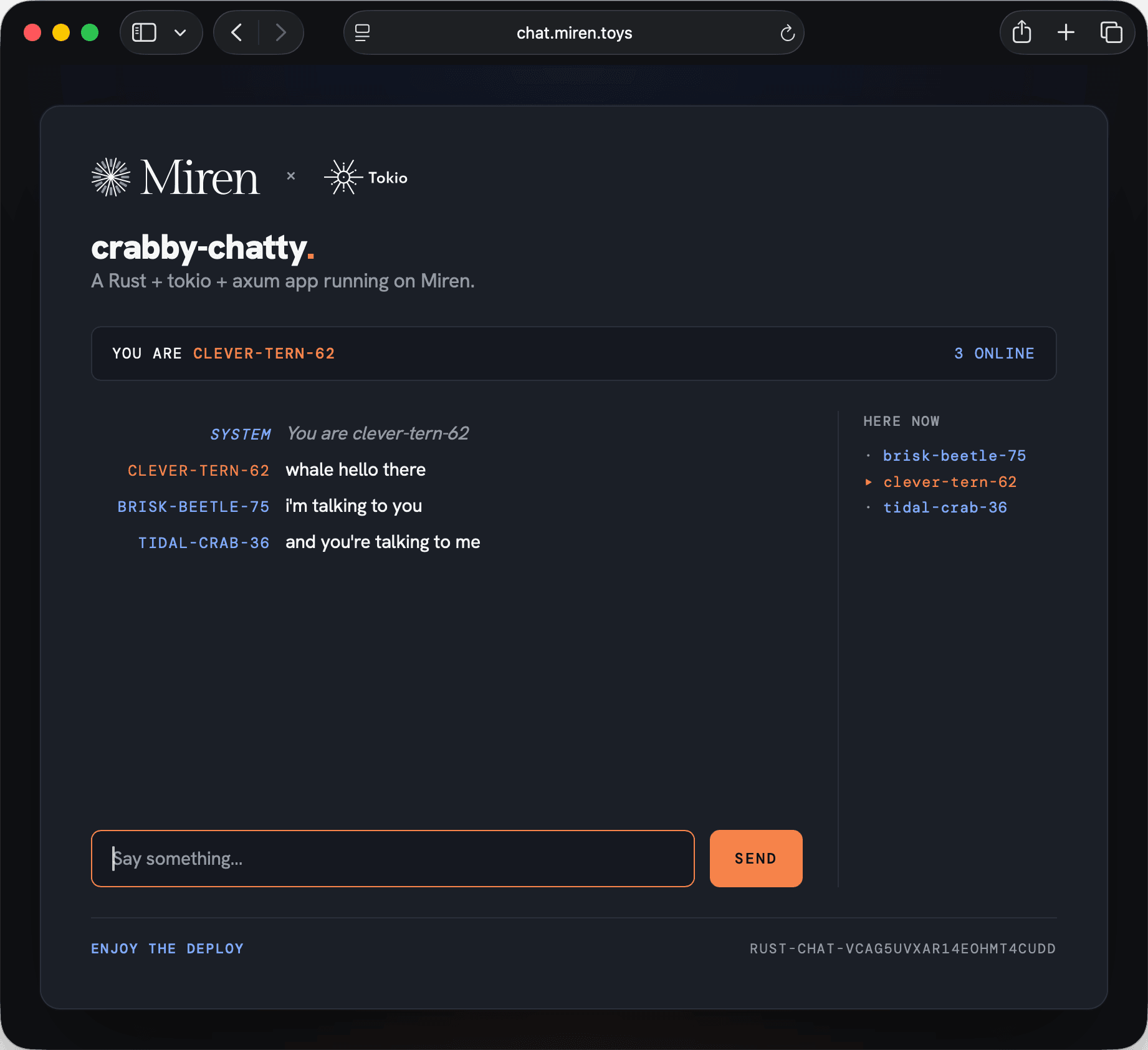
Miren’s “A Gopher Meets a Crab” lands because it does not treat Rust like a classroom exercise. It starts from a real Tokio chat server, the kind of networked, concurrent project that quickly exposes whether a language’s ergonomics hold up under pressure. That setting matters: a chat app forces you to think about messages, failure, and state changes all at once, which is exactly where Rust’s rules stop being abstract and start becoming useful.

The author comes to Rust from Go with years of respect already built up, then finally gets a reason to go hands-on. That shift is the whole story: Rust stops being a language admired from across the fence and becomes a tool judged by whether it makes a live system easier to reason about. Writing the demo while traveling to the inaugural TokioConf, and running the chat server live in a sample-app repository, gives the piece a real-world edge instead of a tutorial tone.
What feels harder than Go at first
The first serious Rust project does not hide the friction. It makes it obvious that Rust asks you to be more explicit about what can happen, what cannot happen, and what must be handled right now. For a Go developer, that can feel heavier at the start, because Rust’s compiler is not merely checking syntax, it is insisting that intent be spelled out in code.
That is also why this kind of first project is so revealing. Tokio describes itself as a runtime for writing reliable asynchronous applications with Rust, and its toolkit includes async I/O, networking, scheduling, timers, and more. In a chat server, all of those pieces matter at once, so the newcomer gets a concentrated lesson in how Rust organizes complexity rather than smearing it over with convenience.
Why exhaustive enums stop feeling like a burden
One of the clearest takeaways is how Rust’s enums change the shape of maintenance. Miren frames exhaustive enums as a relief, not an obstacle, because the compiler can force the issue when a new case appears instead of relying on a future test run or a tired human memory. In practice, that means the missing branch shows up immediately as compiler error E0004, the non-exhaustive-patterns error that requires every possible value of the input type to be covered.
That is the kind of rule that can feel restrictive in week one and clarifying in week two. Rust enums enumerate possible variants, and pattern matching can destructure enums, structs, and tuples, so the compiler is not just nagging, it is helping you model the program truthfully. In a chat server, where message types and connection states keep multiplying, that pressure turns into a net reduction in cognitive load.
The `?` operator is where Go developers really notice the payoff
The other standout moment is error handling. Miren calls the `?` operator a near-revelation compared with the more verbose style many Go developers live with, and that comparison rings true because `?` compresses a lot of repetitive branching without hiding the fact that failure exists. It is not magic, it is just a cleaner way to say, “propagate this if it failed.”
That matters in asynchronous code, where the number of places something can go wrong grows fast. Tokio’s own tutorial leans on predictable behavior and “no surprises,” and async/await is presented as a way to lower the complexity of asynchronous application development. Put those ideas together and the appeal of Rust becomes easier to see: less ad hoc plumbing, more explicit control over the path a result takes.
Tokio makes concurrency feel structured, not improvised
Tokio is the piece that makes this crossover story concrete. Its chat-server example uses message passing over mpsc channels to broadcast messages to all connected clients, which is a clean fit for the mental model of a room full of peers talking through a central flow of events. That design gives the project enough moving parts to show where Rust is strict, but also where that strictness pays off in clarity.
This is where the comparison with Go becomes especially useful. Go makes concurrency approachable by keeping the surface area small, while Rust with Tokio tends to make the boundaries louder and more explicit. The payoff is that failure states, ownership, and message flow are harder to ignore, which can be exactly what you want when the app is not just a toy but a system you expect to keep behaving under load.
Rust’s stability story explains why the learning curve feels worth it
The piece also benefits from placing this first serious project against Rust’s longer arc. Rust 1.0 was announced on 2015-05-15 as the beginning of a commitment to stability, with breaking changes largely out of scope after that point. That decision still shapes how newcomers experience the language: the rules can be demanding, but they are not moving underneath you every few months.
That stability promise is part of why the Rust ecosystem feels credible for real work, not just experiments. When you read the Rust Programming Language Book, scan the Rust Blog, or follow the Rust Project’s evolution, the message is consistent: Rust wants to be explicit about what a program does and steady about how it changes. For a Go developer who already values pragmatism, that steadiness makes the stricter parts easier to accept.
What this kind of first project really teaches
The most valuable lesson in Miren’s article is not that Rust is hard. It is that some of Rust’s hardest-feeling parts are actually the language telling you where your assumptions are fuzzy. Exhaustive matching, the `?` operator, and Tokio’s channel-based chat architecture all push the same direction: surface the state, name the failure, and let the compiler help you keep the promises you made.
That is why a Tokio chat server is such a strong first serious project for a Go developer. It is small enough to finish, but rich enough to reveal the real shape of Rust’s concurrency model and its payoff. By the end, Rust does not look like a pile of rules to memorize; it looks like a language that turns “I hope I remembered everything” into “the compiler made me prove it.”
This article was produced by Prism’s automated news system from verified source data, official records, and press releases, then run through automated quality and moderation checks before publishing. The system is built and supervised by the people who set the standards it runs under. Read our full AI policy.
Did this article answer your question?