RustCurious lesson 9 explains traits as Rust interfaces
Lesson 9 turns traits into the capability checklist Rust learners keep missing, and it makes trait bounds feel less like magic and more like API design.
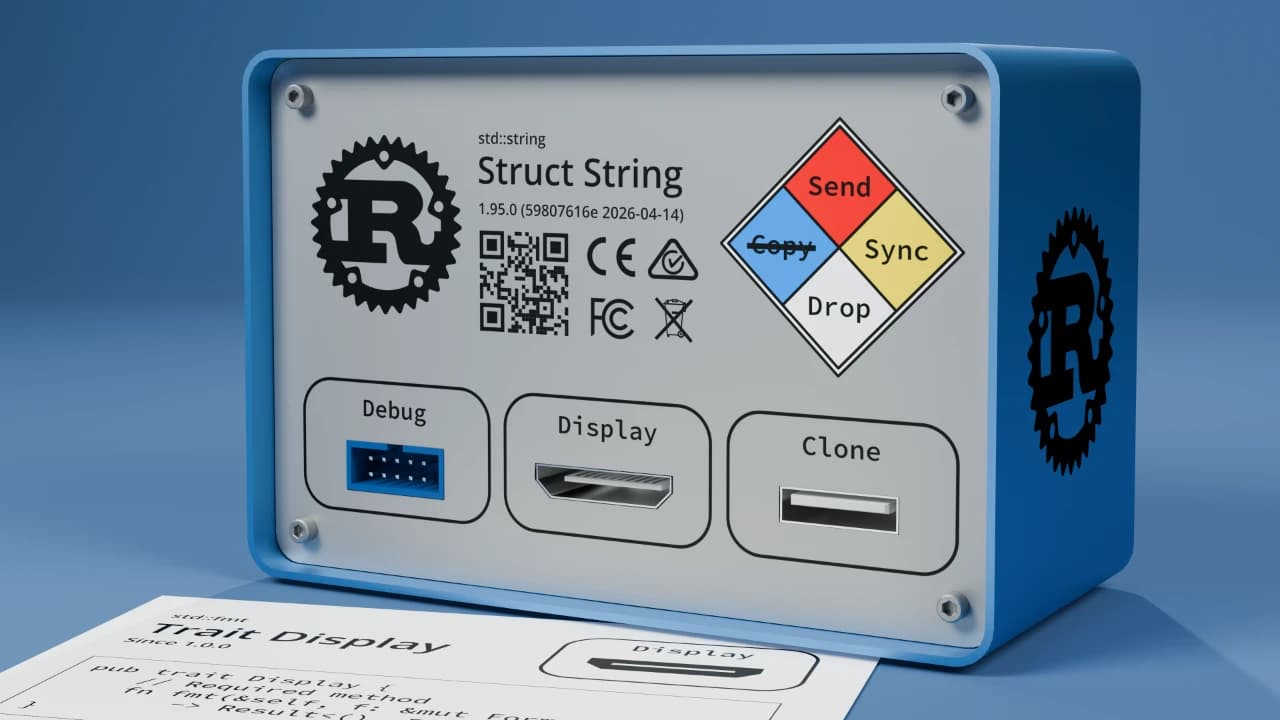
RustCurious lesson 9 lands on the point where many Rust learners start stalling: traits stop being “just methods on a type” and become the language’s way of expressing capability, contract, and composability at once. That is the lesson’s real value. It gives you a cleaner mental model than the usual inheritance-shaped explanation, because it shows traits as interfaces a type can choose to implement, and trait bounds as the requirements an API can demand from a generic type.
Traits are capability markers, not mini classes
The clearest thing lesson 9 gets right is the shift away from class hierarchy thinking. In Rust, a trait is not a parent type you inherit from, and that difference explains a lot of beginner friction around syntax like `T: Display` or `T: Iterator`. The Rust Book frames traits as shared functionality a type can have, and the Rust Reference defines a trait as an abstract interface that types can implement.
That model matters because it changes how you read generic APIs. A Rust function is not usually saying, “give me an object from this family tree.” It is saying, “I do not care what concrete type you pass in, but it must satisfy these behaviors.” Lesson 9 makes that sound like a checklist, which is the right instinct for Rust. Once traits click, code that once looked abstract starts reading like precise operational requirements.
The confusion this lesson actually resolves
This is where the lesson earns its keep for frustrated learners. One common sticking point is the difference between “a type has a trait” and “a function requires a trait bound.” Lesson 9 separates those ideas cleanly. A type can implement a trait because it supports some behavior; a generic function can then ask for that behavior without knowing the type itself.
That distinction clears up several recurring Rust puzzles:
- why `impl Trait` is not the same thing as a concrete type
- why generic functions often ask for `Copy`, `Display`, or `Iterator`
- why some APIs feel flexible but still refuse types that do not meet a contract
- why trait errors usually point to missing behavior, not a broken inheritance chain
For a learner who keeps expecting Rust to work like object-oriented inheritance, this is the mental reset that prevents a lot of dead ends. It replaces “what is this type derived from?” with “what can this type do, and what does this API require?”
Why generic code starts making sense
The practical payoff shows up fast in everyday Rust. The language uses trait bounds to restrict which types and lifetimes can be used as generic parameters, and that is why generic APIs often look like capability lists instead of buckets of related classes. The Rust Reference is explicit here: trait and lifetime bounds are how generic items restrict their parameters.
Lesson 9 helps you see that these bounds are not ceremony. They are how Rust keeps code reusable without giving up compile-time checking. If a function needs formatting, cloning, iteration, or copying, the trait bound says so directly. That is one reason Rust APIs are often easier to reason about once you understand traits: the compiler is enforcing the contract before the program ever runs.
The language spec backs up the lesson
RustCurious is not presenting a private teaching trick here. The same model appears in the core documentation and in the language’s own design notes. The Rust Book says a trait defines functionality a type has and can share with other types, and it uses trait bounds to specify which behaviors a generic type must have. The Rust Reference goes further by calling traits abstract interfaces and by spelling out that trait bounds restrict generic parameters.
That overlap matters for catch-up learning. If lesson 9 finally makes traits feel legible, you can carry that understanding straight into the official docs without re-learning the idea from scratch. It is the same concept, just expressed in the course’s more approachable language. For anyone who has bounced off the Rust Book’s trait chapter before, this lesson works as a bridge rather than a detour.
Why this matters beyond beginner syntax
Traits are not just a primer topic. They sit under some of the most important parts of Rust’s ecosystem and standard library. Iterator chains, formatting, error handling, asynchronous abstractions, and extension traits all lean on the trait system. Once you understand the mechanism, you stop seeing these APIs as separate mysteries and start recognizing the same pattern repeated at different levels.
That is also why teams adopting Rust benefit from this kind of lesson. Idiomatic Rust often prefers small, focused traits over big inheritance trees, and the payoff is practical: code is easier to compose, easier to test, and often easier for the compiler to optimize because more structure is visible at build time. Lesson 9 gives you the intuition for why that style dominates Rust codebases.
Traits are still an evolving core subsystem
The trait system is stable enough to build on, but it is still actively evolving. Rust’s core team has been reimplementing the trait solver to fix long-standing bugs, enable future type-system improvements, and reduce compile times. That is a strong signal that traits are not peripheral machinery. They are one of the central systems Rust keeps refining because so much of the language depends on them.
The modern trait story now reaches into features that used to feel out of reach. Rust 1.75 includes support for async fn in traits and return-position impl Trait in traits, which shows how far the language has pushed trait-based abstraction. The Rust Blog has also described traits as a single interface notion that works for both static and dynamic dispatch with minimal, predictable costs, which is exactly the kind of performance-aware flexibility Rust is built around.
Who should use lesson 9 as a catch-up resource
This is the lesson to reach for if traits still feel fuzzy after the first pass through Rust docs. It is especially useful if you can already write basic code but keep getting stuck on trait bounds, generic constraints, or the difference between static and dynamic dispatch. It is also a smart refresher if you know the syntax but still cannot tell when a trait is acting as a contract, when it is enabling polymorphism, and when it is just carrying a capability through an API.
That is the real test of a good Rust explanation: does it help you predict how the language behaves when you meet a new API? Lesson 9 passes that test because it reframes traits as Rust’s interface language, and once that clicks, the rest of the system starts looking much less like magic and much more like design.
This article was produced by Prism’s automated news system from verified source data, official records, and press releases, then run through automated quality and moderation checks before publishing. The system is built and supervised by the people who set the standards it runs under. Read our full AI policy.
Did this article answer your question?