Rust’s rise cools as TIOBE ranking slips from January peak
Rust fell to 16th in TIOBE after a January high of 13th, but an 83% admiration score and active Foundation work show the language is still gaining ground where it matters.
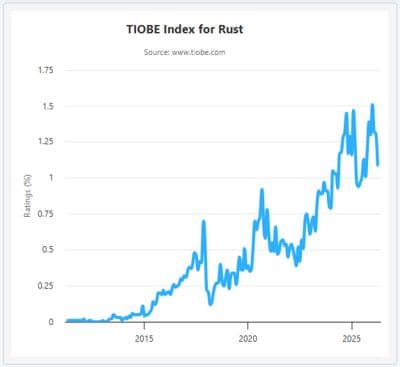
Rust’s long climb through the language rankings just hit a speed bump. TIOBE’s April reading put Rust at 16th with a 1.09 percent rating, down from a January 2026 peak of 13th and 1.51 percent, a slide that TIOBE CEO Paul Jansen said points to a possible plateau and a top-ten finish that now looks farther off.
That matters because TIOBE has often been treated, fairly or not, as a shorthand for language mindshare. But its own methodology is a reminder to keep the signal in perspective: the index is built from search-engine-driven popularity data across more than 20 sites, including Google, Amazon, Wikipedia and Bing, and TIOBE says it measures interest, not language quality or total code volume. Rust first entered the top 20 in June 2020, and for a while it looked like a realistic challenger to C and C++.
The broader Rust story is less dramatic than the ranking dip suggests. Stack Overflow’s 2024 Developer Survey still named Rust the most admired programming language, with an 83 percent score, even though its usage share remained well behind JavaScript, Python and SQL. That split between admiration and raw prevalence has long defined Rust’s place in the ecosystem: developers respect it, but the language still asks for commitment.
The Rust Foundation’s own data points in the same direction. Its 2024 State of Rust Survey ran from December 5 to December 23, 2024, and its 2025 annual report says the Foundation’s work centered on infrastructure, interoperability and safety-critical adoption. The Foundation’s technology report also said the Safety-Critical Rust Consortium held meetings in Montreal, London and Utrecht, a sign that Rust’s strongest growth is coming from serious production use rather than general-purpose popularity.

That shift is visible in the places where Rust keeps showing up. Rust for Linux continues to move forward, with mainline support approved by Linus Torvalds, and the language’s release cadence is still active: Rust 1.90.0 shipped on September 18, 2025, and stable release notes continued to show fixes into March 2026. The picture that emerges is not a language losing relevance, but one settling into a more mature phase.
TIOBE’s latest reading suggests the easy part of Rust’s rise may be over. The harder part now is proving that deep adoption in systems software, security-sensitive infrastructure and mixed-language production stacks matters more than a climb from 13th to 10th ever would.
This article was produced by Prism’s automated news system from verified source data, official records, and press releases, then run through automated quality and moderation checks before publishing. The system is built and supervised by the people who set the standards it runs under. Read our full AI policy.
Did this article answer your question?