This Week in Rust 647 spans databases, AI, cryptography, and kernel work
Rust's weekly digest now looks like a full-stack signal, with practical releases you can try soon in networking, AI, crypto, and kernel-adjacent tooling.

Rust's ecosystem is no longer a single-lane story
One weekly Rust digest now reaches across databases, AI tooling, post-quantum cryptography, kernel work, and async infrastructure without feeling stretched. That breadth is the real headline: Rust is maturing from language fandom into a practical builder's stack, and the strongest items in this issue are the ones you could imagine putting to work soon.
The most revealing backdrop is the infrastructure layer. The Rust Infrastructure Team's Q1 2026 recap and Q2 plan sit inside a longer push that includes serving the crates.io index and docs.rs through Fastly, continuing docs.rs modernization, and completing the migration of rust-lang/rust pull request merges off Homu and onto the new Rust-written Bors bot. That matters because Rust's package and documentation systems are part of the language's core dependency surface, not just maintenance trivia. The 2025 State of Rust Survey reinforces that point with a concrete signal: 7,156 responses collected over 30 days, from November 17 to December 17, 2025, in the survey's 10th annual run.
The quickest practical wins are in networking, AI, and developer tooling
If you want the fastest payoff from this issue, the items that stand out are tailscale-rs, Fresh 0.2.23, RustNet, KAIO, and the new crop of observability and integration tools around them. Tailscale announced tailscale-rs as an experimental Rust library preview on April 15, 2026, modeled on tsnet-style functionality and with bindings for C, Elixir, and Python. It is explicitly not production-ready yet, but it is exactly the sort of thing that will tempt people who want to embed networking behavior in Rust without reinventing a whole stack.
Fresh 0.2.23 is smaller but easier to use immediately: Windows-1251 support and a faster file finder are the kind of release notes that matter the first time you hit an ugly legacy file or a search that feels too slow. RustNet is another clear utility play, described in its repository as a cross-platform terminal network monitor with deep packet inspection, connection-state tracking, process identification, and TUI output. Add haproxy-spoe-rs for HAProxy SPOA integrations, and the week starts to look less like “new crate Friday” and more like a real networking toolbox.
On the AI and systems side, KAIO is the eye-catcher. Its repository says it is a Rust-native GPU kernel authoring framework that compiles Rust to PTX at build time, and it claims 92.5% of cuBLAS sgemm performance on an RTX 4090. That is the kind of number that makes people stop skimming, because it turns “Rust for GPU kernels” from an idea into a benchmarked claim. flodl, meanwhile, pushes into heterogeneous multi-GPU distributed training, while Sinbo, a CLI snippet manager, and AimDB round out the release list with the sort of utility projects that often become everyday tools faster than bigger frameworks do.
Post-quantum crypto is no longer a future problem
The pquantum.dev entry lands differently because the urgency around post-quantum migration is real now, not theoretical. NIST approved FIPS 203, 204, and 205 for post-quantum cryptography on August 13, 2024, and says organizations should begin migrating now. NIST in Gaithersburg, Maryland, United States, has been blunt that these standards are ready to be implemented, and the NSA has also been pointing organizations toward quantum-readiness planning.
That context makes Rust tooling in this area feel timely rather than speculative. If you have any interest in crypto libraries, protocol design, or just learning what a post-quantum migration path might look like in Rust, pquantum.dev is the sort of project that deserves attention now, not after the first wave of production migrations has already hardened the defaults.
The language debates are still grounded in real work
This issue also surfaces the kind of language and compiler discussions that only make sense if Rust is already being used for serious systems work. The acyclic e-graph item as Cranelift's mid-end optimizer is a reminder that compiler internals are still evolving, and stable tail calls remain an unstable feature in the compiler, with a documented tracking issue in the unstable book. That is a good marker of where Rust still wants more room to grow: language design is moving, but carefully.
Other pieces in the issue keep that practical edge. “Why flat error codes are not enough” sounds like design theory until you have to debug a real API that lost too much signal. “Typed scalar types” sits on top of Rust's type system in the way the language has always encouraged, and “borrow-checking surprises” is exactly the kind of topic that helps people avoid stepping on the same rake twice. The roadmap for an extended standard library matters for the same reason: when enough teams are building real products, the conversation shifts from “can Rust do this?” to “how much of this should be standardized?”
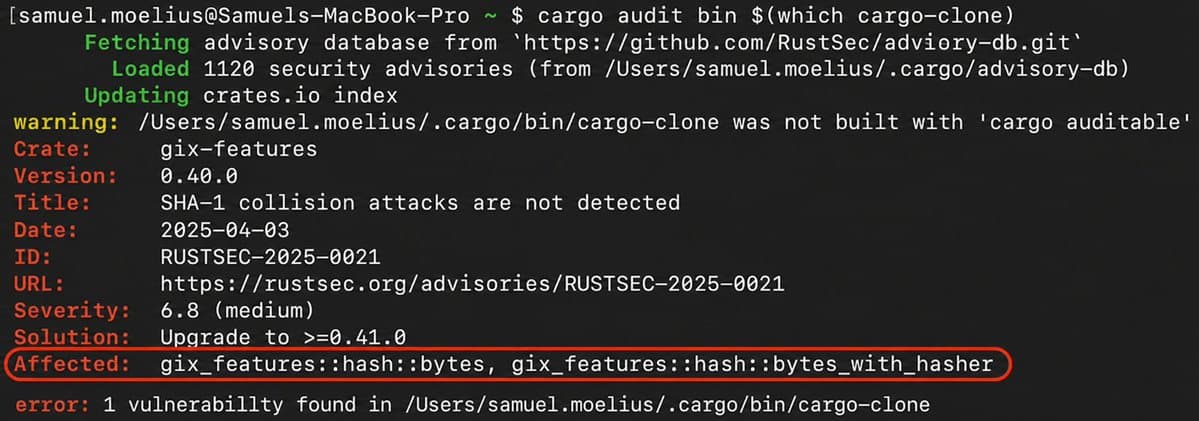
Supply-chain security also lands with more force after what Rust has already seen. Rust's blog documented a crates.io phishing campaign in September 2025, and later in 2025 it documented malicious crates including evm-units and uniswap-utils. Against that backdrop, “No one owes you supply-chain security” reads less like a slogan and more like a hard lesson the ecosystem keeps relearning.
The tutorials that teach you the most in the least time
The tutorial side of the issue is where the week becomes immediately useful. The strongest pieces are the ones that translate directly into better Rust you can write now: untangling Tokio and Rayon latency spikes, fixing DNS tail latency with a minimal configuration change and a small function, reimplementing traceroute, debloating async Rust, and building a TUI dashboard for AI coding agents. Those are not toy examples. They are the kinds of articles that show you where performance disappears, where async gets bloated, and where a few targeted changes can buy back real responsiveness.
Profiling is another area where the practical value is obvious. The guide that walks through flamegraphs, PGO, BOLT, and native CPU targeting is exactly the sort of thing that pays off once your code is already correct and you are trying to make it feel fast. The mini grep project for ownership and borrowing still matters because the best way to internalize Rust's rules is to use them on something small enough to understand end to end.
Taken together, issue 647 shows Rust expanding in the directions that matter most to working builders: infrastructure that keeps the ecosystem trustworthy, tools you can reach for soon, and enough compiler and runtime depth to keep advanced users interested. The language is still the center, but the ecosystem around it now looks like a complete shop floor.
This article was produced by Prism’s automated news system from verified source data, official records, and press releases, then run through automated quality and moderation checks before publishing. The system is built and supervised by the people who set the standards it runs under. Read our full AI policy.
Did this article answer your question?