Solana Foundation Joins RustConf as Diamond Sponsor for Montréal Event
Solana Foundation is confirmed as Diamond sponsor for RustConf 2026 in Montréal, its third year at the top tier as crypto's most Rust-native platform bets bigger on the language's flagship event.
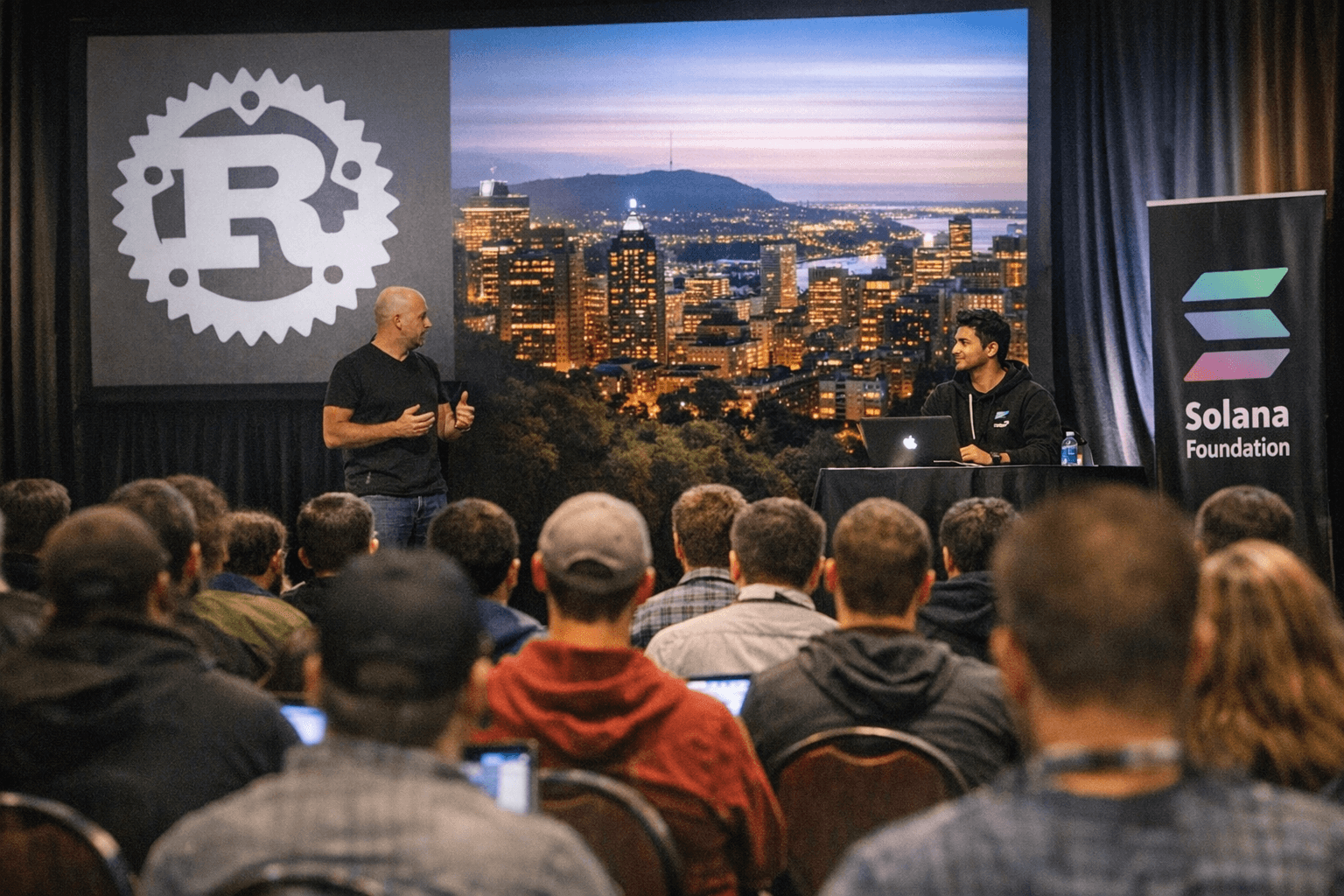
The Rust Foundation has named the Solana Foundation as the first confirmed Diamond sponsor for RustConf 2026, the annual conference set for September 8-11 in Montréal, Canada. For Solana, which has held the Diamond slot at RustConf since at least 2024, the commitment is less a debut than a doubling down: the blockchain platform has become the most prominent example of Rust running at production scale in financial infrastructure, and it keeps paying to make sure the Rust community knows it.
The reason Solana invests at this level is baked into the codebase. The Agave validator, the primary Solana implementation maintained by Anza, is written entirely in Rust. On-chain programs, what most blockchains call smart contracts, are authored in Rust and compiled to BPF bytecode before being JIT-compiled by validators at runtime. The architecture even includes hooks to GPU implementations for its most parallelizable components, with signature verification being the canonical example. For a network built around extreme throughput, Rust's zero-cost abstractions and ownership model are not stylistic choices; they are structural requirements.
At RustConf 2024, where Solana held the exclusive Diamond tier, the foundation used its main-stage slot to explain directly why it is invested in Rust's success. At RustConf 2025 in Seattle, the Diamond sponsorship continued alongside a Gold sponsor list that included AWS, Google, JetBrains, Meta, Microsoft, and Virtu Financial, whose speaker delivered a talk titled "Write Once, Use Everywhere: Shared Libraries Across the Entire Trading Stack." High-throughput, performance-driven domains, whether trading infrastructure or blockchain validators, are no longer peripheral to RustConf's programming; they are shaping its center of gravity.
That shift matters for what Montréal's sessions might look like. Solana's engineering surface area, Gulf Stream's approach to pushing transaction forwarding to the network edge so validators can execute ahead of time, the concurrency patterns required to handle thousands of parallel validator accounts, the safety guarantees needed when on-chain programs handle real assets, maps directly onto the systems programming challenges Rust was designed to address. Developers working in networking, embedded systems, or distributed infrastructure will recognize those patterns even if they have no interest in blockchain.
RustConf has run annually since 2016 and is now organized by the Rust Foundation, the independent nonprofit that stewards the language. The Montréal event will run in-person and online, with registration details expected in the coming weeks. The CFP process and speaker announcements are also forthcoming.
A Diamond sponsor buying a platform at the Rust community's flagship event signals something about where Rust's production story is being written. The validator engineering problems Solana has been solving in public, with an open-source Rust codebase, offer one of the richest real-world curricula in high-throughput systems design available to the ecosystem. Montréal should make that case loudly.
This article was produced by Prism’s automated news system from verified source data, official records, and press releases, then run through automated quality and moderation checks before publishing. The system is built and supervised by the people who set the standards it runs under. Read our full AI policy.
Did this article answer your question?