tenferro-rs brings dense tensor computing to Rust
tenferro-rs landed on crates.io as a Rust-native dense tensor stack, aiming to keep scientific computing, autodiff, and backend control inside Rust.
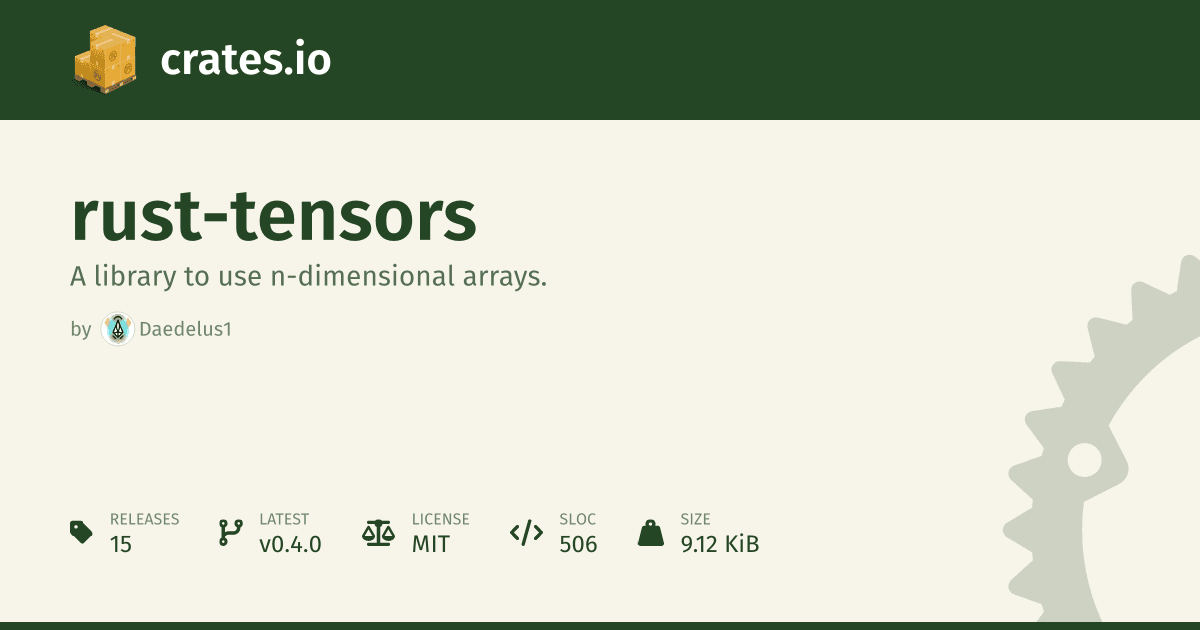
tenferro-rs landed on crates.io with a Rust-native dense tensor stack built for scientific computing, and it arrived with more ambition than a typical AI wrapper or hobby tensor crate. Introduced by tensor4all on June 23, 2026, the project positions itself around dense numerical work for the agentic AI era, where gradients, transforms, and backend control matter as much as model glue code.
The stack is trying to cover a wide surface area in one place. Its design combines linear algebra, PyTorch-style eager autodiff with optional backward(), JAX-style traced graph execution, NumPy-style einsum, FFT support, and explicit CPU and CUDA backends. The GitHub repository also adds an experimental WebGPU backend, which widens the portability story beyond the usual CPU-first prototype phase. In practice, that means tenferro-rs is not just chasing inference kernels or a single training path; it is trying to become a general tensor foundation that Rust developers can build on without immediately jumping to another language for the core math.

The project’s own framing makes that clearer. tenferro separates tensor data, execution timing, automatic differentiation, and device location, a design that is meant to let users stay in typed tensor code for ordinary computation, switch to eager execution when they want PyTorch-like training loops, or move to traced graphs for JAX-like grad and vjp workflows. The repository describes the stack as influenced by both JAX and PyTorch, and that mix puts the emphasis on workflow flexibility rather than a single execution model.
That is the part that matters most for Rust developers weighing scientific computing options. If tenferro-rs matures, it could reduce the need to bridge out to Julia or Python for the numerical core of a project, especially when ownership, static typing, and backend selection are already important to the surrounding system. The explicit split between CPU, CUDA, and experimental WebGPU also points to implementation choices that can be tuned instead of hidden behind one runtime path.
Burn already occupies part of this space. It is a tensor library and deep learning framework focused on numerical computing, training, and inference, so tenferro-rs enters a field that is already taking Rust ML seriously. The difference is that tenferro-rs is leaning hard into typed tensor computation and traced transforms from the start, which makes it feel like an early but serious attempt to turn Rust into a place where dense numerical work can stay put instead of being shuttled across language boundaries.
This article was produced by Prism’s automated news system from verified source data, official records, and press releases, then run through automated quality and moderation checks before publishing. The system is built and supervised by the people who set the standards it runs under. Read our full AI policy.
Did this article answer your question?