TRV Monolith shows pure Rust crypto can stay dependency-free
TRV Monolith makes a bold case for pure Rust crypto: fewer dependencies, tighter audit paths, and real speed claims, but still with clear experimental tradeoffs.
A crypto engine without dependency baggage is either a serious security move or a very polished experiment. TRV Monolith sits right on that fault line, and that is exactly why Rust developers should care. The project is being pitched as a complete, dependency-free cryptographic engine written entirely in pure Rust, with hashing, stream encryption, MAC construction, and key derivation all living inside one unified core. That is a striking claim in a community that already prizes auditability, but usually gets there by composing many smaller crates instead of asking one codebase to do everything.
What TRV Monolith is claiming
The May 20, 2026 forum showcase presents TRV Monolith as a self-contained cryptographic engine built from scratch in pure Rust. The repository reinforces that message by describing the project as native Rust, fully dependency-free, and organized around a unified core for hashing, encryption, and key derivation. It also references a security policy and a monograph hosted through Zenodo, which is a notable signal for a project that wants academic evaluation, peer review, and cryptanalytic scrutiny rather than casual hobby adoption.
The architecture language matters here. TRV describes itself through a BTGS primitive, shorthand for a Boolean Transformation Gate System, and the forum writeup says the engine uses a 256-bit internal state with a branchless, unrolled transformation loop. In practice, that means the project is not just trying to be small, it is trying to be mechanically easy to reason about. For Rust builders, that combination is immediately interesting: a compact core, no external crate stack, and an implementation story that leans on control over allocation and data flow.
Why dependency-free is appealing, and what it costs
Dependency minimization solves a real problem in Rust security work. Every crate you remove from a cryptographic path removes an audit target, a potential transitive vulnerability, and another piece of code you have to trust before shipping. For a hobbyist builder, that can translate into easier code review, a smaller attack surface, and fewer moving parts when something breaks in a security-sensitive setting.
But the tradeoff is just as real. A monolithic engine asks one codebase to carry more design weight, more correctness burden, and more testing responsibility than a stack of specialized crates would. Instead of inheriting algorithms and constant-time implementation details from a broad ecosystem of focused libraries, you are trusting one architecture to get the hard parts right. That makes TRV Monolith compelling as an architecture choice, but not automatically as a default production standard.
The project is also aligned with a broader Rust instinct that is larger than any single repo: build systems that are easier to reason about, easier to audit, and less entangled with C or FFI dependencies. In security work, that can be the difference between a design that is theoretically elegant and one that is practically reviewable.
The performance claims are the real test
TRV’s public numbers are part of the story because they show the project is trying to justify the architecture with throughput, not just with philosophy. The forum post reports roughly 163 MB/s on Apple Silicon ARM64 and about 340 MB/s on Intel Xeon x86_64 for TRV-Hash. It also says TRV-MAC outperforms HMAC-SHA3-256 by 15.15x in sequential 10 KB packet authentication. Those are the kind of figures that make cryptography folks stop and look twice, especially when they come attached to a pure Rust implementation.
A separate developer-preview repository pushes the performance message further. It describes a macOS Apple Silicon binary intended for evaluation and non-commercial research, sets a 50 MB limit per vault or operation, and claims about 1.2 GB/s hashing throughput plus 40 to 100 MB/s vaulting in single-core Apple Silicon tests. That preview framing matters because it signals the project is still being explored rather than presented as finished infrastructure. The speed claims are impressive, but they sit inside a constrained evaluation context, not a broad compatibility promise.
For a hobbyist builder, that is the key question: are these benchmarks evidence of a mature, general-purpose engine, or evidence that a carefully designed specialized engine can be very fast in a narrow lane? Right now, the available details point more toward the second answer.
How TRV compares with the rest of Rust crypto
TRV Monolith is entering a Rust crypto ecosystem that already values pure Rust implementations. RustCrypto says it provides pure Rust implementations of many cryptographic algorithms, and its GitHub organization lists 39 repositories spanning hashes, key derivation, password hashing, symmetric encryption, signatures, and more. That is the established Rust pattern: modular building blocks, each with a specific job, each easier to swap or review on its own.
TRV takes the opposite shape. Instead of a crate collection, it pushes a unified engine. That makes it interesting precisely because it is less typical. RustCrypto represents the ecosystem’s confidence in composability, while TRV represents confidence in consolidation. Both approaches are trying to earn trust, but they do it through different trust surfaces.
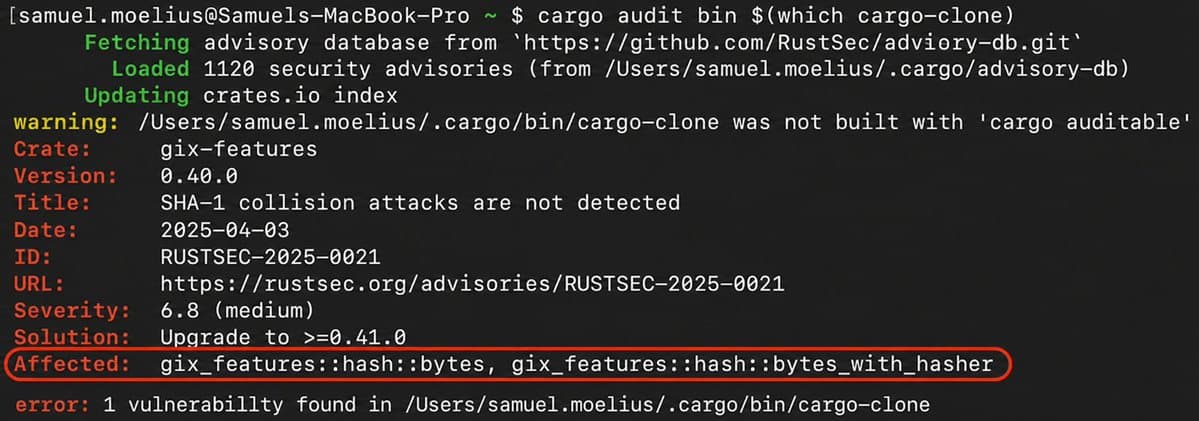
The timing also gives TRV extra relevance. The Rust project issued a March 21, 2026 Cargo advisory for CVE-2026-33056 involving the tar crate, then announced Rust 1.94.1 for March 26, 2026 to address it. On May 25, 2026, another Cargo advisory covered CVE-2026-5222, tied to sparse-registry URL normalization, and Rust 1.96.0 followed on May 28, 2026 with fixes for two Cargo vulnerabilities affecting third-party registries. In parallel, the RustSec Advisory Database, maintained by the Rust Secure Code Working Group, exists specifically to track crate advisories, while cargo-audit and cargo-deny remain the standard tools for scanning dependency trees and policy checks.
That context is why a dependency-free crypto engine resonates. Rust’s security story is not just the compiler and not just Cargo, it is also the choices individual projects make at the library boundary. TRV Monolith is a direct statement that some builders want smaller trust surfaces, less transitive risk, and architectures that can be inspected without crawling through a crate stack.
TRV Monolith is not proof that dependency-free crypto should replace the modular RustCrypto model. It is proof that the question is still live. The project looks credible as an architectural experiment, maybe even as a serious niche engine, because it pairs pure Rust implementation, source availability, a security policy, and published performance claims with a design that is visibly trying to reduce trust surface. That makes it less a curiosity than a reminder: in Rust, the safest-looking answer is often not “more crates,” but “which dependencies do you really need?”
This article was produced by Prism’s automated news system from verified source data, official records, and press releases, then run through automated quality and moderation checks before publishing. The system is built and supervised by the people who set the standards it runs under. Read our full AI policy.
Did this article answer your question?