Zerostack brings Unix philosophy to Rust AI coding agents
Zerostack landed on crates.io as a 1.0 Rust agent with multi-provider support, session memory, and a lean pitch aimed straight at bloated AI tools.
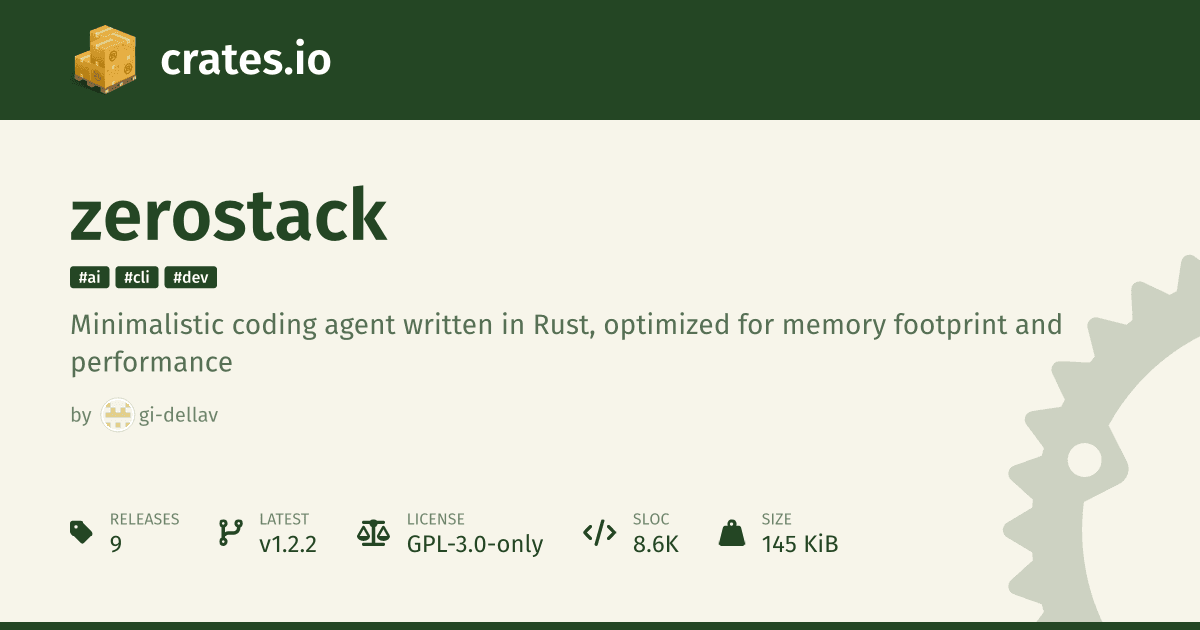
The AI coding-agent stack keeps getting heavier, and Zerostack answered with the opposite bet: a Unix-inspired Rust tool that wants to stay understandable, scriptable, and small enough to slot into an existing workflow. Released as version 1.0.0 on crates.io, it was framed as a local-first helper rather than a cloud-bound monolith, and that positioning was the point as much as the code itself.
Zerostack’s pitch leaned hard on Unix philosophy. Instead of trying to be an all-in-one platform, it was presented as a composable agent that does one job well, exposes clear interfaces, and stays modular. The project centered on session management, permission handling, prompt switching, and multi-provider AI connectivity, which makes it more than a thin model wrapper. It is an agent architecture built to be stitched into real workflows, not a new workspace you have to live inside.
The feature list backed that up. Zerostack’s GitHub listing said it worked with OpenRouter, OpenAI, Anthropic, Gemini, Ollama, and custom providers. Its permission system included four configurable modes, per-tool patterns, session allowlists, and policies for external directories. Sessions could be saved, loaded, and resumed, with auto-compaction to keep them inside context windows. The terminal UI was crossterm-based and included markdown rendering, mouse selection and copy, scrollback, and a toggle for reasoning visibility. Prompt modes could also switch at runtime between code, plan, review, and debug.
That design lands neatly in Rust’s lane. Rust’s own project description calls the language “blazingly fast and memory-efficient,” with no runtime or garbage collector, and says its ownership model helps guarantee memory safety and thread safety at compile time. Zerostack uses that reputation as part of the product story: if the agent is going to live close to the shell, manage permissions, and juggle sessions locally, a small footprint matters.

The launch also arrived inside a crowded wave of Rust-based and Rust-port coding agents, including OpenCodeRust, OpenCoder, Coro Code, and similar projects pushing local control, session persistence, TUI workflows, and multi-provider support. One launch report claimed Zerostack kept its binary to 8.9 MB, sat around 8 MB of idle RAM, and used roughly 1.5% CPU during tool operation, though that figure came from a secondary source rather than a primary benchmark.
Zerostack’s real test is not whether it can match the biggest agents feature for feature. It is whether a Rust tool that stays lean, hackable, and local can feel better to live with. On paper, that looks less like a compromise than a rebuttal.
Know something we missed? Have a correction or additional information?
Submit a Tip