Ferrari HyperSail aims to power sail handling with crew-generated energy
Ferrari’s 100-foot HyperSail shows how to run serious sail power from human effort and renewable input, a blueprint DIY sailors can scale down.
Ferrari unveiled HyperSail as a 100-foot monohull built around crew-generated energy, high-voltage storage, and a flight-control architecture designed to keep the boat moving without depending on conventional drive trains. A dead battery at the wrong moment is one of the oldest sailing headaches: the autopilot is working hard, the winch loads are climbing, and the engine is not the safety net you want to lean on offshore.
What HyperSail is actually trying to do
HyperSail has a foil on the keel, is designed to fly on three points of contact, and is being built in Italy for launch and initial sea trials scheduled in 2026. It is an open-innovation project, a two-way transfer of ideas between Ferrari’s automotive engineering and offshore sailing. The project is not just about speed or spectacle, but about how to organize power when the boat itself is the system.
The yacht is intended to be energy self-sufficient and powered by renewable sources. The electrical architecture is the heart of the boat, not an accessory layer: sail handling, foil control, keel behavior, and stability management all hang off the same power logic.
The electrical core: 800V, twin batteries, and a flight controller
HyperSail uses an 800V system built around twin high-voltage battery packs and a flight controller. That is a very different approach from a simple house bank feeding a few isolated loads. On HyperSail, the batteries are not only there to keep the lights on, they are there to stabilize a boat that is expected to shift load constantly between propulsion, trim, and control.
HyperSail’s energy-management concept is engineered for complete self-sufficiency and powered by renewable sources and crew-generated energy. The practical lesson for a smaller cruiser or racer is to think in terms of load groups, not single devices. If your autopilot, chartplotter, instruments, and electric winches all draw from the same bank, you need to know what happens when they peak together, not just what each one uses in isolation.
HyperSail points to separate pathways for generation, storage, and control so the boat can keep functioning when one part is stressed. On a smaller boat, that can mean a house bank split from critical control loads, separate charge sources, and enough reserve capacity that the pilot does not collapse the system every time the wind pipes up.
Winch by Wire and the value of human power
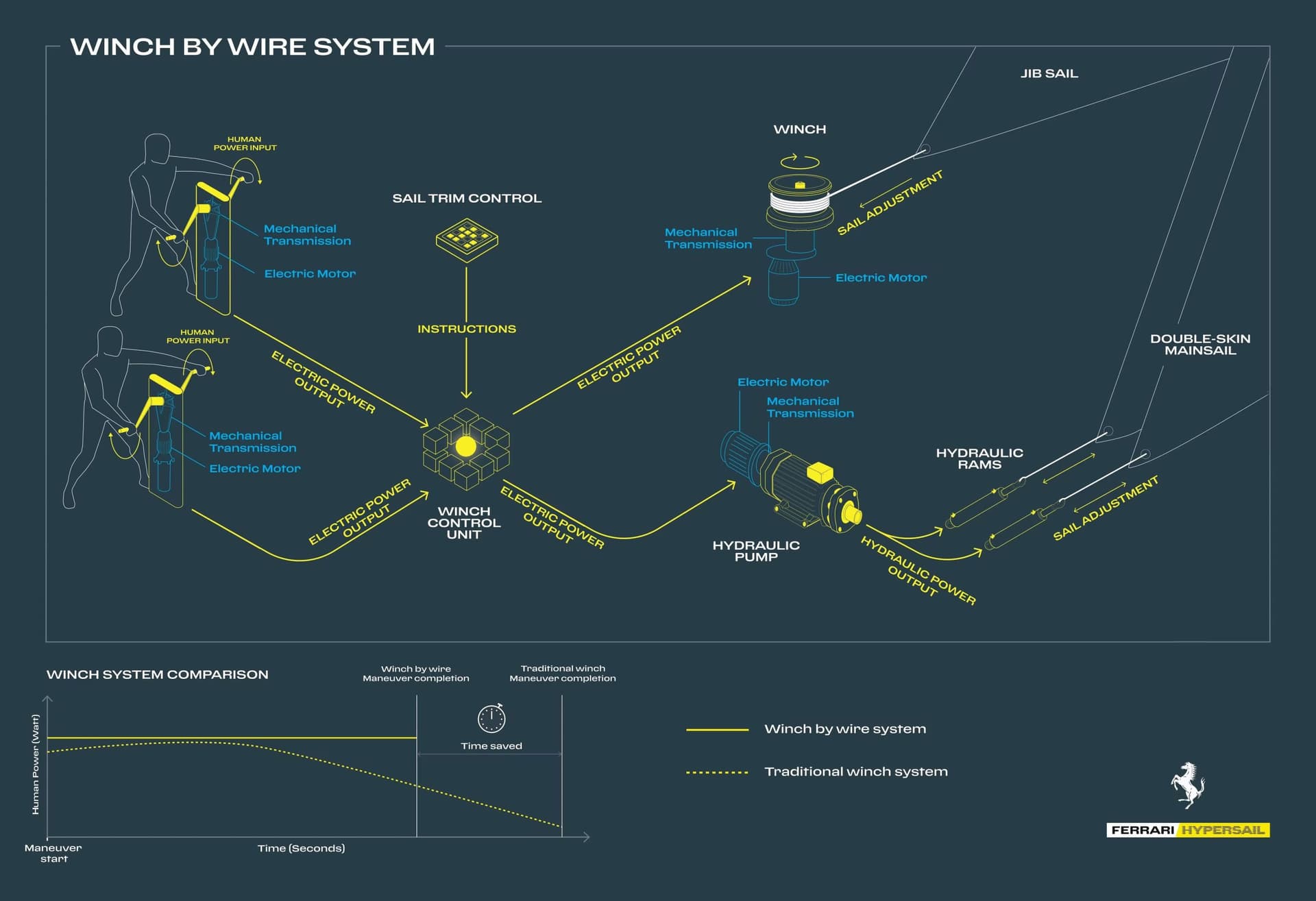
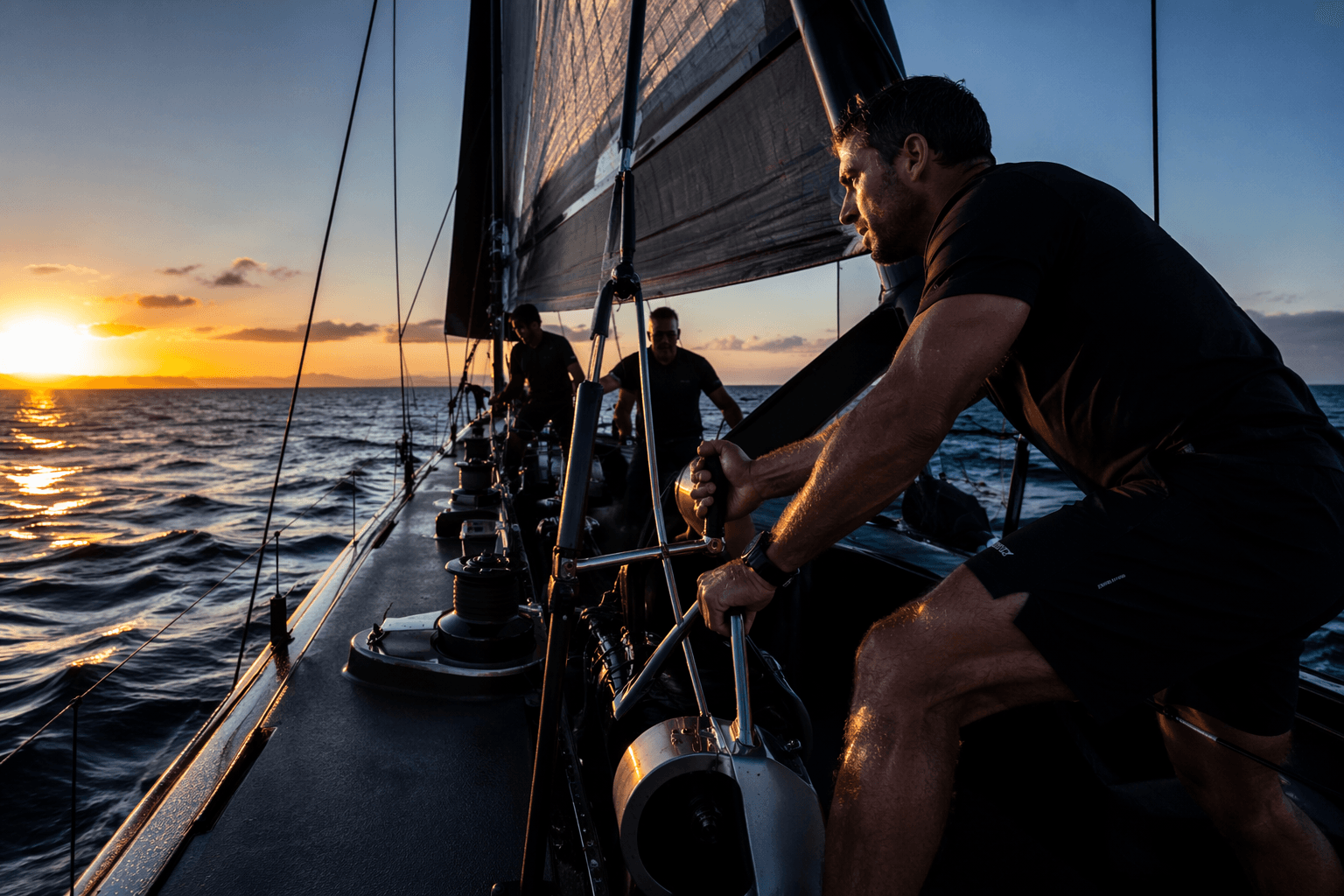
One of the most relevant ideas for DIY sailors is Ferrari’s Winch by Wire setup. Instead of sending effort through a purely mechanical or hydraulic drive train, the system converts crew input into electrical energy. The e-pedestals and e-winches are the core of a system meant to redistribute crew power in real time while maintaining a steady, efficient cranking cadence.
A single crew member can manage loads of up to 9 tonnes using the system. If one sailor can handle that kind of load, the boat needs a way to turn short, intense bursts of human effort into controlled electrical output without wasting energy in friction, heat, or awkward manual gearing.
For a refit on a 35-footer or a club racer, the lesson is not to chase Ferrari hardware. It is to separate the question of “how do I move the load?” from “how do I power the load?” If you are considering electric winches, powered primaries, or a high-draw traveler system, the design win is in smoothing the load, not just making it stronger.
What this means for foils, autopilots, and high-draw gear
On HyperSail, sail trim, foil ride height, and stability controls are increasingly converging into one electrical ecosystem. That is the same direction many performance boats are already moving in, even if the hardware is much smaller. Autopilots, hydraulic assists, active foils, and energy storage all compete for the same finite power budget, and the boat that manages that budget cleanly will be easier to sail hard for longer.

A small boat with a strong electrical system can still be fragile if every critical function depends on a single point of failure, such as one battery, one charger, or one distribution panel. HyperSail’s system architecture suggests a better habit: decide which functions must stay alive first, then build generation and storage around those priorities. On a cruising boat, that might mean keeping navigation and steering separate from comfort loads; on a racer, it might mean preserving pilot and control systems before anything else.
The project also uses renewable and kinetic inputs instead of assuming the engine will fill every gap. Solar, wind, and recovered energy are part of the concept, and sailboats already carry the best generator on board: motion.
A project built to change hands as it changes phase
In April 2026, Ferrari completed the design and construction phase and moved the project into system integration. Around the same time, Giovanni Soldini left the project and Enrico Voltolini was named project leader. John Elkann described the change by saying, “Ferrari Hypersail is a project that requires different skills in its various development phases.”
A project centered on energy architecture, control integration, and sail handling does not need the same talent mix at every stage. Early on, it needs concept and structural vision. Later, it needs system integration discipline, the kind that matters just as much on a DIY refit when the parts are already bought and the challenge is making them work together under load.
Ferrari also used Milan Design Week on April 21, 2026, to reveal the HyperSail livery, tying the boat to design research as much as to performance engineering. The yacht is under construction in Pisa, Italy, and Ferrari has kept the launch target in 2026.
This article was produced by Prism’s automated news system from verified source data, official records, and press releases, then run through automated quality and moderation checks before publishing. The system is built and supervised by the people who set the standards it runs under. Read our full AI policy.
Did this article answer your question?