Historic Coast Guard Boathouse Hoisted Into Place as Chatham Shellfish Hatchery
A 90-year-old Coast Guard boathouse that once sheltered the Pendleton rescue lifeboat CG36500 arrived in Chatham by barge and was craned onto its new foundation in a single morning.
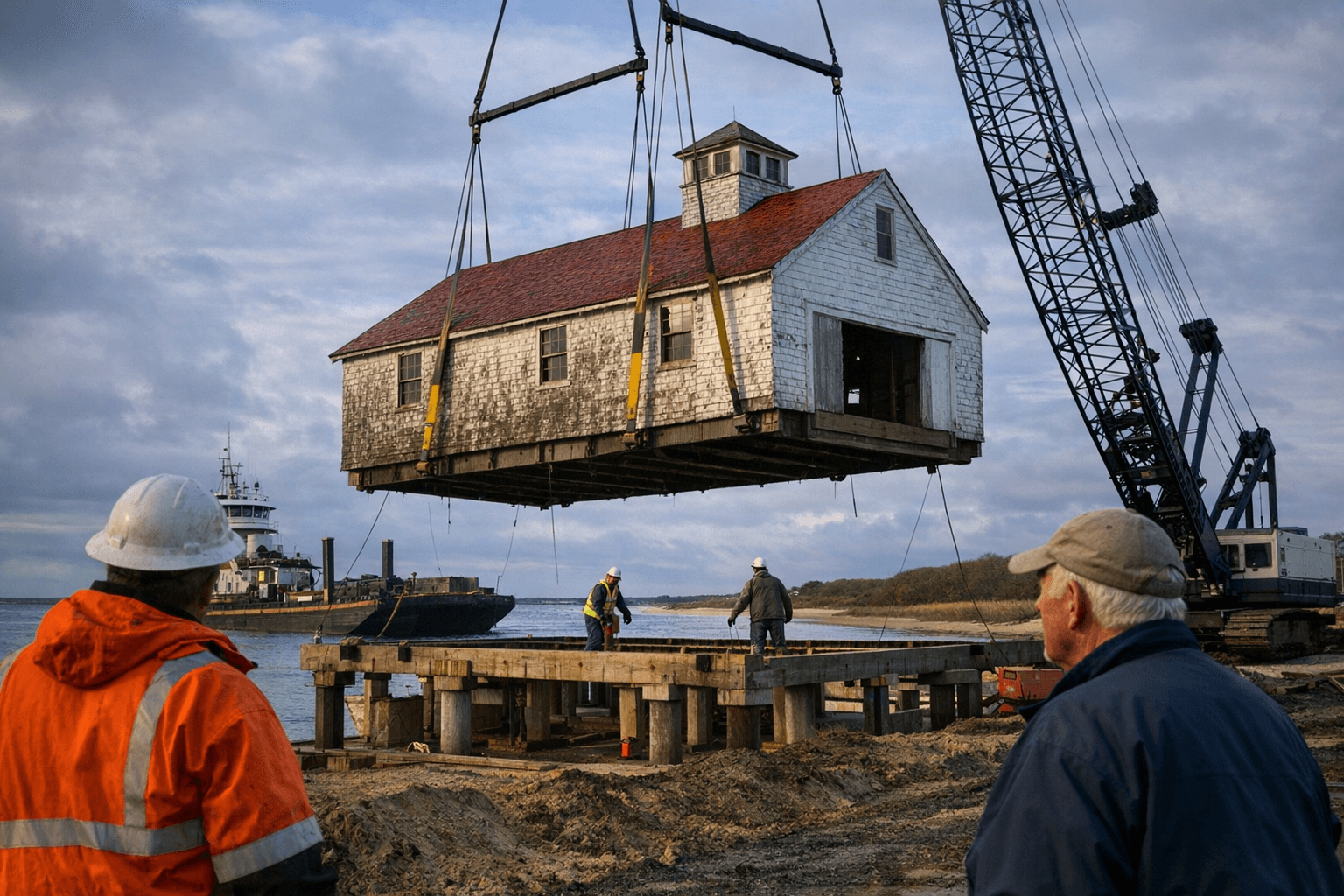
Dropping a historic boathouse into the water mid-lift because someone miscalculated the crane's counterbalance load is the kind of catastrophic loss no preservation grant can undo. The crew from Robert B. Our Marine did not miscalculate. On March 25, they staged a crane-and-counterbalance system on Bridge Street in Chatham, Massachusetts, and set a 1936-built Coast Guard boathouse onto a new foundation pier at 90 Bridge Street without incident.
The structure had arrived the previous day, March 24, traveling by barge from a New Bedford work yard through Buzzards Bay, past Woods Hole, and across Nantucket Sound into Stage Harbor. The town advertised the arrival window as 3 p.m. to 5 p.m. and designated Harding's Beach, Battlefield Landing, Champlain Road, and Old Mill Boatyard as spectator locations. That two-hour window tells you everything about how tightly the marine contractor had to know the tidal range, the barge draft, and the structure's weight before the tow even left port.
The boathouse is not ordinary freight. Built in 1936 on Stage Island and standing over Stage Harbor for 73 years, it sheltered CG36500, the motor lifeboat that Coxswain Bernie Webber and his three-man crew drove into a 70-knot nor'easter on February 18, 1952, returning with 32 survivors pulled from the broken stern of the tanker SS Pendleton. That rescue became the basis for the film The Finest Hours and earned all four crewmembers the Gold Life-Saving Medal. After the Coast Guard decommissioned the boathouse in the 1970s, it was sold to Stage Island developers, barged to Quincy in 2009, and later stored in Hull, where it came within days of demolition. Jay Cashman, who originally moved it to Quincy, and Dave Dougherty were credited by the town with keeping the structure alive long enough for Chatham to bring it home.
Getting it home required years of civic groundwork. Chatham's Select Board accepted the boathouse as a gift in 2021. Voters at a 2024 town meeting approved a $4 million allocation for the rehabilitation as part of an $11 million multi-use waterfront project. In October 2025, the project drew $730,620 from the Healey-Driscoll Administration's Food Security Infrastructure Grant program, covering pumps, tanks, generators, pipes, and fittings for the shellfish upweller the restored building will house. GEI Consultants, Inc. and Pomroy Associates joined Robert B. Our Marine as project partners for the lift and placement.
The municipal logistics of the hoist encode a direct lesson for any DIYer planning a large structural move. The town temporarily closed Bridge Street and restricted access on the east side of the Mitchell River Drawbridge to give the crane swing clearance and keep traffic clear of the rigging operation. That advance coordination with permitting authorities is not bureaucratic overhead; it is what makes a clean lift possible. Trying to negotiate street closures on the day of a hoist, with a contractor on the clock and a barge sitting in tidal water, is how projects fail.
The harder calculation is whether to restore or rebuild at all. Before the boathouse ever reached Bridge Street, it spent time in a New Bedford yard for structural repairs, costs layered on top of barge fees, crane day rates, and foundation construction at the new pier. An earlier estimate had put a purpose-built replacement structure with the same footprint at $3.4 million. Chatham chose the boathouse anyway, and the logic is the framework every restorer should run: does the structure have documented history no new build can replicate, a defined adaptive reuse, and an active funding base? Here, all three conditions held. When one of them is missing, the argument for rebuilding new is hard to beat.
The finished facility will replace Chatham's current shellfish upweller at Old Mill Boatyard, and the surrounding pier will include floats for public boat access alongside the hatchery operation.
Know something we missed? Have a correction or additional information?
Submit a Tip