How to inspect lifelines before they fail offshore
A lifeline can look fine and still fail under load. Use this deckside check to catch weak gates, stanchions, terminals, and backing points before offshore miles.
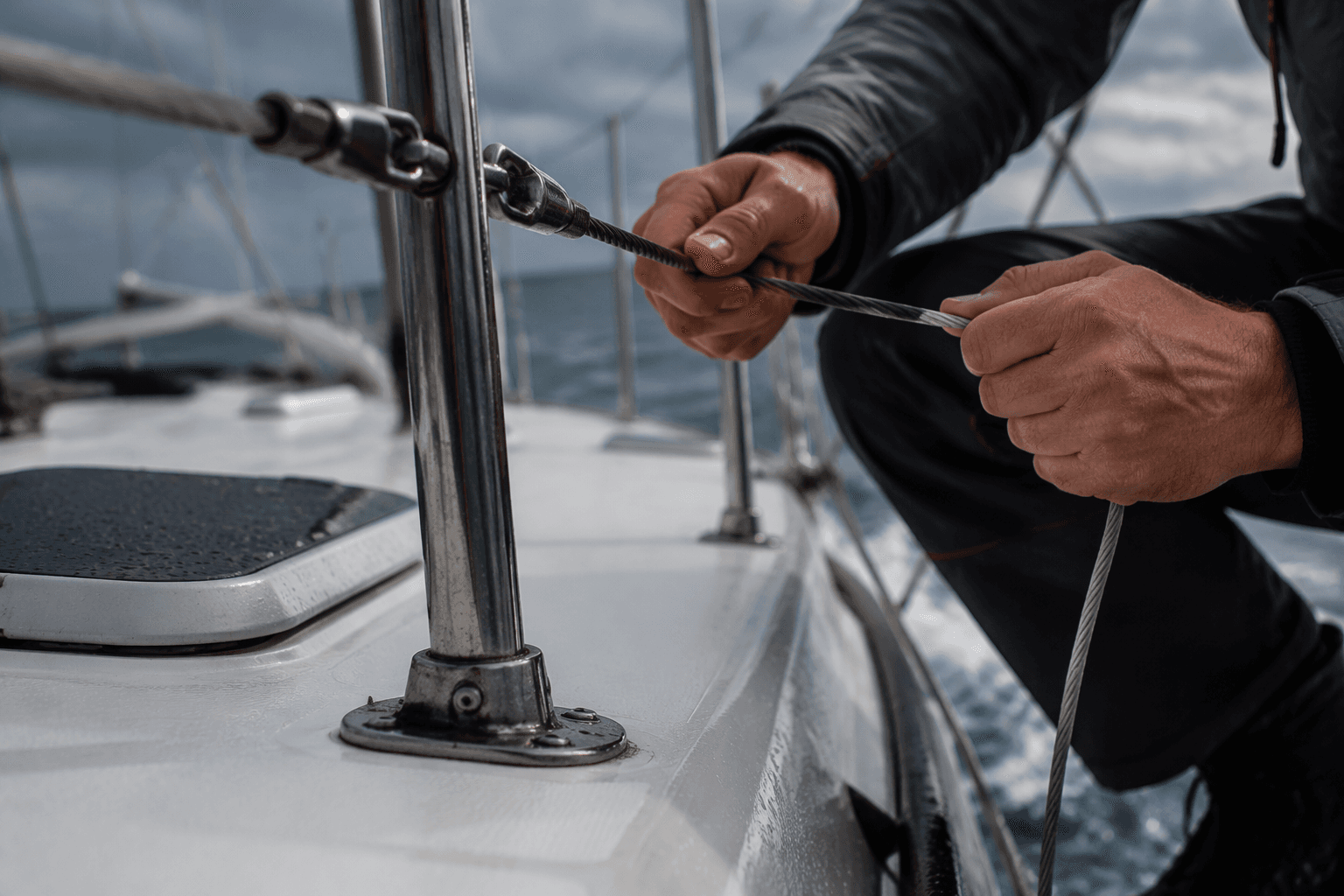
If you lose your balance at the leeward rail, lifelines are the line between “onboard” and “overboard.” On an aging boat, that makes the lifeline system a safety check, not a cosmetic one. The right inspection starts with the whole system, from the gate hardware to the backing points under the stanchion bases, before the sea gets a vote.
Treat the lifeline as a system
The first mistake is to think in parts instead of load paths. Wire or rope, stanchions, end fittings, gates, tensioners, and attachment points all work together, and one weak piece can undercut the rest. That is why a 1998 U.S. Naval Academy and US Sailing study led by Ralph Naranjo set out to quantify the loads imposed on lifeline components and determine failure modes.
That same logic sits behind the offshore rule books. World Sailing’s Offshore Special Regulations govern offshore racing for monohulls and multihulls and are republished every two years, with the 2026-2027 edition effective on 1 January 2026. US Sailing’s Safety Equipment Requirements set uniform minimum equipment and training standards for boats racing in differing conditions.
Start where people actually touch the system
Gates deserve the first look because they are the part of the lifeline system you open, close, and trust in a hurry. They are also a natural weak point, because boarding use and emergency use ask for the same hardware to do two different jobs. If a gate latch is sloppy, damaged, or hard to secure, that is not a nuisance issue. It is a warning that the system may not hold when someone grabs it under load.
From there, move down the line with your hands and eyes. A fast walk along the deck should turn up rust, broken strands, bent stanchions, cracked bases, damaged gate hardware, loose fasteners, and lifelines that are too loose or too stiff. A shiny exterior does not clear a fitting. A system can look fine at a glance and still be compromised by corrosion or worn terminals.
Inspect the trouble spots in order
1. Check the gates and their latches first. Open and close each one, then make sure the closure feels secure and consistent.
If the gate hardware is damaged or the latch does not sit cleanly, treat that as a repair item before passage.
2. Move to the stanchions and their bases. Look for bent tubing, movement at the base, cracked fittings, and anything that suggests the post is no longer standing as it should.
The stanchion is only as strong as the way it is fixed to the deck and backed underneath.
3. Examine the lifeline runs and terminals. On wire, look for broken strands and rust.
On rope, look for wear and any section that has gone too stiff, too soft, or otherwise changed character.
4. Inspect the attachment points and backing points under deck. A fitting can look sound above deck and still be working loose underneath.
If a base shifts when you push or pull it lightly, the backing structure deserves immediate attention.
5. Judge tension as part of the safety check. Lifelines that are too loose invite a person to go over them, while lifelines that are too tight can hide damage or mask hard use.
You are looking for a system that feels ready to take a real load without giving you false confidence.
6. Fix or replace anything that makes you hesitate. If a gate, terminal, stanchion, or backing point looks suspect, take the doubt seriously and correct it before offshore sailing.
Do not let the material debate distract you from the inspection
The lifeline material argument has changed more than once, which is exactly why the rest of the system still matters. World Sailing, then ISAF, accepted Dyneema lifelines in 2012, banned them from all offshore racing in 2015, and revisited the issue in 2018. Later amendments allowed HMPE ropes in some lower categories and in some multihull contexts, which means the rules have not stood still.
That shifting rulebook is one more reason to inspect the whole installation, whether you are dealing with wire or high-modulus rope. The material choice does not cancel the need to examine gates, stanchions, terminals, tension, and the structure under the deck.
Take the overboard risk seriously before the boat does
US Sailing’s Lifesling case histories and the 2005 Crew Overboard Rescue Symposium address crew-overboard prevention and recovery.
This article was produced by Prism’s automated news system from verified source data, official records, and press releases, then run through automated quality and moderation checks before publishing. The system is built and supervised by the people who set the standards it runs under. Read our full AI policy.
Did this article answer your question?