Methodical Multimeter Checks Help Diagnose Dead Boat Engine Gauges
A dead gauge often needs a cheap electrical check, not a new instrument. Start at the batteries, then trace power, ground, sender, wiring, and gauge in order.
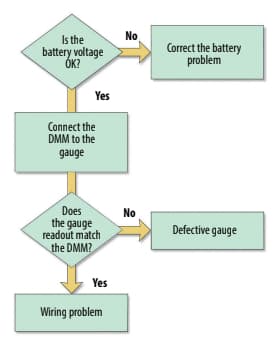
Start with the cheapest failure first
A dead engine gauge does not automatically mean a bad gauge. On most boats, the smarter move is to chase the electrical path first, because salt, vibration, moisture, and corrosion can turn a healthy circuit flaky without warning. That matters even more when you remember that the vast majority of recreational boats in service today still use analogue instrumentation, so this is not an old problem, just a common one.
The practical payoff is simple: a methodical check can save time, money, and the headache of swapping parts that were never the real fault. If you treat the gauge as one piece in the whole system, instead of as a standalone mystery, you can usually narrow the issue quickly to power, ground, sender, wiring, breaker, or the instrument itself.
Build the fault tree before you touch the wrench
The best troubleshooting pattern is straightforward: identify the symptom, test for voltage, confirm ground, then compare what you read with what you expected. That flowchart-style approach keeps you from guessing, and it matches the basic marine electrical training that ABYC emphasizes through multimeter use, wiring, over-current protection, battery installation, wire terminations, and corrosion mitigation.
Good Old Boat’s troubleshooting approach fits the same logic. If the alarm horn and other gauges are working, the problem is probably between the ignition switch and the gauge, or in the ground connection. That kind of clue matters because it narrows the search before you start unbolting anything.
Start at the batteries and work forward
Voltage gauges are the easiest place to begin because you can check them directly at the house and starter batteries. If the battery voltage is wrong, or if the feed to the panel is weak, the gauge may be telling the truth about a system problem rather than failing on its own. A basic test lamp can quickly show a blown fuse, an open wire, or a defective breaker, which makes it one of the most useful tools on board or in the shop.
From there, trace the wiring path instead of jumping straight to the gauge face. A cheap digital multimeter tells you whether a circuit is alive and what the voltage actually is, which is far more useful than a guess based on where the needle is sitting. If the circuit is dead at the source, the gauge is only the messenger.
Confirm the ground before replacing the instrument
A bad ground can make a good gauge look dead. That is why the ground connection belongs near the top of the fault tree, not at the end of it. If the circuit has power but the return path is compromised, you can end up with a gauge that flickers, reads strangely, or stays flat no matter what the engine is doing.
This is where clean, logical tracing pays off behind a crowded helm. ABYC-recommended wire color codes are commonly used by boat builders and manufacturers, and many engine makers follow those color recommendations, which can make it faster to identify the right lead in a messy panel. Even so, color alone is not proof, so the meter still has to confirm what the wire is actually doing.
Know which kind of instrument has failed
Boats.com divides engine instruments into three troubleshooting groups: sender-driven gauges, voltmeters and ammeters, and tachometers. That split matters because each category fails in a slightly different way. Most analogue fuel, temperature, and oil-pressure gauges use a variable resistor sensor mounted on the engine, while voltmeters and ammeters read a different part of the electrical picture altogether.
Tachometers deserve special attention because they bring their own wiring and setup issues. A non-working tach can be caused by something as simple as an incorrect cylinder-selector setting on the gauge, which means the problem may be in the configuration rather than the hardware. That is exactly why a one-size-fits-all parts swap can waste time.
Match the sender to the gauge
One of the most overlooked causes of a wrong reading is incompatibility between the sender and the gauge. Marine fuel senders commonly use standardized resistance ranges, and if the pair does not match, the needle can read wrong even when the wiring is fine. A widely used U.S. standard is about 240 ohms empty to 33 ohms full, while European systems may use a different range such as 0 to 180 ohms.
That mismatch can look like a failed gauge, but it is really a pairing problem. Before replacing the instrument, check whether the sender and gauge were designed to work together. In a crowded refit or a used-boat mystery panel, that single check can prevent an unnecessary replacement and solve the issue at the dock.
Use the right meter and read what it is telling you
A basic multimeter is enough for most of the work, and ABYC training treats DVOM selection and use as core skills because the meter reading itself is often the clue. If you want to go one step further, a clamp-capable meter lets you measure current without disturbing the wiring, which is especially useful when you do not want to open a live circuit just to see if current is flowing.
The point is not to collect tools for their own sake. The point is to turn each reading into a decision: power present or not, ground sound or not, sender matched or not, wiring intact or not. That method keeps you from replacing a gauge that was only reacting to bad voltage, a broken ground, or a corroded connection upstream.
Why a dead gauge is a safety issue, not just an annoyance
A dead or inaccurate engine gauge can hide the kind of problem that turns a short day sail into a bad one. Low oil pressure, overheating, or a failing charging circuit may not be obvious until the engine is already unhappy, and on a boat that can escalate quickly. Treating the gauge as part of the whole electrical system is the fastest way to protect both the engine and the budget.
That is why the best first checks are still the basics: battery health, wiring integrity, corrosion, fuses, and grounds. Once those are sorted, the rest of the diagnosis gets much easier. The payoff is a cleaner panel, fewer wasted parts, and a better chance of catching the real fault before it becomes an expensive day on the water.
This article was produced by Prism’s automated news system from verified source data, official records, and press releases, then run through automated quality and moderation checks before publishing. The system is built and supervised by the people who set the standards it runs under. Read our full AI policy.
Did this article answer your question?