Reef early, keep control: practical sail reefing techniques explained
Reef early and the boat stays lighter on the helm, flatter, and faster. The real win is catching the change before the main starts fighting you.
Why reefing early pays off
The fastest way to lose control of a cruising boat is to wait until the main is already too much sail. Once the boat is overpressed, heel increases, weather helm builds, drag goes up, and steering gets heavier just when you need precision most. Reefing is not just a comfort move, it is a way to keep the boat balanced, protect the rig, and stop a manageable day sail from turning into a hard-muscled wrestle.
That is why experienced sailors talk about reefing early, not bravely. The right moment is before the rail is buried and before the crew starts compensating for a sail plan that has become too ambitious. In practical terms, a heel angle past about 15 degrees is often used as a reefing cue, even though keelboats may sail well anywhere from roughly 10 to 30 degrees depending on the design. The point is not to chase a number, but to notice when the boat starts telling you the main is too much.
Read the boat, not the calendar
The best reefing decision usually comes from feel, not forecast alone. If the helm is loading up, the boat is rounding up, the leeward rail is spending too much time in the water, or the crew is having to brace constantly, the sail is already doing more than it should. Reefing at that stage is damage control; reefing before it gets there is seamanship.
Forecast trend matters too. A building breeze, a squall line, or a shift that is expected to strengthen the apparent wind should push you toward reefing while the deck is still calm enough to work safely. Cruising and racing writers keep making the same point for a reason: a smaller, better-shaped main can be faster and easier to steer than a larger sail that is dragging the boat sideways and loading the rudder.
Slab reefing is still the workhorse
On a boom-mounted mainsail, slab or jiffy reefing remains the standard for a reason. Good Old Boat describes it as the most common and most traditional approach on a typical modern sloop, and North Sails goes even further, saying it is the method used by about 90% of the fleet. That is not old-fashioned compromise, it is the proven system most sailors trust because it is simple, direct, and reliable.
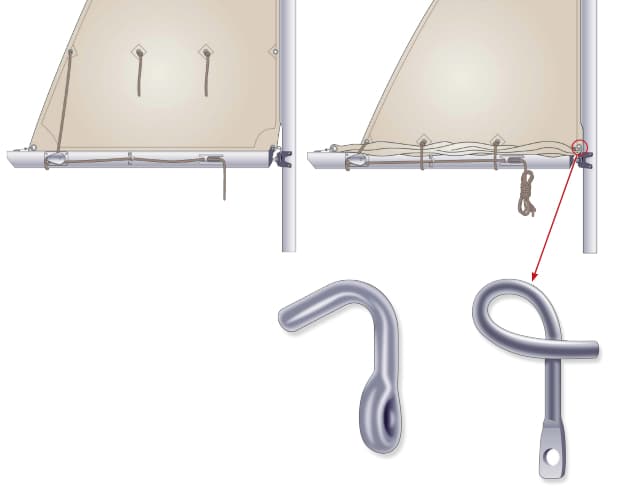
In a slab reef, the lower part of the sail is effectively folded out of service by lowering the sail to reefing cringles at the luff and leech. Those cringles take the new tack and clew positions, while the excess cloth is gathered and tied up so the sail keeps a clean shape. The key detail is that the reef is set in the cloth and hardware designed to take the load, not improvised with whatever line happens to be handy.
Know the difference between reef points and real load-bearing gear
This is where a lot of sailors make an expensive mistake. Reef points are not load-bearing. They are only there to secure the bunt, the extra cloth that hangs below the reef once it is set. If those ties are treated like structural support, the sail shape suffers and the rig takes a beating for no good reason.
Practical Sailor notes that reefing lines and hardware should be used to set the reef, not to take the full load indefinitely. It also reports Seldén’s service-load estimates of 5.5 kN at the reef clew and 3.5 kN at the reef tack, which is a useful reminder that these forces are real, not theoretical. A common answer is an earring or similar lashing that transfers the load properly so the reef line is not asked to do a job it was never meant to carry for a long passage.
Set up the maneuver before you need it
Good reefing starts by taking pressure off the sail. The boat should be turned head to wind before you begin, and the boom vang and mainsheet should be eased so the sail can drop cleanly and the slides are not fighting the system. Done right, reefing becomes a controlled sequence instead of a scramble with one hand on the halyard and the other on the rail.
That sequence is exactly why cockpit-led reefing has become so popular. Seldén’s single-line reef system is built to let you ease the halyard to premarked reefing points and then haul in the reefing line so the luff and leech are reefed at the same time. The practical advantage is obvious on a pitching deck: less movement, less exposure, and less chance of losing the moment when the boat is still willing to cooperate.
Hooks, horns, and cockpit control
Reef hooks still matter because they make the new tack secure, and the common straight hook or the more secure ram’s-horn style on the gooseneck can both work well when properly rigged. The best installations let the sailor manage the reef from the cockpit, which keeps the process short and predictable when the wind is building. A reef that can be set without leaving the safer part of the boat is not just convenient, it is part of keeping the crew calm and the boat on its feet.
UK Sailmakers says a well set-up boat can tuck in a reef in a minute or two, and that timing is part of the appeal. When reefing takes only a couple of minutes, there is far less temptation to delay the decision until conditions become awkward. Quick, clean reefing is what turns the technique from an emergency measure into a routine part of smart sail handling.
Why earlier reefing makes the boat easier to sail
The big misunderstanding is that reefing makes the boat slower in every case. In reality, an overpowered main often costs speed by increasing drag, loading the helm, and forcing constant corrections. A smaller sail, set properly, keeps the boat flatter and more efficient, which can make the whole package sail better rather than merely more conservatively.
That is the practical payoff for newer owners as well. Reefing turns from a vague theory into a concrete set of lines, hooks, cringles, and timing cues, and once those pieces are understood the boat becomes easier to handle in real wind instead of just tolerable in light air. The same judgment that keeps the helm balanced also saves wear on sails and rigging, which is where reefing quietly starts paying for itself.
A seamanship skill with deep roots
Reefing is not a modern workaround. It has deep roots in standard ship handling, and crews on sailing ships were expected to know how to shorten sail as part of normal seamanship. Even the famous clipper era is remembered for ships carrying so much canvas that other vessels would already have been reefed down, which is a good reminder that sail choice has always been a judgment call, not a display of toughness.
That history still matters because the old lesson has not changed: the best reef is the one you take before the boat forces your hand. Reef early, keep the boat balanced, and you get the version of sailing that feels controlled, efficient, and a lot less expensive to fix afterward.
This article was produced by Prism’s automated news system from verified source data, official records, and press releases, then run through automated quality and moderation checks before publishing. The system is built and supervised by the people who set the standards it runs under. Read our full AI policy.
Did this article answer your question?


