Rebuild Your Westerbeke Alternator With This Step-by-Step Teardown Guide
Most Westerbeke alternator failures trace back to one worn front bearing, not a dead unit. Here's the full teardown, inspection, and reassembly sequence.
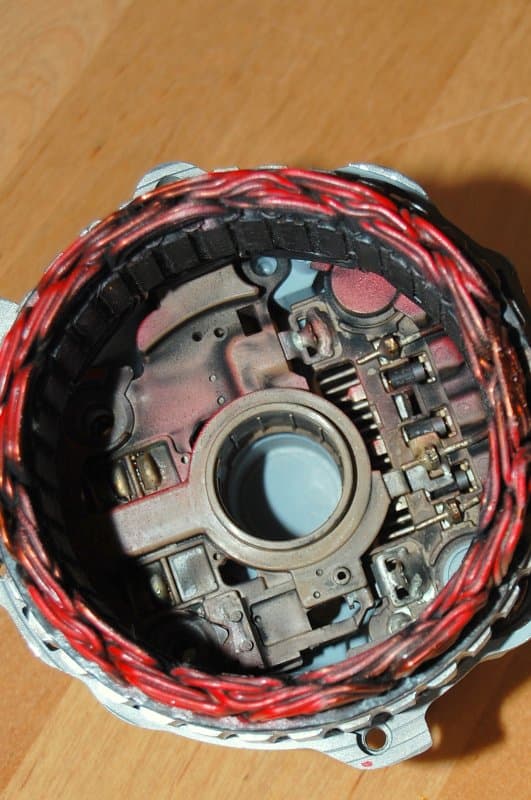
A failing Westerbeke alternator is a dead Westerbeke alternator. That's the assumption, and it costs sailors real money every season it goes unchallenged. The Mitsubishi-built 50A that came stock on engines like the Westerbeke 44B Four is fully rebuildable on your workbench, and the most common failure point, the front bearing, takes roughly two minutes to swap once the case is open. Knowing what's actually worn versus what's still perfectly serviceable is the difference between a productive winter-shop afternoon and an unnecessary replacement bill.
This is the complete teardown, inspection, and reassembly sequence.
The Alternator You're Working With
The Mitsubishi-built Westerbeke 50A is a compact, internally cooled unit with dual fans built directly into the rotor, one on the front face, one on the rear. It's a common sight on vintage Westerbeke marine auxiliary diesels and is well-suited to charging modest battery banks on day sailors and coastal cruisers. It was never designed for the sustained, high-amperage demand of a large lithium house bank, but within its intended role, it is a durable, rebuildable workhorse. One detail that shapes the whole rebuild procedure: in this Japanese-style design, the voltage regulator and brush assembly are a single integrated unit, and that unit is soldered directly to the stator. Everything comes out together.
What You'll Need Before You Open It
Attempting this without the right tools turns a straightforward job into a frustrating one. Have the following ready before you pull the first bolt:
- Impact driver or impact wrench (non-negotiable for the pulley nut)
- Lead or soft-faced mallet for separating the aluminum case halves
- Bearing press, or a heat gun with appropriate technique
- Digital multimeter with a diode-test function
- Sharpie marker for alignment marks before disassembly
- A brad nail or small pin punch to retain the brushes during reassembly
Step 1: Pulley Removal
The pulley nut is torqued on and will not break loose with a ratchet alone. An impact driver is the correct tool here, not a workaround. If you don't own one, any mechanic's shop can break it loose in under a minute. Once the nut is removed, the pulley slides off the shaft. Before you go any further, mark the front and rear case halves with your Sharpie so you have a reference point for reassembly orientation.
Step 2: Splitting the Case
Four bolts hold the front and rear aluminum halves together. Remove them, and the case will separate to expose the front-bearing retainer plate. If the halves are stubborn due to corrosion or a tight press fit, a soft-faced or lead mallet applied with light taps around the case will free them. Never use a steel hammer on the aluminum. For particularly resistant cases, applying gentle heat to the exterior expands the aluminum enough to ease separation without damaging the casting. This same heat technique applies when the front bearing itself is a stubborn press fit.
Step 3: Front Bearing Inspection and Replacement
With the case open, the front-bearing retainer plate is right there. Remove the plate, press out the old bearing, and inspect it for roughness, pitting, or contamination before ordering a replacement. On a well-maintained engine with significant hours, the front bearing is almost always the only part that actually needs replacing; it handles the mechanical load of belt tension continuously and simply wears before everything else does. The rear bearing is worth a quick spin test while you're in there, hold the shaft and spin the outer race by hand and feel for any roughness or grinding. It frequently survives to a much higher service interval, but if it feels rough, document it and replace it while the case is already apart.
Step 4: Rotor Removal
The rotor is a press fit into the rear bearing, which means freeing it may require more than a light touch. Use your soft-faced mallet and work deliberately; the aluminum surfaces on the rotor and case will not survive abuse from a steel hammer. If the rotor resists, apply gentle heat to the rear case around the bearing bore to expand the aluminum, then try again. Once the rotor is free, inspect the slip rings, the copper-colored contacts on the rotor shaft where the brushes make contact. Look for grooving, pitting, or contamination from brush dust or oil. Lightly grooved slip rings can be cleaned; heavily grooved or pitted ones indicate that the brushes were worn far down before the alternator came out of service.
Step 5: Stator, Brush Holder, Regulator, and Diode Pack
Three screws (gray on this unit) retain the stator and regulator assembly in the rear case. Before you remove them, mark the stator orientation relative to the case with your Sharpie; the stator must go back in at the same rotational position. Once the screws are out, the entire assembly, brush holder, voltage regulator, and diode pack, slides out as one unit. In this design the stator is soldered to the regulator and brush assembly, so there is no splitting them for individual component replacement at the bench level.
Inspect the brushes for length. Brushes worn short mean the whole regulator and brush assembly needs replacement, not just the brushes. Then test the diode pack with your multimeter on diode-test mode. A healthy diode conducts in one direction and blocks in the other. A diode that reads open or shorted in both directions has failed. Diode pack failure causes symptoms ranging from undercharging to overcharging to a complete charging failure depending on which diode in the pack is affected, and misdiagnosing it as a battery or wiring problem wastes time and money.
Reassembly
Reassembly follows the reverse of teardown, but two steps require specific attention or the alternator will not go back together cleanly.
First, retain the brushes. Before sliding the stator and regulator assembly back into the rear case, insert a brad nail or small pin punch through the small hole in the rear case to hold the brushes retracted against their springs. This is the same principle as retaining a distributor's components during installation: it keeps the brushes from fouling against the rotor shaft during assembly. Once the rotor is seated and the front case is bolted on, pull the pin.
Second, respect your alignment marks. The stator must go back in at the orientation you marked before disassembly. Re-install the three gray screws before attempting to seat the rotor into the rear bearing cavity. Seat the rotor by setting the assembly shaft-down on your workbench with the shaft nut making contact, then apply firm downward hand pressure on the case. One light tap is usually all that's needed if hand pressure isn't enough. Torque the four case bolts evenly, reinstall the pulley, and torque the pulley nut to the manufacturer's specification.
Knowing When to Stop
This rebuild is well within reach for a DIYer who is comfortable disassembling small mechanical components and competent with a multimeter, but it is not a beginner project. Electrical testing of the diode pack and regulator requires genuine multimeter competency, not just casual familiarity with the tool. If the rotor shows signs of heat damage or winding shorts, if the diode pack has failed, or if the case shows severe corrosion at any mating surface, the right call is to send the unit to a professional rebuilder. Some damage is not economical or safe to address at home, and the cost of a professional rebuild is far lower than what a misdiagnosed alternator can do to a lithium bank.
System-Level Thinking: Alternators and LiFePO4
Sailors converting to LiFePO4 or adding a larger house bank have a specific reason to understand this rebuild beyond just fixing a worn bearing. A 50A Mitsubishi-Westerbeke unit will be worked hard continuously charging a large lithium bank, which accepts current at a higher rate than lead-acid and can pull the alternator toward its thermal limits faster than the original design anticipated. Knowing your alternator's actual condition and output gives you real data when sizing a charging system, adding an external regulator, or deciding whether the existing alternator is the right unit for the new load.
Whatever the battery chemistry, combine any alternator work with a review of your charging circuit against ABYC standards: correctly sized conductors for the sustained amperage, appropriate fusing between the alternator output terminal and the battery, and secure terminations at both ends of every run. A freshly rebuilt alternator wired into an undersized circuit is not a reliable charging system; it's a fire risk waiting for the right conditions. Get both right, and the rebuilt Westerbeke unit will outlast most of the boats it charges.
This article was produced by Prism’s automated news system from verified source data, official records, and press releases, then run through automated quality and moderation checks before publishing. The system is built and supervised by the people who set the standards it runs under. Read our full AI policy.
Did this article answer your question?