What breaks on passage? Prioritize sail repairs for offshore cruising
Carry less, fix faster: offshore success starts with the sail-repair kit and jury-rig parts that keep a torn spinnaker from ending the passage.
In Good Old Boat’s passage tally, more than 34 boats, 22 percent, including the crew on that passage, dealt with torn sails. Sailors felt the failures fastest in blown spinnakers first, then torn mainsails. That is the real offshore packing problem, because a boat does not have room for a complete spare of everything, only the gear that keeps the next failure from becoming the end of the passage.
Start with the sail kit, because sails fail in plain sight
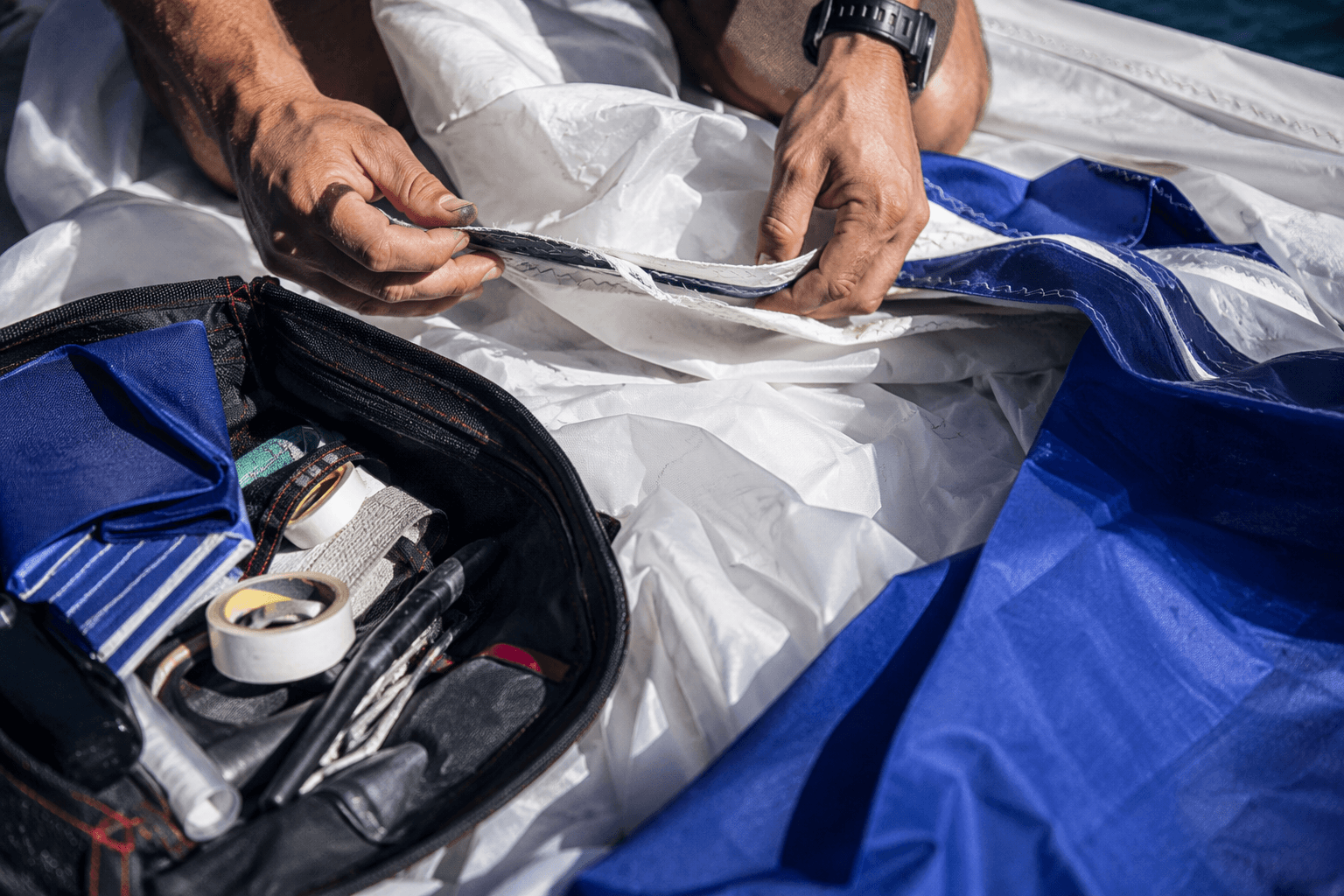
A sail-repair kit is essential gear for an ocean crossing. A blown spinnaker or torn mainsail is not a theoretical inconvenience offshore; it is the moment when sail area, balance, and speed all change at once. If you only have space for one repair system, make it the one that can close a rip, reinforce a weak panel, and get the cloth working again before the boat starts loading up the next flaw.
The smallest useful kit is compact, not fancy. The pieces that keep showing up in practical sail-repair setups are sail repair tape, cloth patches, thread, needles, webbing, and sharp scissors, with 100 mm slit cloth in the mix in one Bainbridge demo. That combination lets you choose between a quick tape job, a stitched patch, or a more durable reinforcement depending on the size and location of the tear.
Carry repair materials you can use in a seaway
A passage kit has to work when the boat is moving, wet, and noisy. That means the materials need to be easy to reach, simple to identify, and fast to deploy, because a repair that lives in the quarterberth is not a repair kit, it is dead weight. Offshore, the right answer is often the fastest workable one: tape a lightweight sail, stitch a split panel, or lash in a temporary reinforcement and shorten sail while the cloth holds together.
The mindset matters as much as the contents. A good skipper does not try to eliminate uncertainty, they make sure the boat can stay safe and functional after a common failure. On passage, that usually means preserving shape enough to continue, not restoring the sail to loft-perfect condition.
Think in systems, not just cloth
Once you move beyond the sails, the spares discussion gets broader, but the logic stays the same. Offshore spares lists keep circling the same systems: sails, starter, alternator, steering, rigging, head repair, and pump kits. You are not packing a second boat; you are packing the means to keep the most failure-prone systems from stopping the voyage.
That is especially true for steering. Good Old Boat’s passage data also puts autopilot and windvane issues at 19 percent. The smallest useful steering kit is the one that keeps the boat under control if the normal system quits, whether that means the tools to lash a temporary solution, the parts to reconnect a failed link, or the backup method that lets you keep making way until the break is sorted.
Rigging deserves the same treatment. A split stay, a damaged shackle, or a chafed line does not call for a warehouse of spares; it calls for the gear that lets you patch, lash, splice, or substitute quickly enough to keep the rig working.
Pumps and electrics are worth room because they stop the boat cold
Pumps and electrical gear usually earn their locker space because when they fail, the consequences compound fast. Repair kits for the various pumps come up again and again in sailors’ spares lists, and so do starter and alternator spares, because a dead pump or dead charging system can turn a manageable problem into a passage-stopping one. The trick is to carry the smallest kit that restores function, not a pile of parts that only looks comprehensive in the marina.

That same logic applies whether you are dealing with a bilge pump, a head pump, or the charging side of the house bank.
Chafe is the silent failure that deserves its own kit
Chafe is an “unending battle.” Practical Sailor’s dock-line guidance for hurricane season starts with chafe protection for mooring lines. That advice belongs offshore too, because chafe is what turns a loaded line, halyard, or sheet into a sudden break after hours of rubbing. The fix is rarely glamorous: sleeves, wraps, sacrificial protection, and regular checks before the line saws through.
Sail tape and patches are obvious, but chafe protection keeps the rest of the system intact long enough to matter.
Pack for the failure that changes the passage
Jeremy Wyatt warned in Yachting World that poor preparation for an ocean crossing causes more damage than the weather. Waterborn Magazine identified eight common problems sailors experience at sea.
This article was produced by Prism’s automated news system from verified source data, official records, and press releases, then run through automated quality and moderation checks before publishing. The system is built and supervised by the people who set the standards it runs under. Read our full AI policy.
Did this article answer your question?