Breadtopia Forum Members Rally to Rescue a Struggling New Sourdough Starter
A starter begun on March 5 showed only modest bubbles before stalling. Breadtopia forum members traced the failure to five fixable causes, starting with a 2:1:1 feeding ratio shift.
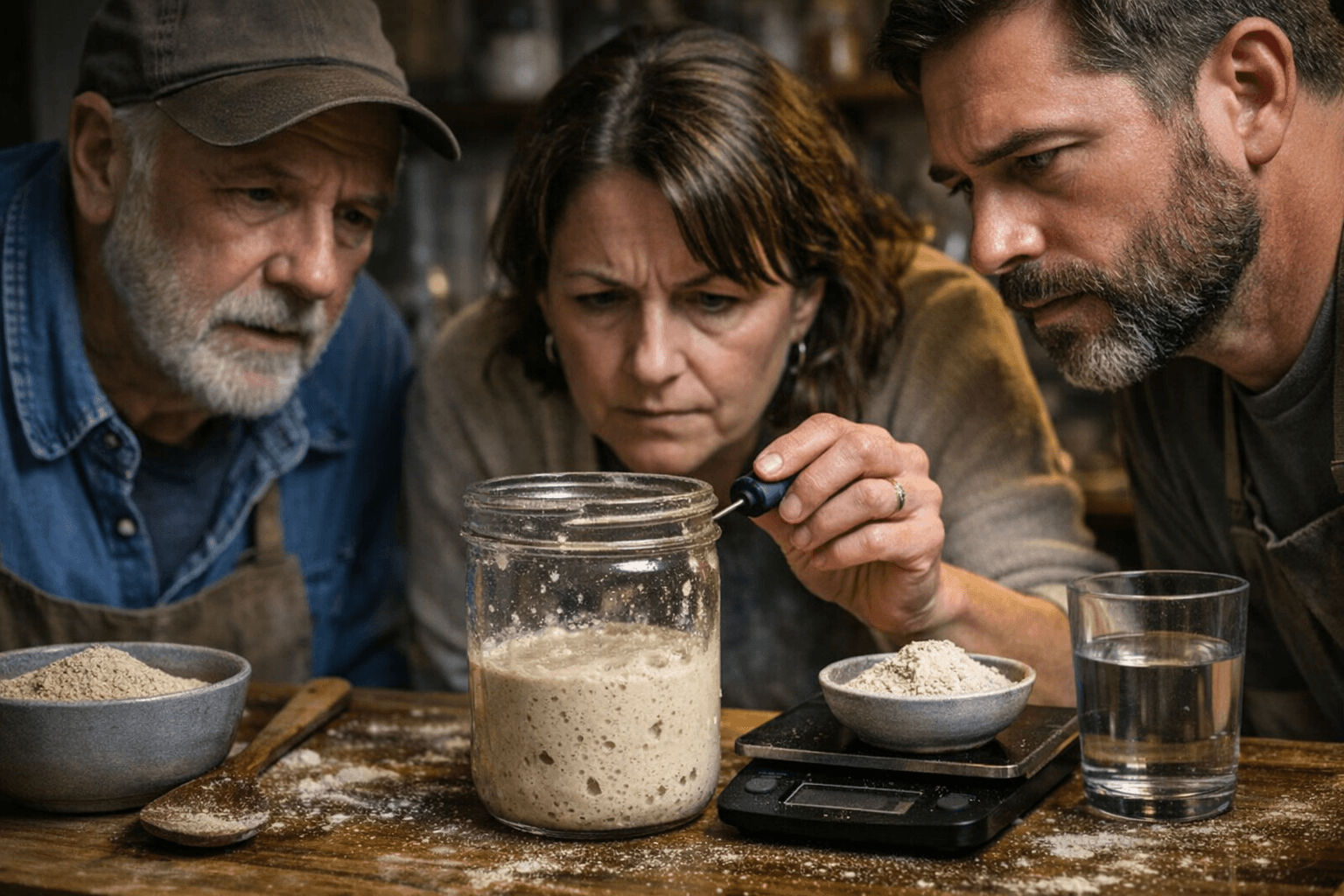
The starter sitting on your counter, barely bubbling after three weeks, is not necessarily a lost cause. jesaaragon found that out the hard way, and then found it out in the best possible way: through the Breadtopia community forum.
The thread, posted March 26, laid out a precise and familiar history. The starter had been running since March 5, built on Gold Medal brand bread flour and filtered water, 50 grams of each, with daily discards back down to 50 grams. For the first five to seven days it produced modest bubbles and nothing more. No visible rise. No doubling. Around that point it simply stalled. Mid-experiment, jesaaragon had also switched to a Costco flour after watching Instagram bakers recommend it, adding a new variable to an already quiet culture.
Forum regular Abe and other experienced members answered with a practical, iterative diagnosis, asking for photos and feeding schedules before offering targeted interventions. Their responses, taken together, map the five most common reasons a new starter refuses to rise.
Feeding ratio is the first checkpoint. jesaaragon's 1:1:1 setup, one part starter to equal parts flour and water, leaves a young culture swimming in its own metabolic waste with insufficient fresh substrate to work through. The forum's immediate recommendation was 2:1:1, doubling the flour and water relative to the starter, giving wild yeast a larger food source on each cycle.
Flour choice comes next. White bread flour alone, particularly a commodity brand, lacks the bran particles and native microflora that accelerate microbial diversity in a new culture. Adding even a small portion of whole wheat or rye flour to the feed introduces those organisms directly. The diagnostic is a single feeding with a tablespoon of whole rye stirred in, tracked over the next 12 hours.
Water chemistry is the third variable and among the most underestimated. Chlorinated tap water actively inhibits the bacterial activity a new starter depends on. Several forum members pointed to mineral or sparkling water as an immediate substitute. A rubber band placed at the starter's surface level after feeding gives a precise visual record of any rise over the following hours, making the comparison between water sources easy to track across consecutive feeds.
Temperature ranks fourth. A starter held at 68 degrees Fahrenheit behaves like one running in slow motion. The oven-light trick, leaving the oven off but the interior light on with the door cracked to create a warm-proof environment near 76 to 78 degrees, often breaks a temperature stall within a single feed cycle.
The fifth failure mode is the false rise, which many new bakers mistake for proof that fermentation has started. The burst of activity common around days two and three comes from leuconostoc bacteria rather than wild yeast, and it collapses quickly, leaving the culture looking stalled when it was never properly established to begin with. A healthy maturing starter smells rounded and lactic, similar to yogurt, with a slightly tacky, web-like texture when pulled. A false-rise culture smells sharply alcoholic and thin.
Across all five interventions, the Breadtopia thread converged on a single readiness standard borrowed from professional test kitchens: three consecutive feedings showing consistent doubling before treating a starter as bake-ready. Not one promising afternoon. Three reliable cycles. That benchmark keeps appearing in the forum because it keeps being the answer.
This article was produced by Prism’s automated news system from verified source data, official records, and press releases, then run through automated quality and moderation checks before publishing. The system is built and supervised by the people who set the standards it runs under. Read our full AI policy.
Did this article answer your question?