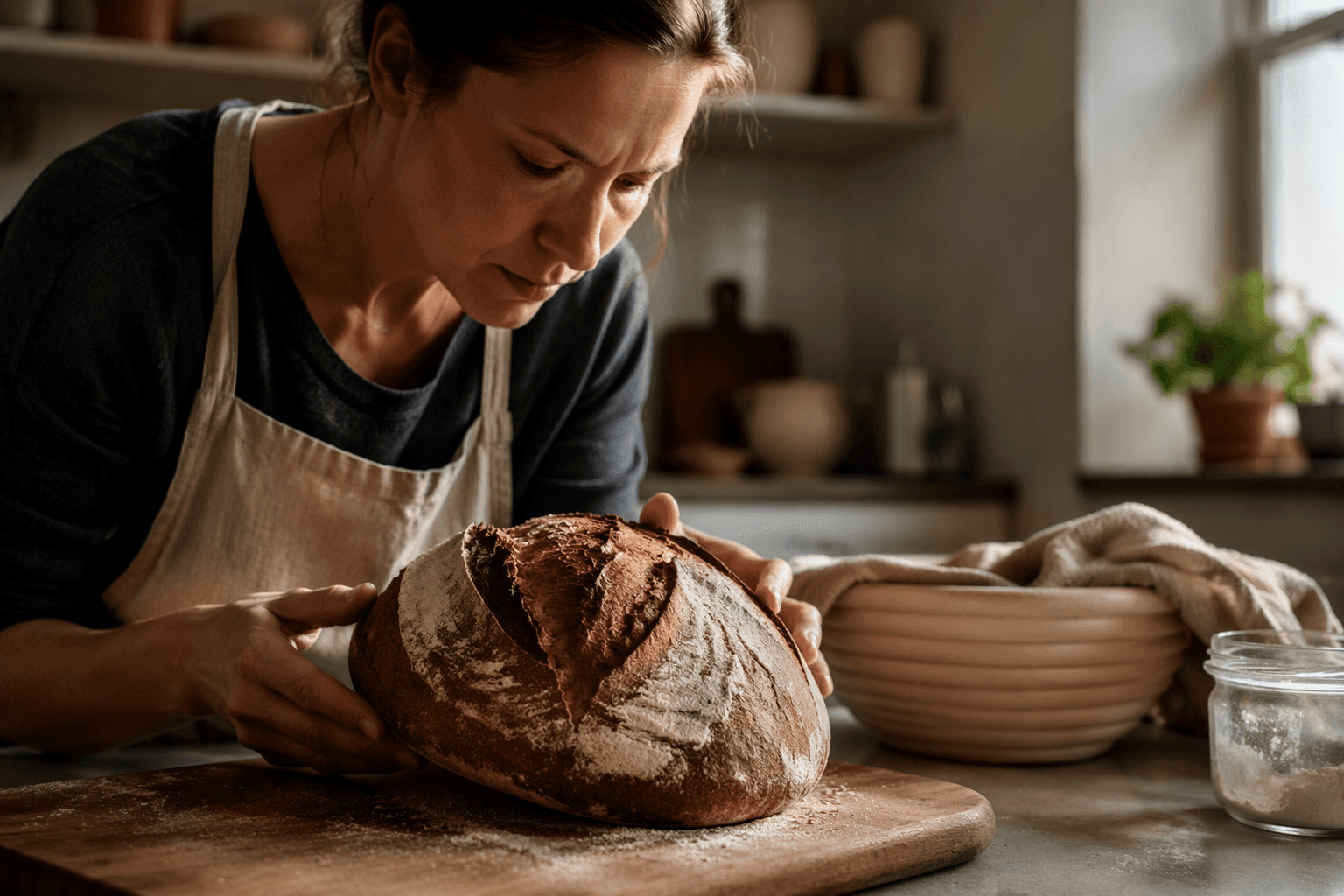
How to Bake Same-Day Sourdough Bread Without Overnight Fermentation
Learn practical same‑day sourdough workflows, measurements, and warm‑fermentation tricks to mix in the morning and bake that same day without an overnight cold retard.

1. What same‑day sourdough means and why it matters
Same‑day sourdough is a deliberate approach that speeds fermentation so you can mix in the morning and bake by dinner. It relies on a larger, very‑active starter and warm, accelerated fermentation to shorten the timeline while keeping a crusty exterior and tender crumb that still showcases wild yeast and lactic acid bacteria.
2. The core idea: more starter + warmer dough
Multiple community recipes emphasize that a higher starter percentage and a warm dough temperature are the two levers that make same‑day baking work. The Original Report describes the method as one that “relies on a larger, very‑active starter and warm, accelerated fermentation to allow mixing in the morning and baking by dinner.” Those two adjustments speed up activity without adding commercial yeast.
3. Essential ingredients (a clear, proven same‑day formula)
A reliable, explicit same‑day ingredient set from a tested recipe reads: 330 g warm water (~75°F), 150 g active sourdough starter, 500 g bread flour, and 10 g salt. These amounts are given exactly in the Cravethegood recipe and support a straightforward, no‑knead, beginner‑friendly day‑bake process.
4. Starter feed and readiness (how to prep your starter)
Plan to build or feed your starter ahead of morning mixing so it is very active at mix time; Countryroadssourdough gives a precise feed option: “Feed starter a 1:5:5 ratio and leave at 72°F (15 g starter: 75 g flour: 75 g water) | Day One: 10 pm.” A strongly fed starter the evening before (or an active feed several hours before mixing) is the simplest way to ensure strong rise during the day.
5. Mix and autolyse basics
Start by mixing starter and water briefly, then add flour and salt to form a shaggy mass, Pantry Mama instructs: “Weigh out your sourdough starter and water into a large mixing bowl and mix together briefly.” For the Cravethegood plan, mix at 8:00 am, combining 330 g warm water and 150 g starter until mostly combined, then add 500 g flour and 10 g salt and knead by hand until incorporated.
6. Rest and the role of temperature
After mixing, cover and let the dough rest in a warm spot, Cravethegood recommends a 45–60 minute rest at ~75°F. Countryroadssourdough reinforces that you should “keep the dough around 75°F, warmer dough ferments more quickly, while cooler temperatures will slow things down,” and basing schedules on this temperature will help you hit same‑day targets.
7. Stretch & folds: how to do them and when
Stretch & folds build strength without heavy kneading: with damp hands, grab the dough, pull until a flap is long enough to fold over itself, fold it, rotate the bowl 90°, and repeat until you’ve completed a set. Cravethegood advises performing three sets of stretch & folds, and Countryroadssourdough schedules those sets between 8:30 and 9:30 am in a counter method timeline.
- Cravethegood frames a roughly 8‑hour day from an 8:00 am mix to a dinner‑time loaf, calling the recipe “easy” and “same day.”
- Countryroadssourdough’s counter method runs: Feed starter (1:5:5) at 10 pm, mix dough at 8:00 am, stretch & folds 8:30–9:30 am, bulk 9:30–12:00 pm, pre‑shape 12:00 pm, final rise 12:30–1:30 pm and preheat/place dough in freezer at 2:00 pm while oven heats.
- Farmhouse on Boone offers a later rhythm: feed starter around 8:00 am, bulk at about 1:30 pm, shape at 6:00 pm and bake at 7–8:00 pm.
8. Timelines that actually work, pick the one that fits your day
Different explicit schedules achieve same‑day results at different paces:
These are distinct, source‑specified options, choose the schedule that matches your start time and kitchen temperature.
9. The high‑starter, rapid option (50% starter method)
A bolder approach uses much more starter: Natalya Syanova writes, “using 50% sourdough starter in the dough. Honestly, I feel like I wasted so much time not trying this sooner. The difference is astounding! No autolyse, and the fermentation process speeds up dramatically, taking just about 3.5 to 4 hours, and the resulting bread is nothing short of delicious. Also all mixing can be done by hand.” This is a valid, explicit community technique for a very fast turnaround; expect a different texture and flavor profile from longer ferments.

10. Proofing and cold‑retard options (same day vs hybrid)
Same‑day recipes intentionally reduce or omit long cold retards, but you have choices: Pantry Mama notes you “can skip cold fermentation or shorten it to suit timeline.” Natalya also suggests a hybrid: “Hi there, Fermenting the loaf on the counter for an hour or two after shaping and then baking it the same day can yield a slightly different result compared to refrigerating it overnight. let the loaf proof for 2 hours after shaping at room temperature, then move it to fridge for 30 min and then bake it.” Countryroadssourdough uses brief freezer time before scoring to firm dough, not as a long overnight retard.
11. Tools, vessels, and temperature control
Keep equipment simple: Danish dough whisks, wooden whisks, silicone spatulas or hands are all explicitly recommended for mixing. Farmhouse on Boone suggests preheating a Dutch oven for an hour before bake; Countryroadssourdough recommends a proofing solution or bread mat for warmth and even mentions a promo code (“use code country10 for 10% off”) for keeping dough at target temperature.
12. Scoring trick: freeze briefly for cleaner cuts
If scoring feels gummy, Countryroadssourdough’s workflow includes a practical trick: “Before scoring, add the dough to the freezer while the oven preheats so it is easier to make your cuts in the dough.” A short stint in the freezer firms the surface, making neat slashes and better oven spring more manageable.
13. Flour choice, nutrition, and flavor tradeoffs
For reliable same‑day rise, Pantry Mama recommends white bread flour: “This recipe works best with white bread flour rather than all purpose flour or whole wheat flour.” She also answers a common concern: “Does Same Day Sourdough Bread Still Taste Good? Yes sourdough bread made with a single day process will still taste good! It still contains wild yeast and lacto acid bacteria. It won't however have that strong sourdough depth of flavor because it has not had a long cold ferment. It won't have the complexity of sourness that you might otherwise expect from this type of bread. Same day sourdough bread is still delicious and better for you than yeasted bread, however it won't have as low gluten levels or as low glycemic index as longer fermented sourdough bread. Not bad, just different!”
14. Troubleshooting common same‑day problems
Sticky or loose dough can happen, community threads show bakers struggling after lamination steps and asking why a dough “didn’t come together at all and shaping was just one big mess.” If your starter came straight from the fridge, Farmhouse on Boone cautions that starting with a cold starter “technically” allows same‑day baking but “it won’t be ready by dinnertime.” Use warm holds, stronger feedings the night before, or a higher starter percentage to recover speed.
- 8:00 am, Mix 330 g warm water (~75°F) with 150 g active starter until mostly combined, add 500 g bread flour and 10 g salt, mix to a shaggy dough and knead by hand until incorporated.
- Cover and rest in a warm spot (~75°F) for 45–60 minutes.
- Perform three sets of stretch & folds through the morning (Cravethegood: “Perform 3 sets of stretch and folds, shape, and proof, then bake!”).
- Shape, proof, and bake the same day, the site promises you’ll “have a crusty, tender sourdough loaf ready in 8 hours.”
15. A concise, reproducible same‑day checklist
If you want one straightforward path to a same‑day loaf, follow the Cravethegood outline exactly:
This keeps tools and steps minimal and follows an explicitly documented recipe with a strong rating (“4.81 from 61 votes”).
16. Community voice and practical value
Same‑day sourdough is a community‑driven compromise: it sacrifices some depth of fermented sourness for accessibility, speed, and the joy of baking fresh bread the same day. These techniques let bakers with school runs, work shifts, or hungry housemates participate without multi‑day logistics, and they preserve the tangible benefits of wild fermentation versus instant yeast.
17. Final wisdom to carry into your kitchen
Same‑day sourdough isn’t a shortcut to identical results as a long cold ferment; it’s a flexible, reliable method to make delicious bread on a tighter schedule. Start with an active starter, aim for a warm dough (around 75°F), choose the timeline that fits your day, and tweak starter percentage if you want faster or slower results, practical adjustments that keep sourdough baking accessible and rewarding.
This article was produced by Prism’s automated news system from verified source data, official records, and press releases, then run through automated quality and moderation checks before publishing. The system is built and supervised by the people who set the standards it runs under. Read our full AI policy.
Did this article answer your question?