Khorasan Mills Releases Step-by-Step Sourdough Starter Guide for Home Bakers
Khorasan Mills breaks down sourdough starter creation into plain daily steps, proving that flour, water, and 7-10 days are all you really need.

Starters are not hard to make or to keep. Here's to taking the mystery out of sourdough starters." That line from Khorasan Mills' newly published guide captures exactly what the Utah-based flour company set out to do with "Creating a Sourdough Starter," a step-by-step resource released on March 10, 2026, and aimed squarely at home bakers who have always wanted a live culture bubbling on their counter but weren't sure where to begin.
The guide cuts through the intimidation that surrounds sourdough fermentation and anchors everything in plain language and practical daily steps. If you've ever hesitated at the idea of cultivating your own starter, this is the resource worth bookmarking.
Two ingredients. That's the whole foundation.
The guide opens with a disarmingly simple declaration: "Flour and water are all you need." No commercial yeast packets, no specialty additions, no complicated chemistry. Khorasan Mills frames the relationship between the two ingredients in straightforward terms: "For the starter, the flour is the food, the water is what helps bring it all together."
On flour selection, the guide keeps it accessible. All-purpose flour works, bread flour works, and whole wheat flour works well too. The flexibility here matters for home bakers who may not have a pantry stocked with heritage grains on hand. On water, though, there is one meaningful caveat: reach for purified, bottled, or filtered water. Tap water that contains fluoride or chlorine doesn't work as well, so it's worth running your tap through a filter or grabbing a bottle if that's what's coming out of your faucet.
Day 1: getting your starter off the ground
The guide's Day 1 instruction is precise and easy to follow. Using a pint or quart jar, you combine ¼ cup plus 2 tablespoons of flour with ¼ cup of purified or filtered water. Mix well, set the lid on until it's just snug (not sealed tight), and leave it on the counter for one full day. That's it. The jar size matters because you'll need room for the culture to expand and for daily feedings over the days that follow.
The full day-by-day procedure for Days 2 through 10 exists in the complete Khorasan Mills guide, though those intermediate steps weren't included in the excerpts available for this article. For the complete sequential instructions, the original guide on the Khorasan Mills site is the place to go.
The 7-10 day feeding rhythm
Here's where many first-time starter makers either succeed or give up: the daily feeding commitment in the early phase. Khorasan Mills is direct about what's required: "Feed the starter each day for 7-10 days when first creating the starter."
The guide draws a helpful analogy, noting that a sourdough starter is like our own bodies in that it needs to be fed to stay healthy. During this first week, you'll also need to remove some of the starter each day to maintain enough empty space in the jar so that each new feeding has room. The guide's instruction to "always keep enough empty space in the jar for the next feeding" is a practical reminder that a crowded jar will work against you.
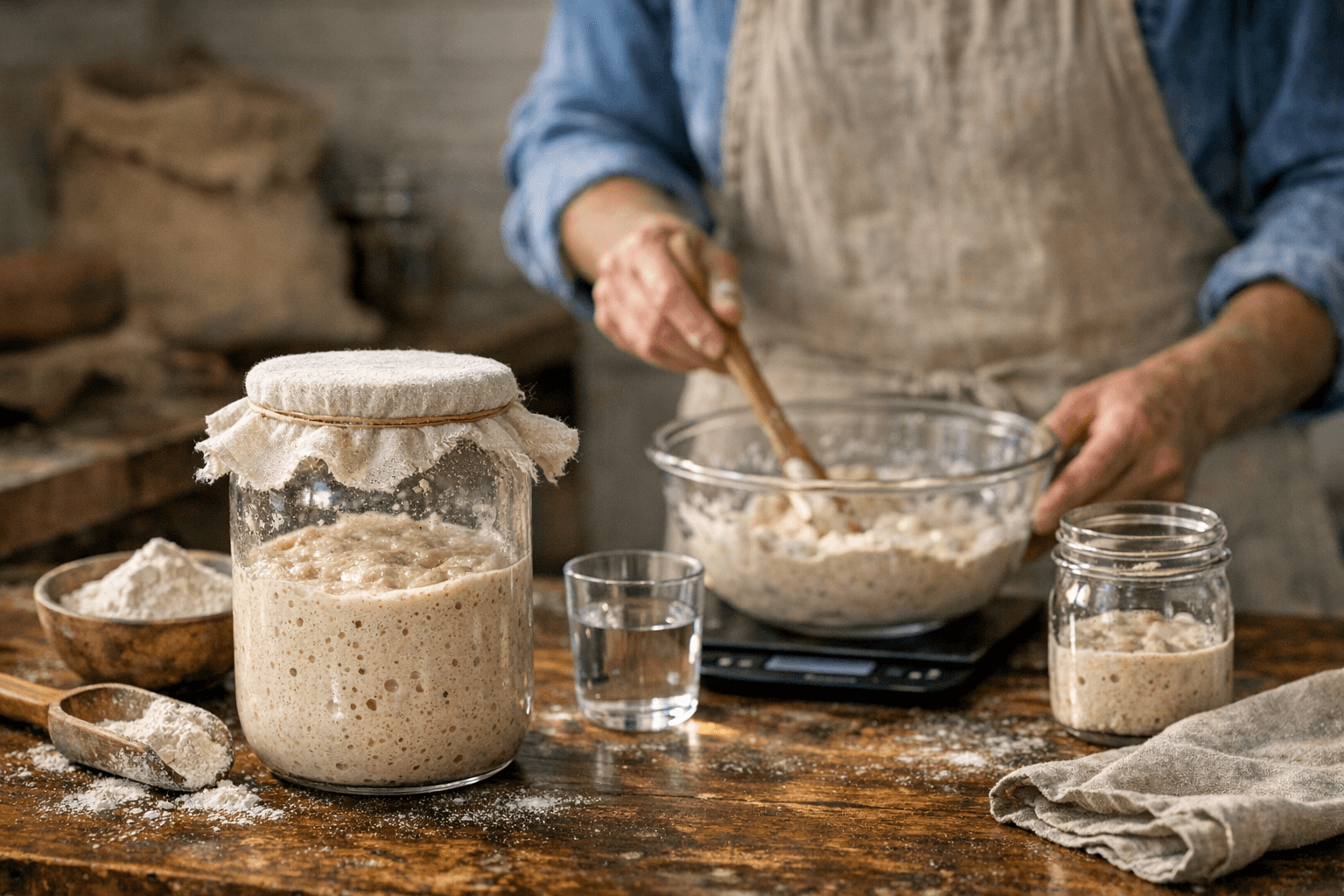
The good news is that this intensive daily routine has a defined end point. Once the starter is mature at the end of the first week, daily feeding is no longer necessary. The guide points readers toward a separate "Maintaining the Starter" section for ongoing care instructions beyond the creation phase.
Why bother? The starter's range of uses
If you're on the fence about whether a sourdough starter is worth the week-long commitment, consider what you'll have access to once it's alive and healthy. Khorasan Mills frames the starter as an answer to a fundamental baking question: "If I couldn't find yeast, how would I make and bake bread?" The answer, of course, is that wild yeast and bacteria cultivated in a jar of flour and water have been doing this job for thousands of years.
Beyond that philosophical appeal, the practical applications are genuinely broad. "A starter is the basis of good, flavorful sourdough - not just breads, but pancakes, waffles, cookies, banana bread, pasta - so many choices." A mature, healthy starter opens up an entire category of naturally leavened and fermented baking that commercial yeast simply can't replicate in terms of depth of flavor.
Storing your starter for the long haul
Once your starter is mature and you're not baking every day, the fridge becomes your best tool. Khorasan Mills is clear on how refrigeration works: "The fridge is cold, the starter will slow down and go dormant in the fridge, and can be stored there for weeks if you are not using it often." This is what makes a starter a genuinely long-term kitchen asset rather than a high-maintenance obligation.
The guide states explicitly that a well-maintained starter "can be used for many years." The key principle is simple: keep it fed and healthy, and when you're not using it, keep it cold. Bakers who pull their starter out of the fridge after weeks of dormancy will need to bring it back to room temperature and feed it before it's ready to leaven a loaf, but the culture itself remains viable through those extended rest periods.
Khorasan Mills in American Fork, Utah
The guide is a natural extension of what Khorasan Mills does as a company. They recently opened a retail space at 920 E State St in American Fork, Utah, where home bakers can presumably find the quality flour that makes a guide like this one worth following. They'll also be at the Be Healthy Utah Conference on April 18-19, 2026, for anyone in the region who wants to connect with them in person.
The combination of a free practical guide, a brick-and-mortar retail location, and a conference presence positions Khorasan Mills as a genuine resource for the home baking community, not just a flour supplier. For anyone who has been waiting for a clear, no-nonsense path into sourdough starter creation, this guide makes the case that the hardest part is simply deciding to begin.
This article was produced by Prism’s automated news system from verified source data, official records, and press releases, then run through automated quality and moderation checks before publishing. The system is built and supervised by the people who set the standards it runs under. Read our full AI policy.
Did this article answer your question?