New Sourdough Strain Boosts Bread Texture While Producing Immune-Modulating Postbiotics
Limosilactobacillus fermentum SPC L75-1 produces softer crumb and immune-modulating postbiotics, showing targeted LAB selection shapes both bread texture and biology.
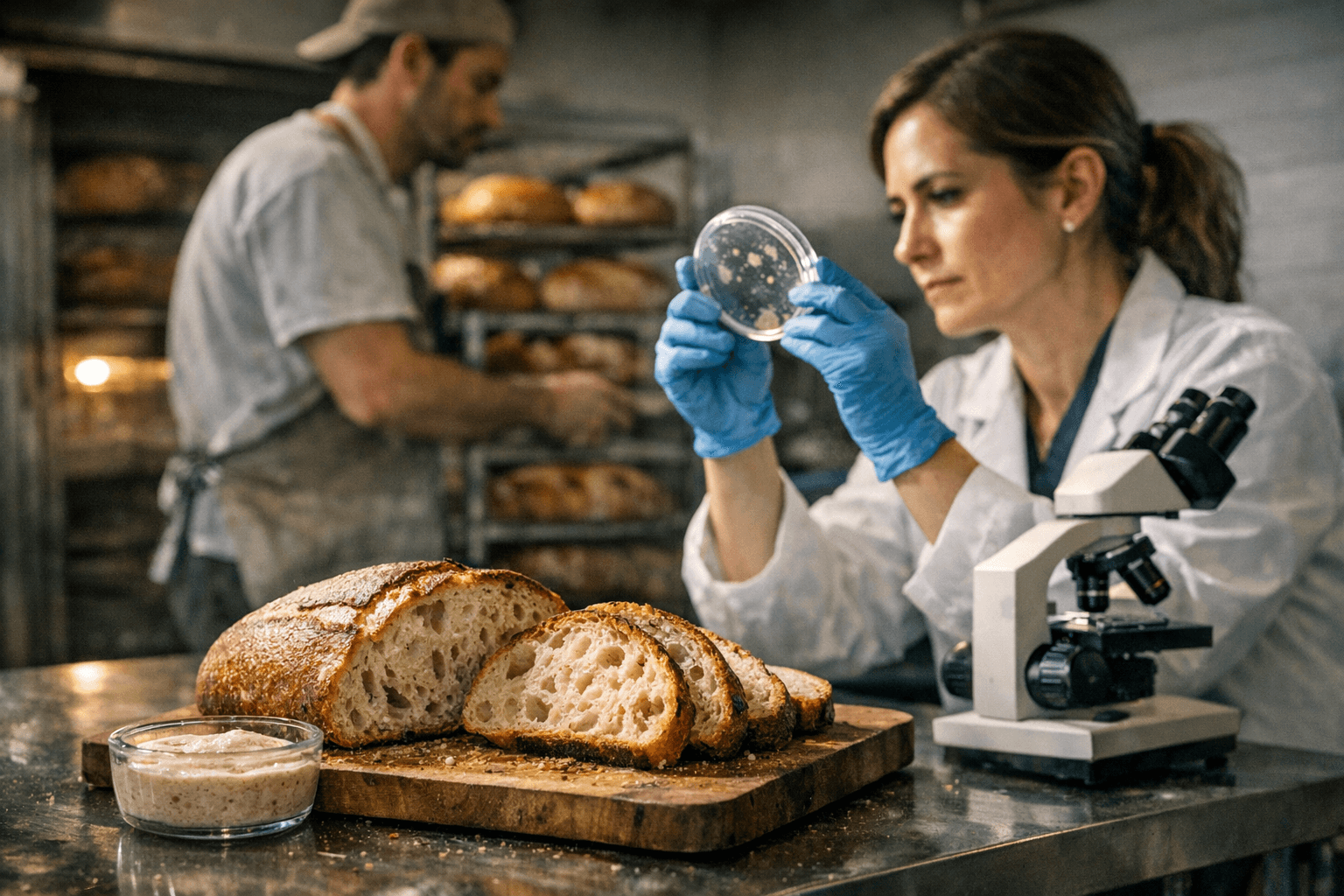
A single lactic acid bacterium, Limosilactobacillus fermentum SPC L75-1, produces softer crumb and generates immunomodulatory metabolites during fermentation, according to research published in BMC Microbiology in 2026.
Researchers isolated the strain and ran it through a targeted battery of technological tests designed to mirror real sourdough fermentation conditions: maltose utilization, leavening capacity, and crumb texture measurement. Bread made with SPC L75-1 outperformed control loaves on both gas production and crumb hardness, with the SPC L75-1 loaves registering measurably lower hardness scores, a direct proxy for the open, yielding crumb structure that bakers spend years chasing through hydration adjustments and fermentation timing.
The second phase of the study moves into territory most bakery-focused microbiology papers leave unexplored. Fermentation metabolites from SPC L75-1 were extracted and applied to in vitro immune-cell models, where they produced signals consistent with what scientists classify as postbiotic activity: metabolic byproducts of fermentation that alter host cell responses without requiring any live bacteria to be present. That distinction carries real-world weight. Postbiotics are heat-tolerant and shelf-stable, meaning their functional properties survive baking temperatures that kill every live organism that produced them.
For starter developers and small-production bakers, the findings illustrate a design principle that spontaneous, undefined ferments cannot easily replicate. Selecting a specific, characterized LAB strain rather than relying on ambient microflora makes it possible to work toward predictable textural outcomes and a more consistent postbiotic profile in the finished loaf. SPC L75-1 is a concrete, peer-reviewed example of that approach in action.
The paper also offers a methodological template worth noting: the three-stage pipeline the team used, covering strain isolation, technological performance testing, and cell-based biological assay, demonstrates how a single candidate strain can be evaluated for bakery utility and functional properties simultaneously, compressing what has traditionally been a fragmented, multi-project process into one coherent study.
The immunomodulatory findings carry a necessary caveat. All biological data were generated from in vitro assays, not human trials. Cell-culture models identify candidate mechanisms, but they cannot confirm what happens inside a consumer. Human clinical data are the required next step before any health claims move beyond the laboratory. Strain performance in real baking also varies significantly with flour composition, hydration, fermentation temperature, and commercial scaling, variables that controlled lab conditions cannot fully replicate.
What the study establishes clearly is that targeted strain selection is a lever that artisanal bakers and food scientists can pull simultaneously for quality and functional output. SPC L75-1 reads less like a finished product than a proof of concept, one that maps a credible route from the bench to the banneton.
This article was produced by Prism’s automated news system from verified source data, official records, and press releases, then run through automated quality and moderation checks before publishing. The system is built and supervised by the people who set the standards it runs under. Read our full AI policy.
Did this article answer your question?