Pairwise Models and Serial Feeding Explain Microbial Coexistence in Sourdough
Tufts researchers found pairwise interaction models predict which microbes coexist in sourdough when serial feeding cycles are included. This matters because feeding rhythm shapes starter diversity.
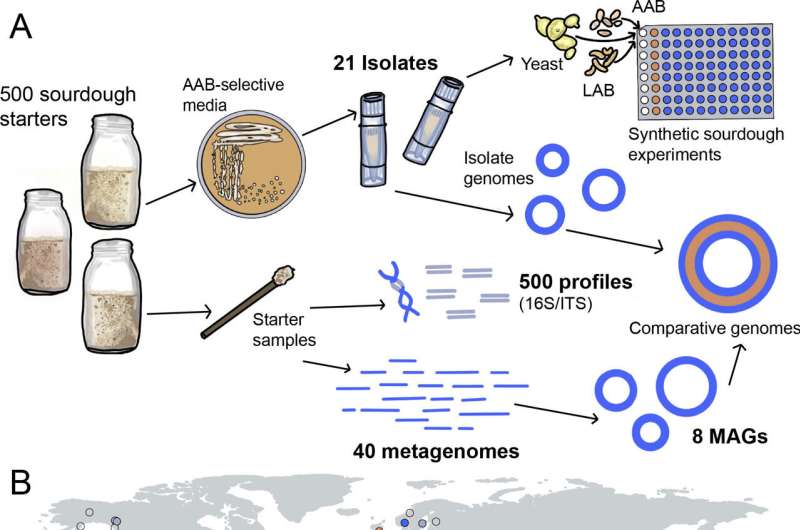
Researchers at Tufts University used microbes isolated from real sourdough starters to test whether simple pairwise interaction models can predict which species coexist in multispecies communities. The team measured growth of isolates alone and in pairwise combinations, built a pairwise interaction model from those data, and then tested the model against mixed communities of up to nine species grown together. The model correctly predicted coexistence and relative abundances for most species; only two of nine species deviated strongly from predictions.
The key advance came when the authors incorporated the serial boom-and-bust life cycle that starters undergo - periodic feeding and removal, or serial bottlenecks - into their predictions. Static, continuous-growth models can overestimate exclusion by slow-growing but competitively strong species. By adding the feeding-removal cycles that bakers impose when they refresh and discard starter, the team prevented those mispredictions and improved agreement with observed community composition.

Kasturi Lele et al. framed sourdough starters as a tractable, real-world model system for microbial ecology. The experiments used isolates taken from actual starters rather than lab strains, then assembled communities up to nine species to test how well pairwise data scale to multispecies outcomes. The finding that pairwise measurements are sufficient for most species simplifies the experimental work needed to predict community outcomes, while the serial-feeding correction highlights the importance of temporal structure in maintenance routines.
For the sourdough community, the study has practical value. Feeding schedule, discard fraction, and refresh rhythm are not just ritual - they are ecological forces that bias which yeast and bacteria persist. Bakers interested in preserving a diverse levain or steering flavor profiles can take from this that refresh frequency and how much you remove matter. A starter kept on a tight refresh schedule will experience different selection pressures than one fed less often, and those choices can influence both stability and functionality of the culture.
Beyond home kitchens, the approach offers a template for predicting microbial dynamics in other managed systems. The combination of pairwise interaction data and serial bottleneck modeling could inform how communities behave in food fermentations, farms, hospitals, and the human body, where periodic disturbances and replenishment are common.
What comes next for bakers and community labs is straightforward: think of your refresh routine as part of the recipe for microbial composition. Future work can test how specific feeding intervals and discard rates translate into flavor, gas production, and resilience, turning ecological insight into practical starter management.
This article was produced by Prism’s automated news system from verified source data, official records, and press releases, then run through automated quality and moderation checks before publishing. The system is built and supervised by the people who set the standards it runs under. Read our full AI policy.
Did this article answer your question?