Sourdough Paska Brings Ukraine's Easter Bread Into the Modern Home Bakery
Ieva Greber's sourdough paska converts Ukraine's towering Easter ceremonial loaf for home bakers who keep a starter, using long fermentation to deepen its egg-and-butter richness.
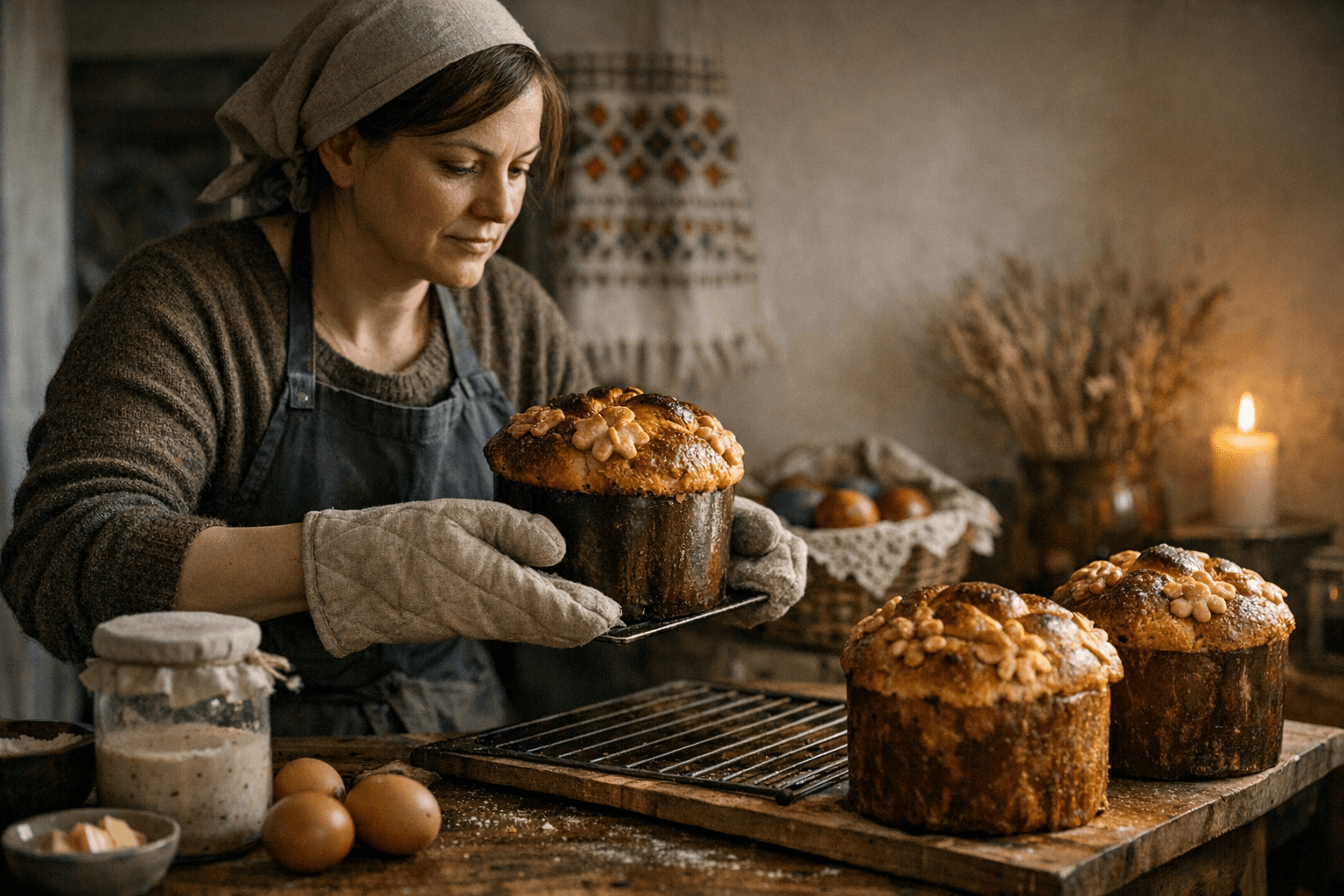
Few breads carry as much weight as paska. The tall, burnished Ukrainian Easter loaf has traveled in wicker baskets to Orthodox churches on Holy Saturday for centuries, blessed before the Resurrection liturgy and eaten at the table that breaks the Lenten fast. Now, food writer Ieva Greber of Somebody Feed Seb has mapped it onto the sourdough process, giving home bakers who maintain a starter a tested route into one of Eastern Europe's most cherished ceremonial bakes.
What Paska Actually Is
Paska is an enriched bread, which puts it in the same territory as brioche or Italian Pane di Pasqua: a dough made deliberately heavy with eggs, butter, milk, and sugar, then leavened and baked tall in a round tin. The word itself traces back to the Imperial Aramaic *pasḥā*, meaning Passover, and it spread across Central and Eastern Europe through Orthodox and Eastern Catholic traditions rooted in the ancient Byzantine world. In Ukraine specifically, the loaf belongs in the Easter basket, or *koshyk*, alongside *pysanky* (decorated eggs), *kovbasa* (sausage), butter, and salt. The basket is brought to church on Holy Saturday to be blessed; after the Resurrection liturgy, it comes home and the feast begins. Paska is not merely a recipe. It is a ritual object that happens to be edible.
Traditionally, paska was leavened with fresh yeast. Greber's approach converts it for an active sourdough starter, a shift that does more than swap one leavener for another. Natural fermentation introduces organic acids and aromatic compounds that, in an enriched dough, sharpen what might otherwise be a one-dimensional sweetness. The fat and eggs don't disappear; they become richer context for the starter's complexity.
The Ingredient Architecture
Getting the structure right starts with flour. Greber specifies strong white flour, the higher-protein option that builds the gluten network capable of holding a tall, domed loaf. In an enriched dough, gluten has to support not only the gas from fermentation but also the weight of eggs, butter, and any fruit or add-ins folded into the crumb. Weak flour risks a loaf that spreads or collapses before it sets.
The enrichment comes from eggs, butter, milk, and sugar. Each plays a role beyond flavor:
- Eggs contribute protein and emulsifying lecithin, which helps fat integrate smoothly and gives the crumb its characteristic tender, almost cake-like pull.
- Butter must go in softened, not melted; cold butter fights the dough, while melted butter can interfere with gluten development before the network is established.
- Milk should be warm but not hot: hot milk risks killing the starter before fermentation begins, while cold milk slows hydration and inhibits rise.
- Sugar feeds the starter, aids browning, and carries the ceremonial sweetness that marks paska as a festive bread rather than an everyday loaf.
For the starter itself, Greber is clear: it needs to be active and bubbly. An enriched dough is harder to leaven than a lean country loaf, so beginning with a starter at or just past peak activity gives the fermentation the headstart it needs.
Aromatics and the Question of Cardamom
Paska's scent is part of its identity. Greber lists three aromatic options: cardamom, orange zest, and vanilla. Each produces a different register. Vanilla pushes the loaf toward the familiar, softly sweet profile that reads as celebratory to most palates. Orange zest gives brightness and cuts through the richness of butter and egg. Cardamom is the traditional choice, but Greber notes its subtlety in classic versions: used lightly, it reads as warmth and depth rather than the pronounced spice of, say, a Scandinavian bun. For bakers new to paska, starting with orange zest and a small amount of cardamom together is one way to access the traditional aromatics without overwhelming a first attempt.
Building the Crumb: Dried Fruit, Marzipan, and Modern Variations
The crumb of a traditional paska carries dried fruit. Greber's version incorporates sultanas and dried apricots, the apricots bringing a jammy tartness that punctuates the richness. What makes her guide particularly useful for contemporary bakers is the range of variations she names. Sweetness can be adjusted up or down to suit family tradition; some households pass down a paska that is barely sweet, almost bread-like, while others expect a loaf that sits closer to the dessert end of the spectrum.
The most striking modern addition is marzipan cubes folded into the dough. Marzipan pockets in the crumb create soft, intensely almond-flavored nodes that melt into the surrounding enriched bread during baking, an unexpected counterpoint to the fruit and the fermentation tang. This is not a traditional element, and Greber presents it as an optional modern embellishment rather than a requirement, but for bakers looking to make the loaf their own it is the kind of detail that becomes a signature variation.
The Fermentation Advantage in Enriched Dough
This is where the sourdough approach earns its place beyond novelty. Standard commercially yeasted paska rises quickly; the fermentation window is measured in hours. A sourdough paska ferments slowly, and the long timeline allows organic acids to develop in the dough matrix. In a lean bread, this expresses as the characteristic tang. In an enriched bread, where fat and sugar blunt sourness, it expresses more subtly: greater aroma depth, a more complex sweetness, and better shelf life due to the acidic environment inhibiting staling. The result is a loaf that tastes considered, rather than simply sweet and rich.
Technique Notes for the Bake
Paska bakes in a round tin to achieve its height. The dough decorations, typically braids, ropes, or crosses applied to the top before baking, are a visible marker of the bread's ceremonial character. They also become structural reference points for slicing once the loaf is cool. Greber's guidance on gluten development is worth taking seriously: enriched doughs can seem deceptively soft and extensible, but they need adequate development to hold their rise through fermentation and the oven spring. Mixing until the dough clears the bowl and passes a windowpane test is worth the effort.
Storing and Serving
Paska keeps well. The enriched crumb, protected by the acidic environment of sourdough fermentation and the moisture from eggs and butter, stays fresh longer than a lean loaf. Greber provides guidance on storage and slicing, and the loaf's density makes it well-suited to being cut into thick portions. At the Easter table it serves both ceremonial and practical purposes: a centerpiece that is also, eventually, breakfast.
For bakers who already keep a starter, paska is the kind of project that makes the effort of maintaining that starter feel worthwhile. It sits at the intersection of cultural history, enriched-dough technique, and the slow-fermentation philosophy that defines the contemporary sourdough movement. Greber's recipe, timed for the days leading into Easter, offers not just a method but a reason to bake something that means something.
This article was produced by Prism’s automated news system from verified source data, official records, and press releases, then run through automated quality and moderation checks before publishing. The system is built and supervised by the people who set the standards it runs under. Read our full AI policy.
Did this article answer your question?