Sourdough signals a premium shift in commercial bread buying
Sourdough is moving from hobbyist prestige to retail signal, even as center-store bread shrinks. The winners are loaves with real fermentation, not just artisan labels.

The bread aisle is getting more selective. What used to be a simple commodity purchase is increasingly behaving like a deliberate choice, and sourdough has become one of the clearest markers of that change. The sales pressure is real, but so is the premium pull: shoppers are still buying bread, only now they are rewarding loaves that look intentional, cleaner, and closer to something made by hand.
The bread aisle is splitting in two
Circana-linked industry figures show a category under strain. In one snapshot, center-store bread dollar sales came in at $11.53 billion for the 52 weeks ended Feb. 22, 2026, down 2.4% year over year, with units down 3.6%. In another look at the category, center-store breads were down 2.1% and center-store sandwich bread was down 2.4% in the 52 weeks ending April 19, 2026. Sandwich bread still dominates the aisle, accounting for 88% of center-store bread volume, but even there the numbers softened: unit sales fell 3.9% and dollar sales slipped 2.8% to just under $10 billion.
That is the signal serious home bakers should notice. The mainstream loaf is not disappearing, but it is no longer enough on its own to lean on convenience and price. Bread is being pulled toward a premium conversation, and sourdough sits right in the center of it.
What counts as real sourdough, and what is just branding
The strongest premium cues are practical, not decorative. Izzio Artisan Bakery describes its breads as starting with a naturally fermented sourdough starter and being crafted in small batches with simple ingredients. Its Organic San Francisco Style Sandwich Bread is made with the brand’s original mother sourdough and is described as having a tangy flavor, porous crumb, and caramelized crust. A product listing says that mother sourdough culture has been living in the bakery since 1994, which gives the loaf a continuity that marketing copy alone cannot fake.
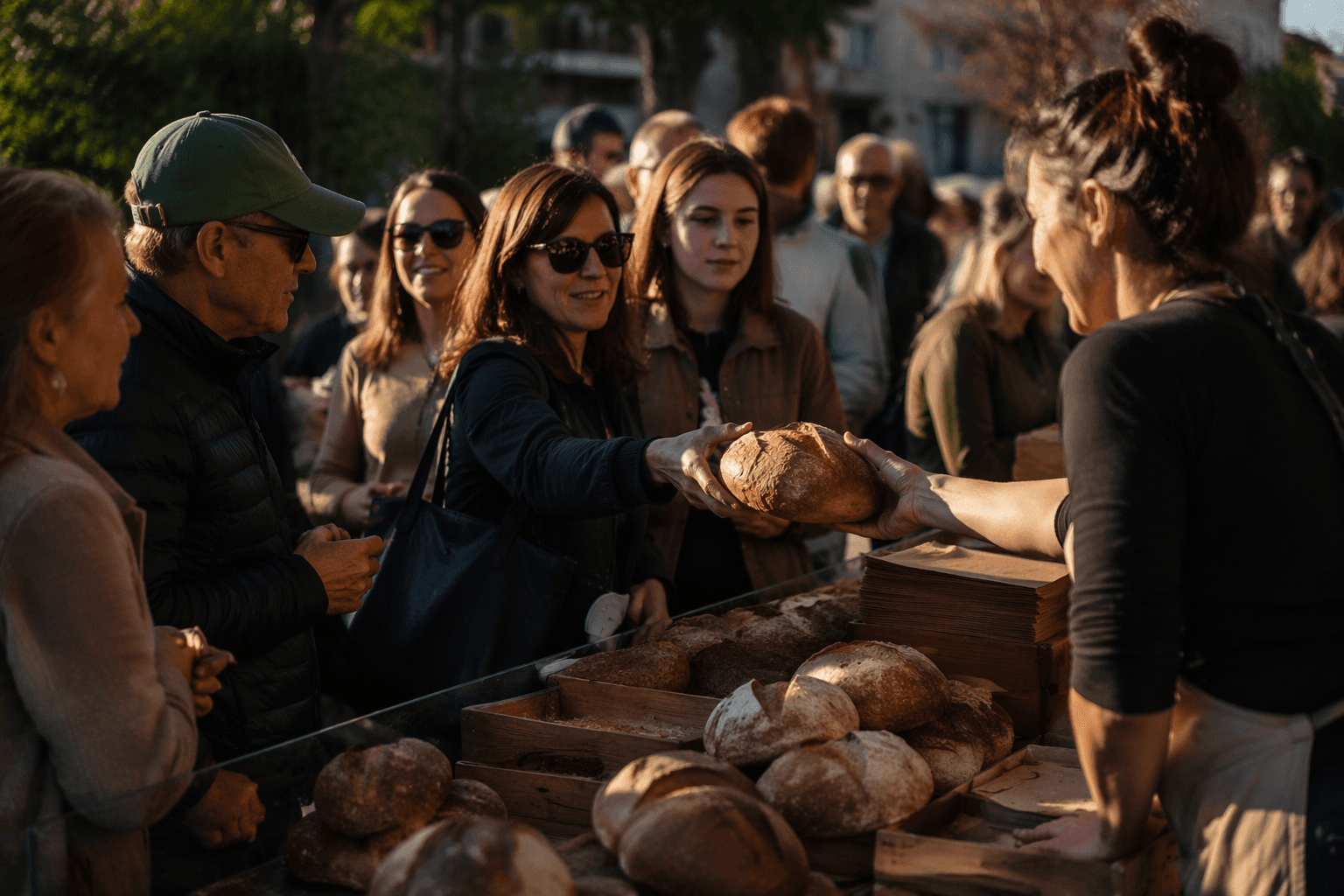
That matters because sourdough is now functioning as a quality shorthand in commercial bread buying. Living cultures, slow fermentation, and short ingredient decks are the real signals. Words like “artisan” and “premium” are only meaningful when they are backed by a process that looks and tastes different from a standard industrial sandwich loaf.
There is also a very specific retail strategy at work. In February 2026, Izzio announced an integrated marketing campaign alongside its sourdough innovation, explicitly contrasting its organic artisan sandwich breads with mainstream sandwich breads made with additives to maximize efficiency and scale. That comparison shows where the category is headed: not just toward a better-tasting slice, but toward a clearer story about how the bread is made.
Why the health language resonates, and where it stops
The health appeal is part of sourdough’s retail power, but it needs to be read carefully. Scientific reviews say sourdough fermentation can improve digestibility, increase nutrient bioaccessibility, and reduce glycemic index compared with regular bread. Those are meaningful differences, yet they are not automatic. The outcome depends on formulation and fermentation conditions, which means a loaf labeled sourdough is not a free pass to every nutrition claim in the aisle.
That nuance is exactly why sourdough is such an effective premium signal. It offers a mix of flavor, texture, and a more plausible wellness story than many bread claims. In practice, shoppers are responding to the feeling that the loaf is doing more, even when the science only supports that feeling under specific conditions.
The pandemic baking boom changed what shoppers expect
This premium turn did not come out of nowhere. King Arthur Baking Company treats sourdough as part of American culinary history, but the modern retail surge was accelerated by the pandemic baking boom. Industry coverage in 2024 said Google Trends searches for “sourdough” had already shown a 3X resurgence since the pandemic period, and a 2025 consumer survey said nearly 30% of U.S. consumers baked more than they had before the pandemic, with sourdough among the most popular choices.
That home-baking experience matters because it educated consumers. Once someone has fed a starter, watched a dough ferment, and learned to read crust and crumb, a supermarket loaf starts to look very different. The result is a more demanding bread shopper, one who is less likely to treat sandwich bread as a blank canvas and more likely to look for signs of fermentation, grain quality, and ingredient restraint.
Why this matters for the shelf, not just the home oven
The market is already rewarding that shift. Research and Markets estimated the global sourdough market at $3.11 billion in 2025, rising to $3.31 billion in 2026 and reaching $4.25 billion by 2030. The growth drivers named in that outlook, artisanal baking, home baking, specialty bakeries, and consumer interest in natural fermentation, line up neatly with what is happening in the bread aisle now.
For serious home bakers, the takeaway is not that every supermarket loaf has become a true sourdough. It is that the commercial bread market is increasingly borrowing the values of sourdough culture: patience, simplicity, and visible fermentation. The labels may still say sandwich bread, but the loaves winning attention are the ones that can point to a starter, a slow process, and a crumb that looks like someone cared. That is the premium shift now showing up where the bread gets bought.
This article was produced by Prism’s automated news system from verified source data, official records, and press releases, then run through automated quality and moderation checks before publishing. The system is built and supervised by the people who set the standards it runs under. Read our full AI policy.
Did this article answer your question?