Sourdough's Lower Glycemic Index Makes It a Smart Choice for Diabetics
Sourdough's GI of 54 beats white bread's 71, and new clinical evidence explains exactly why the fermentation process matters for blood sugar control.
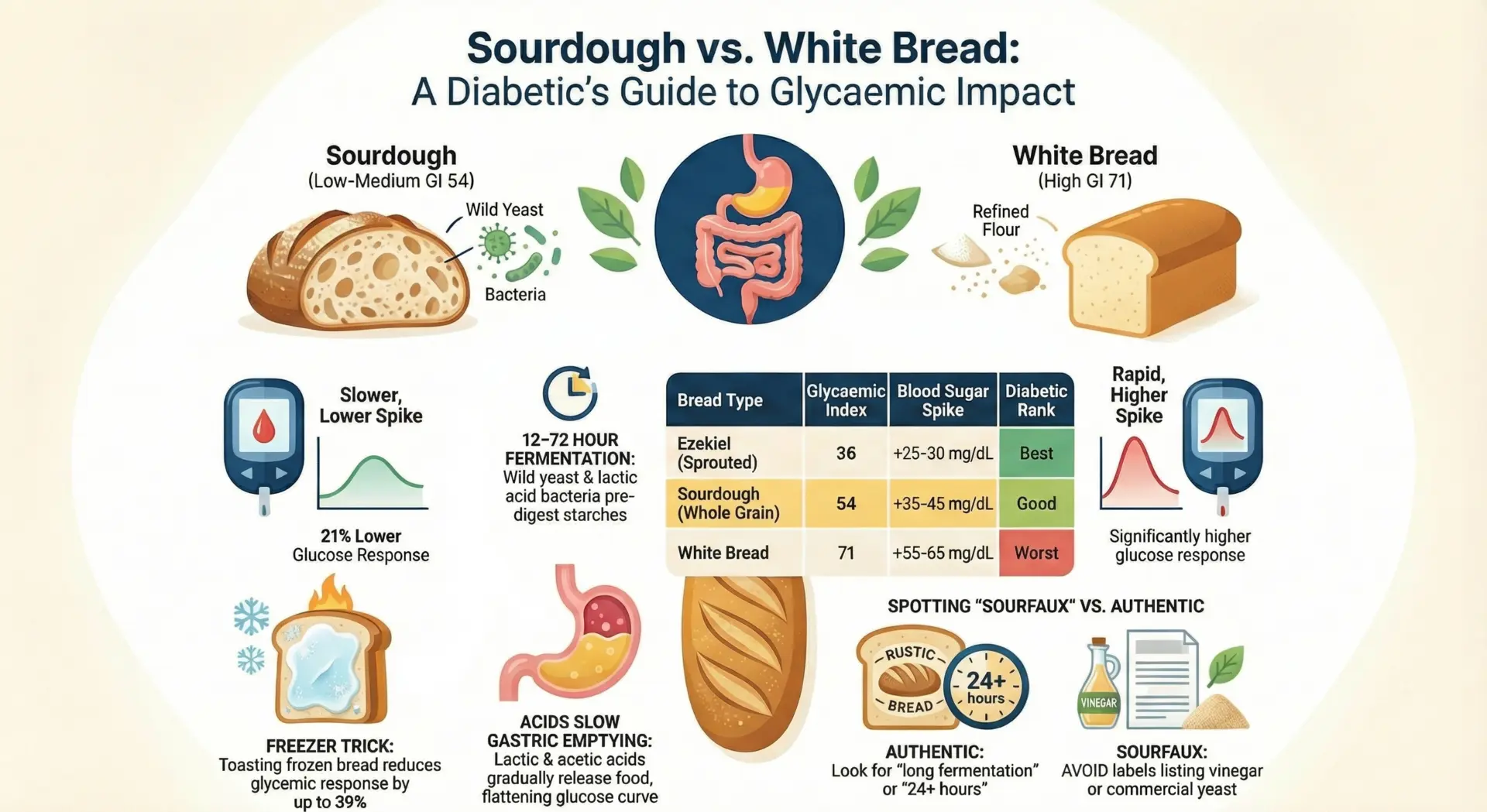
The number that changes the conversation is 54. That's the representative glycemic index value for sourdough bread, according to a medically reviewed guide from Dr. Kristianne Hannemann, PharmD. Compare it to white bread's GI of 71, or standard whole wheat at 68, and the picture becomes clear: the long, slow fermentation that defines a true sourdough isn't just an artisan affectation. It's a biochemical process with measurable consequences for blood sugar, and for people managing diabetes, those numbers matter.
Why Fermentation Changes Everything
The mechanism sits at the heart of what makes sourdough different from every industrially yeasted loaf on the supermarket shelf. During a proper sourdough ferment, lactic acid bacteria are not simply raising the dough; they are actively transforming its starch structure. The bacteria partially break down starches, alter how those starches are organized at a molecular level, and produce organic acids, primarily lactic and acetic acid, that slow the rate at which digestive enzymes can access and break down carbohydrates in the gut.
The result is a bread that digests more slowly than its GI-equivalent competitors. Instead of a sharp postprandial blood-glucose spike, the body sees a more gradual, attenuated rise. Both sourdough fermented breads give glycemic responses significantly lower than conventionally leavened breads, a finding that has now been replicated across multiple controlled trials. The organic acids generated during fermentation also increase the proportion of resistant starch in the finished loaf, a fraction of carbohydrate that bypasses small intestine digestion almost entirely and feeds beneficial gut bacteria instead.
The Clinical Evidence Behind the Claim
Sourdough's glycemic benefit is not anecdote dressed up as science. Dr. Hannemann's guide cites two significant 2024 publications: a systematic review published in *Critical Reviews in Food Science and Nutrition* and a 2024 meta-analysis examining controlled trials, both of which demonstrate lower postprandial glucose responses following sourdough consumption compared with industrially fermented bread. A systematic review of clinical trials followed by meta-analysis evaluated the effect of sourdough consumption on glycemic control, adding to a growing body of evidence that moves the conversation well beyond single-study territory.
The distinction between a systematic review and a single trial matters here. Meta-analyses pool results across multiple studies to identify consistent effects, filtering out the noise of individual experimental variation. When two such analyses published in the same year point in the same direction, the signal is worth taking seriously. For home bakers who have spent years intuiting that their long-fermented loaves feel different, the 2024 literature is finally catching up.
Putting the Numbers in Context
A GI of 54 places sourdough in the low-to-medium range, below the threshold of 55 that many clinicians use to define a low-GI food, and meaningfully below both white bread (71) and standard whole wheat (68). The gap between sourdough and white bread represents a 24% reduction in glycemic index, a difference large enough to shift how a food fits into a diabetic meal plan.
But Dr. Hannemann's guide is careful not to let the numbers become a permission slip. Sourdough still contains carbohydrates. Eating several slices will still raise blood sugar, even if the rise is more gradual than an equivalent portion of white bread would produce. The GI difference is meaningful; it is not a free pass. This is a distinction that matters especially for people using insulin or sulfonylureas, where a miscalculated carbohydrate load carries real clinical risk.
If you want to push the GI even lower, sprouted-grain breads are worth knowing about. Ezekiel-style sprouted breads carry a GI of approximately 36, substantially below even well-made sourdough. Sprouting initiates enzymatic activity within the grain itself, further breaking down starch and increasing nutrient bioavailability. For those who want maximum glycemic control, a sprouted-grain sourdough hybrid sits at the leading edge of what bread can offer.

Practical Guidance for the Home Baker
The practical recommendations that emerge from the clinical literature are specific enough to act on:
- Favor whole-grain sourdough. The fiber content of whole-grain flour adds a second layer of glycemic buffering on top of the fermentation effect. A long-fermented whole-wheat or rye sourdough performs better than an equivalent white flour loaf, even if both are genuinely fermented.
- Pair with protein and fat. The glycemic index of a single food tells only part of the story. Eating sourdough alongside eggs, nut butter, avocado, or cheese slows gastric emptying and further blunts the glucose response. A slice of sourdough eaten alone is not the same metabolic event as the same slice eaten as part of a balanced meal.
- Count the carbohydrates. GI measures rate, not quantity. Carbohydrate counting remains essential for people managing diabetes, regardless of how low the GI of a given food may be. One or two slices is the portion range most consistent with blood sugar management goals; exceeding that erases the GI advantage quickly.
- Monitor individually. Because metabolic responses to food vary significantly between people, Dr. Hannemann's guide recommends using a glucose meter or continuous glucose monitor (CGM) to observe how your own blood sugar responds to sourdough. General GI values are population averages; your personal response may be higher or lower.
What This Means for Bakers Who Sell or Share Their Bread
For small-scale bakers who market sourdough at farmers markets or through community-supported bakery programs, the clinical picture here is a useful calibration. The fermentation science supports describing sourdough as a lower-glycemic option compared with conventional bread. What it does not support is positioning any sourdough loaf as inherently safe for all people with diabetes, or making claims that sidestep carbohydrate content entirely.
The fermentation time and method matter enormously. A loaf that spent four hours rising with a small commercial yeast addition and a token splash of vinegar is not metabolically equivalent to a 16-hour cold-retarded sourdough built on a mature, bacteria-rich starter. Authenticity of process is not just a craft value; it is what underlies the glycemic benefit. The organic acids and structural starch changes that lower GI only accumulate with time and with genuinely active lactic acid bacteria. For anyone communicating sourdough's health story accurately, that distinction is where the conversation should start.
The GI of 54 is a number worth knowing. The fermentation biology behind it is worth understanding. And the combination of both, grounded in 2024 meta-analytic evidence and reviewed by clinicians like Dr. Hannemann, gives the sourdough community something it has long deserved: a scientifically defensible reason to keep baking the slow way.
This article was produced by Prism’s automated news system from verified source data, official records, and press releases, then run through automated quality and moderation checks before publishing. The system is built and supervised by the people who set the standards it runs under. Read our full AI policy.
Did this article answer your question?