Sourdough's Unique Acids and Cultures Set It Apart From Commercial Bread
Sourdough's lactic and acetic acids do far more than create tang — they lower blood sugar impact, extend shelf life, and build a living microbial ecosystem no commercial yeast loaf can replicate.
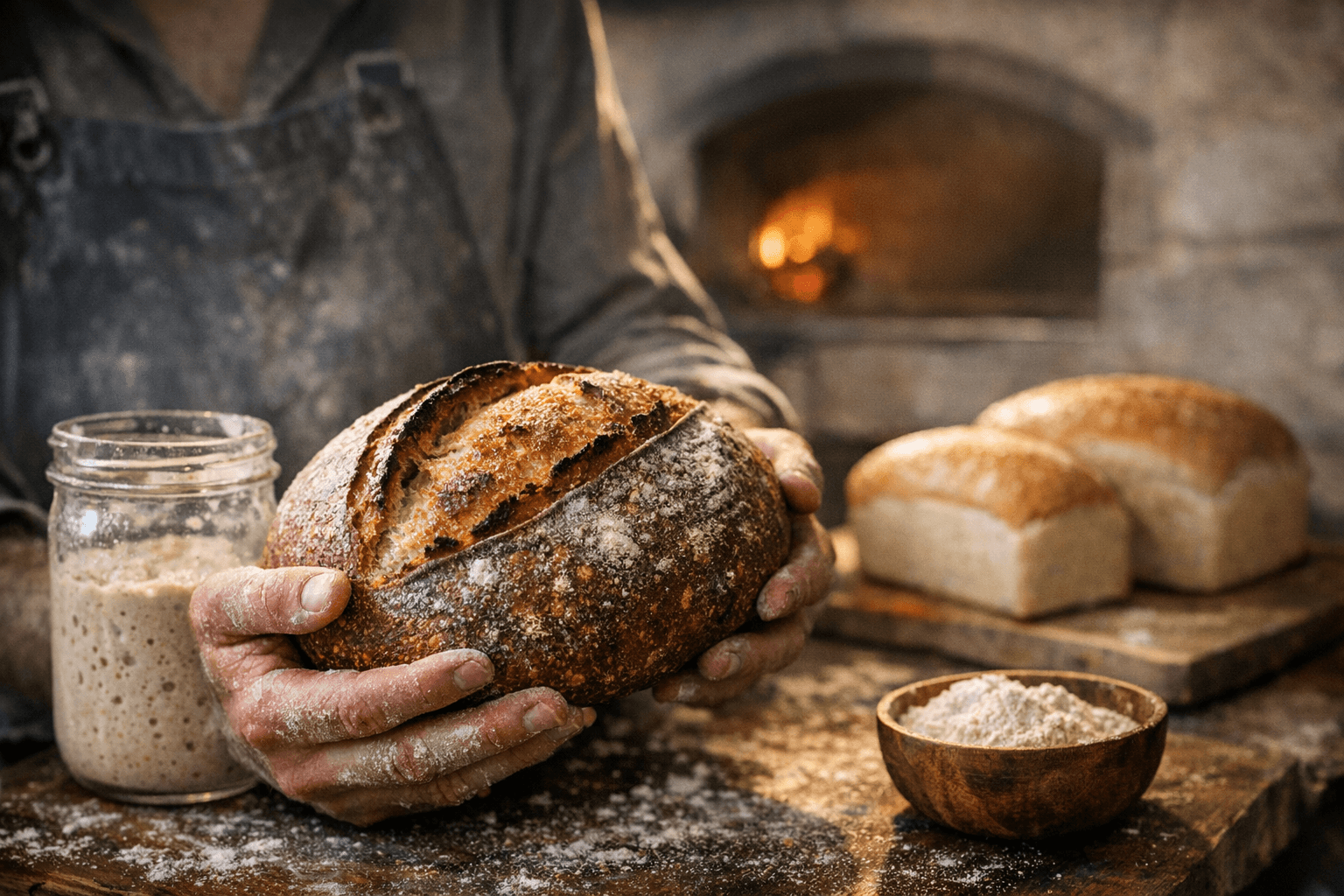
Bread bakers have been coaxing wild microbes into flour and water for a very long time. According to the Encyclopedia of Food Microbiology, one of the oldest sourdough breads dates from 3700 BCE and was excavated in Switzerland, and bread production relied on sourdough as a leavening agent for most of human history; the use of baker's yeast as a leavening agent dates back less than 150 years. That millennia-long head start is not merely a matter of culinary nostalgia. The science now confirms what bakers have always sensed: the fermentation ecology inside a sourdough starter produces acids, structures, and microbial byproducts that no packet of commercial yeast can replicate on its own.
The Living Engine: What a Sourdough Starter Actually Is
Sourdough is the result of fermenting a mixture of flour, water, and other ingredients by lactic acid bacteria (LAB) and yeasts naturally occurring in the flour. That definition sounds simple, but the microbial reality inside a well-maintained starter is far from it. From a microbiological point of view, sourdough is an ecosystem characterized by an environment with a low pH, high carbohydrate concentration, oxygen limitation, and a LAB cell count exceeding that of yeasts. Commercial yeast bread, by contrast, relies entirely on Saccharomyces cerevisiae, a single species selected for speed and predictability. A sourdough starter is a negotiated community; commercial yeast is a monoculture.
Yeast function as the main leavening agent in sourdough, giving it its characteristic bubbles and allowing it to rise by undergoing anaerobic metabolism in the low-oxygen conditions of the starter. During fermentation, the complex carbohydrates in the flour are broken down by various yeast enzymes to yield glucose, which is further broken down into pyruvate through glycolysis, and in the anaerobic environment of the yeast cells, pyruvate is fermented into ethanol, producing carbon dioxide gas as a by-product. That CO2 is the rise. But it is the lactic acid bacteria working alongside the yeast that give sourdough its defining chemical fingerprint.
Two Acids, One Extraordinary Bread
During fermentation, the microorganisms produce carbon dioxide, which increases the volume of the bread, and organic molecules, mainly lactic acid, acetic acid, ethanol, and flavor compounds, such as pyruvate metabolites, higher alcohols, and esters, which create the acidic character of sourdough-containing baked products. Each of those two primary acids plays a distinct role in the final loaf.
Lactic acid is the gentler of the two. It is the milder of the two acids, offering a gentle tanginess reminiscent of yogurt, and apart from its flavor contribution, lactic acid modifies the bread's internal environment, making it slightly acidic. The lactic acid in the sourdough develops its flavors through its slight acidity, improving the overall texture of the sourdough in terms of elasticity and structure, and when sourdough bread is baked, lactic acid is what gives it an airy crumb and a truly crisp crust.
Acetic acid, produced in smaller quantities, carries more punch. Also formed from lactic acid bacteria, acetic acid helps to lower the pH of the dough and plays a role in the transformation of carbohydrates and proteins, while also stabilizing the pH and preventing overfermentation, and like lactic acid, it helps to develop the sourdough's flavors by adding acidity, but also a slightly piquant taste. Due to its stronger antimicrobial properties, acetic acid is particularly effective against fungal growth.
The ratio between these two acids is something every experienced sourdough baker learns to manipulate, even if intuitively. A drier and cooler starter has less bacterial activity and more yeast growth, which results in the bacterial production of more acetic acid relative to lactic acid; conversely, a wetter and warmer starter has more bacterial activity and less yeast growth, with more lactic acid relative to acetic acid. The higher the water content, the higher the production of lactic acid and the lower the production of acetic acid. Chasing a milder, yogurt-forward tang? Feed wet and warm. Want the sharp, vinegary bite of a San Francisco-style loaf? Keep your starter stiffer and cooler.
How the Acids Shape Dough Structure
The acids are not merely flavor agents; they fundamentally alter the physics of bread dough. Acidification improves the interconnectivity in the protein network, identified with Fourier Transform Infrared spectrometry as an increased presence of intermolecular beta-sheets at the expense of intramolecular beta-sheets. In plain terms, a more acidic dough has a stronger, more cohesive gluten network than a non-acidified one. Succinic acid and acetic acid impact the protein secondary structure more than lactic acid, which partly explains why whole-grain sourdoughs, where both acids accumulate in higher concentrations, often develop exceptional structural integrity despite the bran content that typically tears gluten networks apart.
Understanding the balance of lactic and acetic acids in sourdough fermentation is crucial for enhancing the bread's sensory attributes and inhibiting fungal growth on its surface, and achieving this balance involves managing the fermentation process to optimize their concentrations; both lactic and acetic acids lower the pH of the dough, creating an environment that is less favorable for the growth of spoilage microorganisms and fungi.
Blood Sugar and the Glycemic Advantage
One of the most clinically significant differences between sourdough and commercial bread lies in how each affects blood glucose. Commercial bread usually has a high glycemic index of around 70 to 80, while sourdough bread, thanks to the fermentation process, boasts a lower glycemic index of 54.
The mechanism behind this gap runs through the same two organic acids. The organic acids generated during the fermentation process, such as acetic acid, which reduces gastric emptying, and lactic acid, which hinders the availability of starch through interactions with gluten, can lower the postprandial glycemic response in human blood and delay starch digestion. Essentially, the acids slow down the rate at which your body can access the carbohydrates in each slice.
Clinical evidence supports this mechanism. A systematic review of clinical trials found that sourdough is effective in reducing the increment of postprandial glycemia, especially when prepared with whole wheat flour. When four breads prepared from two wheat flours, leavened through two processes (sourdough and Saccharomyces cerevisiae), were fed to eight healthy volunteers, both sourdough fermented breads showed a significantly lower glycemic response with respect to the breads leavened with S. cerevisiae, and the presence of fiber did not seem to influence the breads' glycemic potential. That last point is important: the glycemic advantage appears to come from the fermentation itself, not from added fiber.
Research has confirmed that the resistant starch content increases after fermentation, while rapidly digestible starch, the hydrolysis index, and the estimated glycemic index all decrease. More resistant starch means slower digestion; slower digestion means a gentler blood sugar curve.
The Shelf Life Science: Natural Preservation Without Additives
Sourdough's acid-driven chemistry extends well beyond the eating experience. During fermentation, the bacteria in a sourdough starter produce lactic and acetic acids, which lower the bread's pH, creating an environment hostile to mold and other spoilage organisms; a typical sourdough loaf has a pH around 4.2 to 4.4, while conventional bread sits closer to 5.8 or 6.5. That pH differential is the difference between a loaf that invites mold and one that resists it.
In lab tests comparing sourdough bread to regular bread stored for 14 days, half the regular loaves showed visible mold on the crust; by day 21, every single control loaf had mold, while the sourdough loaves held up significantly longer. Acetic acid, the sharper of the two acids, is particularly effective at suppressing fungal growth. These acids act as natural preservatives, which is why a well-made sourdough loaf can outlast commercial breads that rely on chemical additives to stay fresh.
Sourdough also resists staling. Sourdough resists staling better than regular bread because the acid conditions from fermentation slow down starch recrystallization and alter the gluten structure in ways that keep the crumb softer for longer; research comparing sourdough to regular bread over a 7-day storage period found that sourdough consistently had lower hardness values and a slower staling rate.
One important caveat: not every "sourdough" loaf at the grocery store earns those benefits. Not all bread labeled "sourdough" at the grocery store is made with a true sourdough culture; many commercial versions use regular yeast with added flavoring to mimic the tang, plus preservatives, dough conditioners, and sugar, and these loaves behave more like conventional bread when it comes to shelf life. Check the ingredient list: genuine sourdough is made from flour, water, salt, and a starter culture.
Beyond Flavor: The Postbiotic Picture
The acids are the headliners, but sourdough fermentation produces a much larger cast of biologically active compounds. Sourdough fermentation is studied for its potential health effects due to the presence of postbiotic-like components, which refer to a group of inanimate microorganisms and/or their components that confer health benefits on the host; some postbiotic-like components reported in sourdough are non-viable microorganisms, short-chain fatty acids, bacteriocins, biosurfactants, secreted proteins/peptides, amino acids, flavonoids, exopolysaccharides, and other molecules.
Sourdough fermentation results in a decrease in the phytic acid content of dough and bread that increases mineral bioavailability; sourdough fermentation also leads to an increase in phenolic compounds, protein digestibility, and dietary fiber content of the final bread. Many in vivo studies in humans have associated the consumption of sourdough bread with higher satiety, lower glycemic responses, increased postprandial concentrations of short-chain fatty acids, and improvement in the symptoms of metabolic conditions.
The starter's microbial community also does something particularly elegant with fatty acids. Metabolites from the conversion of fatty acids by specific LAB strains may contribute to the prolonged storage life of sourdough bread; research demonstrated that Levilactobacillus hammesii converts linoleic acid to a monohydroxy octadecenoic acid, preventing fungal spoilage of bread without adversely impacting on the sensory properties. A bacterium, working invisibly inside the dough, engineers its own preservative out of an available fat. Commercial yeast cannot do that.
What Separates True Sourdough from Everything Else
The differences between sourdough and commercial yeast bread stack up at every level: microbial diversity, acid profile, gluten structure, glycemic response, shelf life, and nutritional composition. Temperature, pH, fermentation time, and the composition of lactic acid bacteria and yeasts in sourdough can all impact the nutritional and sensory properties of bread and the postbiotic-like effect. This is precisely why two sourdoughs, baked in different kitchens from different starters, can taste and behave so differently from each other, and so differently from anything made with a commercial yeast packet.
Some starters are hundreds of years old and have been passed down through generations, making them a living piece of history; the act of discarding some starter during feeding has led people to give away their extra starter to friends, family, and even strangers, and this sharing has helped create a welcoming community of sourdough enthusiasts around the world. The science behind sourdough's superiority over commercial bread keeps accumulating. The starter you feed tonight is participating in a fermentation tradition that predates written language, and it is doing so with a biochemical complexity that modern food science is still working to fully characterize.
This article was produced by Prism’s automated news system from verified source data, official records, and press releases, then run through automated quality and moderation checks before publishing. The system is built and supervised by the people who set the standards it runs under. Read our full AI policy.
Did this article answer your question?