The Living Science Behind Your Sourdough Starter, Explained
Your sourdough starter contains over 60 types of bacteria and 80 kinds of yeast — and scientists say they still don't fully understand a technology that's 12,000 years old.
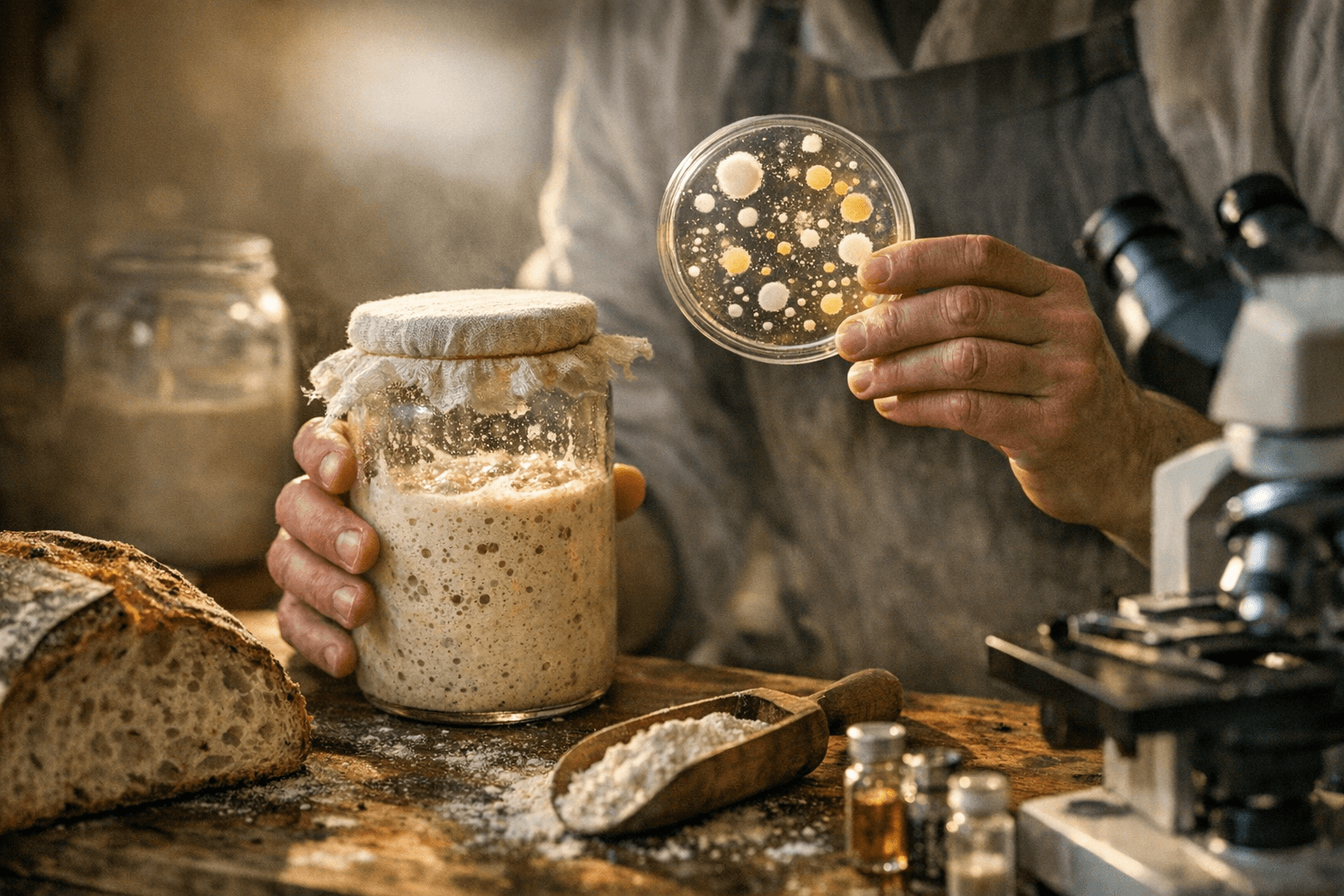
Microbiologist Anne Madden of North Carolina State University put it plainly: "When we study sourdough science, we learn that we know remarkably little for a technology that's — what? — 12,000 years old." That admission, coming from someone who has spent years sequencing the contents of bakers' starters, is the most honest summary of where the science stands. The jar on your counter is not just a fermentation vessel — it's a functioning, self-regulating ecosystem, and it's far more complex than most bakers realize.
What's Actually Living in There
The live microorganisms that inhabit sourdough starters are responsible for the unique aspects of sourdough bread, including its flavor and extended shelf life. At the broadest level, what we know with certainty is that they include lactic acid bacteria and yeast. The yeasts cause the dough to rise by creating carbon dioxide bubbles, while the lactic acid bacteria provide the sour flavor in the form of acetic acid and lactic acid, and preserve the bread by lowering its pH, which prevents the growth of foodborne pathogens.
But the numbers are staggering. Research over the years has uncovered more than 60 types of bacteria and over 80 kinds of yeast in sourdoughs from different regions of the world. Earlier studies identified more than 50 species of lactic acid bacteria, mostly Lactobacillus spp., and more than 20 species of yeast, mostly Saccharomyces spp. and Candida spp., living in sourdough starters. The gap between those older figures and current counts reflects how quickly new species keep turning up as sequencing technology improves.
Despite this diversity, most starters settle into a surprisingly orderly structure. Where conventional breads rely on a single species of baker's yeast — the microbial equivalent of a cattle ranch — sourdough is more like the Serengeti, a diverse ecosystem of interacting yeasts and bacteria. And yet, as Lawrence Uricchio, an assistant professor of biology at Tufts University, notes: "Sourdough starters include a wide diversity of microbes overall, yet within these starters, certain species consistently appear together in non-random patterns." Most starters, despite all that biodiversity, contain just a handful of bacterial species and one or two dominant yeasts.
The Bacteria-Yeast Partnership
The relationship between LAB and wild yeast is not mere cohabitation — it's a finely tuned metabolic exchange. The leavening effect comes from carbon dioxide produced by yeast, but the yeast can't digest all the sugars in flour. That's handled by bacteria, usually lactic acid bacteria, which metabolize those other sugars via anaerobic lactic acid fermentation, with byproducts the yeast can metabolize in turn. In terms of sheer numbers, lactic acid bacteria far outnumber yeast cells in a mature sourdough starter — by roughly 100 to one.
The lactic acid bacteria metabolize sugars that the yeast cannot, while the yeast metabolizes the by-products of lactic acid fermentation. It's a mutual dependency: without each other, pure cultures of yeasts and LAB can be invaded by other microbes, and if left unchecked, both yeasts and LAB will produce more alcohol and acid than even they can tolerate. The stability you see in a well-maintained starter is the result of this ongoing negotiation between kingdoms.
Where the Microbes Come From
Scientists are beginning to discover that the microbes in a sourdough depend not just on the native microbial flora of the baker's house and hands, but also on other factors like the choice of flour, the temperature of the kitchen, and when and how often the starter is fed. A landmark study by Reese et al. examined sourdough starters prepared by 18 professional bakers using a standardized recipe, and found that the microbial communities found in the starters were overall most similar to that found in the flour; therefore, most of the bacteria and yeast arrive with the flour.
Flour choice, it turns out, doesn't just affect flavor and hydration — it actively shapes which microbes survive long-term. Researchers at North Carolina State University led by evolutionary biologist Caiti Heil, Ph.D., found that starters made with whole wheat flour contained higher levels of Companilactobacillus, while those made with bread flour had more Levilactobacillus. What stayed constant regardless of flour type? Yeasts from the genus Kazachstania were consistently the most common across all starters — Kazachstania emerged as the leading yeast in every starter, regardless of flour type or feeding schedule.
What Large-Scale Surveys Reveal
One of the most significant shifts in understanding has come from citizen science and large-scale starter surveys. A landmark study combining starter diversity with functional analysis found that each starter sample contained a median of seven bacterial and 35 fungal amplicon sequence variants. In a survey of 500 starters, Lactobacillus plantarum and L. brevis were the most commonly observed pair of co-occurring bacteria, found together in 177 of 500 starters.
Survey data also exposed just how geographically variable starters can be. As Anne Madden observed, "preliminary assessments reveal that some starters vary drastically in composition, even when they are found geographically close to one another." Researchers also found over 70 different types of yeast in sourdough starters, which contrasts sharply with the common practice of baking bread with only three strains of Saccharomyces cerevisiae. These yeasts vary based on geographic location due to climate.
One significant finding from the Tufts University research is especially reassuring for anyone who has ever worried about their starter collapsing: "The microbial communities in sourdough starters appear remarkably stable. They seem to live quite a long time and to resist invasions by other microbes," says Uricchio. "So perhaps it's not surprising that some people keep these starters going for many years without them spoiling."
Why Feeding Is Biology, Not Just Ritual
Understanding the microbiology turns feeding from a chore into a genuinely purposeful act. When you feed your sourdough starter, the yeast and lactic acid bacteria consume starches and sugars in the flour, and they create byproducts — alcohol and acid — in your starter. These byproducts eventually choke off the yeast and make it difficult for the yeast to reproduce or create carbon dioxide. Feeding resets those conditions.
There are two basic maintenance options: keeping your starter at room temperature and feeding it daily, or storing it in the refrigerator and feeding it weekly. The choice is fundamentally about how fast you want your microbial community cycling through its fermentation stages.
- If you plan to bake with your starter often, keep it on your counter and feed it daily: the organisms in starter thrive at room temperature.
- If you plan to bake less frequently, store it in the refrigerator, knowing it will need a few feedings at room temperature before it's ready for use.
- A healthy starter has a low pH (high acidity) which preserves it at room temperature and creates a hostile environment for other bacteria and pathogens — similar to the way fermented foods keep from spoiling without refrigeration.
Temperature also directly governs the speed of fermentation. The sourdough starter is most active between 24°C and 28°C (75°F to 82°F). Go warmer and your microbes burn through their food supply faster; go cooler and fermentation slows considerably. You have to adjust your starter feeding routine to match your baking frequency, the flour you plan to have on hand, the temperatures currently in your kitchen, and also to time your sourdough starter ripening with your daily schedule.
A ripe, ready-to-use sourdough starter will smell acidic, have a bit of a shine, be light and airy, and have a texture somewhat similar to whipped cream. That sensory window is your best real-time signal — and it's one no timer or formula can fully replace.
The Bigger Picture
Sourdough starters have become one of the most useful experimental systems in microbial ecology precisely because they are both ancient and observable. "We can use sourdough as an experimental evolution framework, to see what happens over time," says evolutionary biologist Caiti Heil. The findings emerging from starter research extend far beyond bread: many real-world microbial communities experience the same kind of boom-and-bust cycles seen in sourdough starters — for example, a course of antibiotics can sharply reduce microbes in a patient's gut, creating a temporary opening for harmful bacteria normally kept in check by other beneficial microorganisms.
After a few days of combining just flour and water, a symbiotic microbial community blooms, ready to help create a loaf of sourdough bread — each starter containing a unique blend of microbes that create a "secret sourdough bread recipe," secret not only to the baker, but also to those they share it with or pass it down to through the generations. The science is increasingly sophisticated, but that essential mystery — the reason you can share a piece of your starter with a friend across the country and produce a completely different loaf — remains stubbornly intact.
This article was produced by Prism’s automated news system from verified source data, official records, and press releases, then run through automated quality and moderation checks before publishing. The system is built and supervised by the people who set the standards it runs under. Read our full AI policy.
Did this article answer your question?