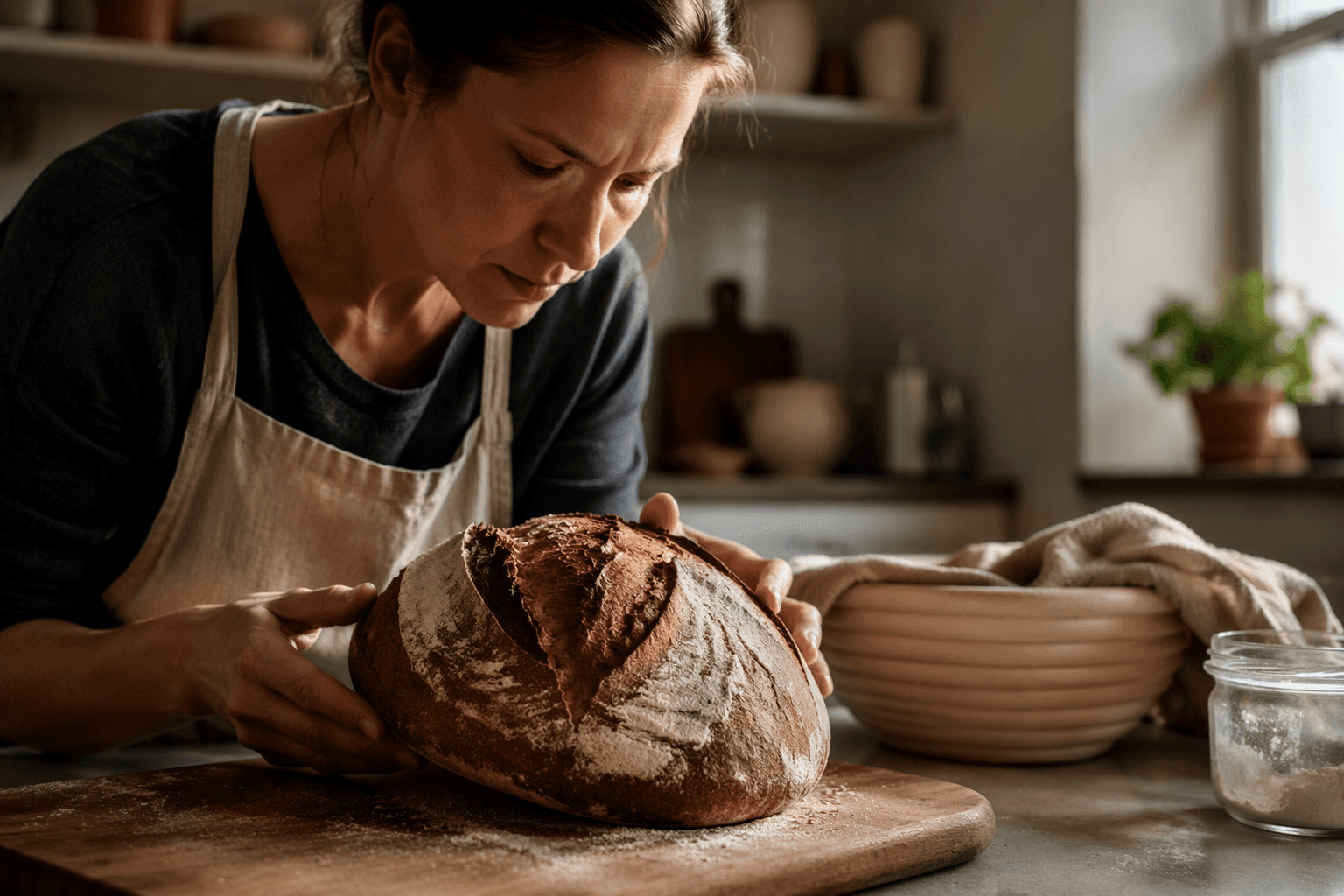
Whole-Wheat Sourdough Made Stable, Flavorful, and Crumble-Free
Crumbly whole-wheat loaves meet their match with the right starter ratios, temperature controls, and a proven step-by-step formula.
Whole-wheat sourdough has a reputation problem. The flavor is extraordinary, the nutrition profile is compelling, and yet so many bakers pull a loaf from the oven only to watch it fall apart at the first slice. The culprit is almost always the same: whole grain flour's high bran content physically cuts through gluten strands during fermentation, weakening the structure that holds a loaf together. Getting past that wall requires a deliberate approach to formula, starter management, and temperature, not guesswork or crossed fingers.
Why whole-wheat loaves crumble
Bran is the outer shell of the wheat kernel, and it does not play nicely with gluten development. When you increase your whole-wheat percentage beyond what a standard sourdough formula accounts for, those sharp bran particles act like tiny blades, interrupting the gluten network before it has a chance to fully develop. The result is a dense, fragile crumb that crumbles under pressure rather than tearing cleanly the way a well-structured loaf should. Understanding this mechanism is the first step toward fixing it, because every corrective technique flows directly from this single problem.
Getting your starter ratio right
The starter is where stability begins. With whole-wheat doughs, the fermentation activity is more aggressive than with white flour because whole grain flour carries more wild yeast and bacterial food on the surface of the bran itself. That means an overly large starter inoculation will push fermentation too fast, exhausting the dough before the gluten network has time to organize itself. A moderate inoculation rate, typically in the range of 15 to 20 percent of total flour weight, gives you enough leavening activity without burning through your fermentation window prematurely.
The hydration of your starter also matters more with whole-wheat doughs. A stiffer starter, maintained at roughly 50 to 60 percent hydration rather than the standard 100 percent, develops more acetic acid and produces a tighter, more resilient gluten structure in the final dough. Liquid starters are perfectly functional for white-flour loaves, but when you're already fighting bran interference, the additional structural support from a stiffer levain is worth the minor inconvenience of maintaining a separate culture.
Building the formula
A reliable whole-wheat formula does not simply swap whole-wheat flour into a white-flour recipe. You need to account for the increased water absorption of whole grain flour, the accelerated fermentation timeline, and the reduced gluten strength by making deliberate compensations across the entire formula.
Start with a flour blend rather than going 100 percent whole-wheat out of the gate. A ratio of 70 percent whole-wheat to 30 percent high-protein bread flour (13 percent protein content or higher) provides enough strong gluten from the bread flour to counteract bran interference while still delivering the deep, nutty flavor profile that whole-wheat is known for. If you want to push toward higher whole-wheat percentages, increase by no more than 10 percent at a time and adjust hydration and fermentation accordingly.
Hydration for this style of loaf works well in the 75 to 80 percent range. Whole-wheat flour absorbs water more slowly than white flour, so autolyse becomes essential rather than optional. A 45-minute autolyse, before you add your starter and salt, allows the flour to fully hydrate and gives bran particles time to soften slightly, reducing their sharpest gluten-cutting effects before fermentation even begins.
Temperature control as a structural tool
Temperature is the variable most bakers underestimate, and it is especially consequential with whole-wheat doughs. Fermentation in whole-wheat progresses faster than most recipes suggest, and even a few degrees of variance in your kitchen can mean the difference between a perfectly developed loaf and one that is over-fermented, gummy, and structurally weak.
Target a dough temperature of 76 to 78 degrees Fahrenheit throughout bulk fermentation. At this range, you get active but controlled fermentation, enough time to build strength through your stretch-and-fold sets without racing past the optimal fermentation point. If your kitchen runs warmer than this, shortening your bulk fermentation time is not sufficient compensation; you need to use cooler water to bring your final dough temperature into range from the very beginning.
A cold proof in the refrigerator, typically 10 to 14 hours at 38 to 40 degrees Fahrenheit, serves a dual purpose with whole-wheat loaves. It slows fermentation to a crawl, allowing flavor development to continue without structural degradation, and it firms up the dough significantly, making scoring cleaner and reducing the risk of the loaf spreading rather than rising during the bake.
The bake itself
Baking whole-wheat sourdough in a covered Dutch oven remains the most reliable method for home bakers. The trapped steam during the first phase of the bake keeps the crust pliable long enough for full oven spring before the loaf sets. Preheat your Dutch oven at 500 degrees Fahrenheit for at least 45 minutes. Bake covered for 20 minutes, then remove the lid and reduce heat to 450 degrees Fahrenheit for another 20 to 25 minutes, until the crust reaches a deep amber color and the internal temperature hits 205 to 210 degrees Fahrenheit.
That internal temperature target is non-negotiable for whole-wheat loaves specifically. Under-baked whole-wheat bread is gummy and prone to collapsing when sliced, which is often misdiagnosed as a crumbling problem when it is actually an underbake problem. A probe thermometer is not optional equipment here; it is the only reliable way to confirm your loaf is fully baked through the center.
Cooling and slicing
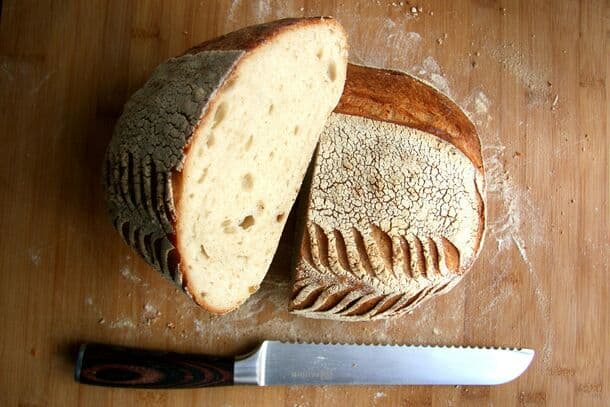
Cutting into a sourdough loaf too early is one of the most common mistakes in the hobby, and with whole-wheat it is even more damaging than with white-flour loaves. The crumb continues to set as the loaf cools, with steam redistributing through the interior for up to two hours after it comes out of the oven. Slicing before that process completes compresses the crumb and produces exactly the kind of gummy, crumbly texture that makes bakers assume something went wrong in fermentation or shaping.
Give your whole-wheat loaf a minimum of two hours on a wire rack before slicing. If patience allows, three hours produces a noticeably cleaner cut and a more cohesive crumb structure. Store the cut loaf cut-side down on a wooden board rather than wrapping it immediately, which traps residual moisture against the crumb.
Whole-wheat sourdough done right is one of the most rewarding bakes in the repertoire. The combination of precise starter ratios, a thoughtfully constructed formula, disciplined temperature management, and a proper bake transforms what is often a frustrating, crumbly experiment into a loaf with genuine structural integrity, complex flavor, and the kind of open, cohesive crumb that makes every slice worth the effort.
This article was produced by Prism’s automated news system from verified source data, official records, and press releases, then run through automated quality and moderation checks before publishing. The system is built and supervised by the people who set the standards it runs under. Read our full AI policy.
Did this article answer your question?