How to Stay Safe From Flash Floods in Slot Canyons
Storms 30 miles away can kill you in a slot canyon; the April 1 Little Wildhorse Canyon rescue proves spring is every bit as deadly as monsoon season.
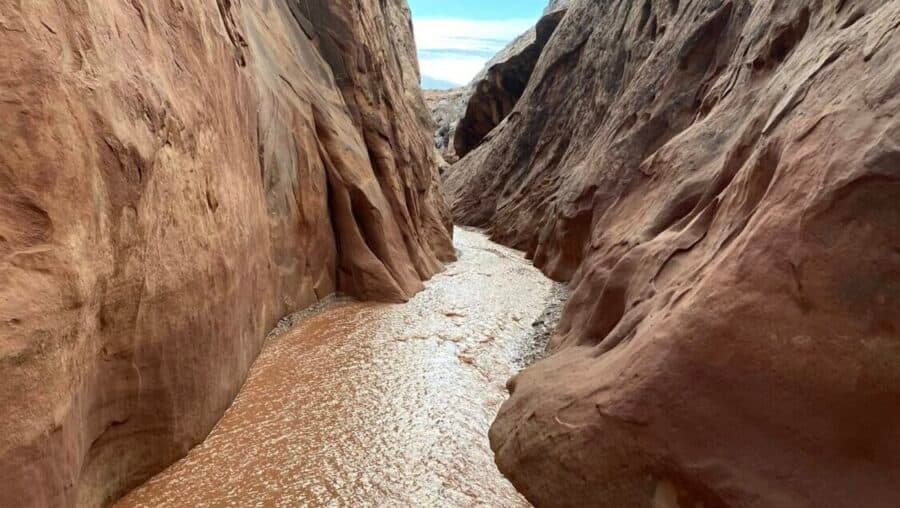
Multiple hikers were swept down Little Wildhorse Canyon near Goblin Valley State Park after heavy rain triggered dangerous flash flooding in southern Utah. The date was April 1, 2026 — and the weather was no joke. Goblin Valley State Park wrote that its rangers had helped to rescue multiple hikers when a flash flood washed them down Little Wild Horse Canyon, just outside the park's boundaries. There was an 80% chance of rain and heavy clouds, pointing toward a high risk of flash flooding. The hikers were described by the park as having survived a "terrifying ordeal," and they were "very lucky" to have only received minor injuries; after locating them, rescuers escorted the hikers back to the trailhead.
Besides Goblin Valley and Emery County SAR, Emery County EMS, Green River State Park, and several other agencies participated in the rescue. That is a sobering number of agencies to mobilize for a single afternoon hike on a popular trail. If that level of consequence can arrive on a spring day with an obvious forecast, it can arrive anywhere in canyon country. This guide gives you the tools to make sure it doesn't arrive for your group.
Why slot canyons are uniquely lethal
The geometry of a slot canyon is the problem. Narrow walls that make these places so photogenic also funnel water with almost no warning and virtually no escape. If you are in a slot canyon with rock walls on either side of you, you could be in danger even if it's not raining directly where you are hiking. Some of these washes and canyons are interconnected for hundreds of miles. The research is unambiguous: thunderstorms twenty or thirty miles upstream can send torrents through a canyon that looks perfectly calm at your feet. The National Weather Service issues specific flash flood watches and warnings for slot canyons. Understanding the difference matters: a watch means conditions are favorable for flooding; a warning means flooding is imminent or already occurring.
Planning and forecasting: the go/no-go decision
Before hiking, check detailed forecasts specifically for your canyon area and the entire upstream watershed. Your local sky is not the relevant data point. Look at weather patterns across the entire watershed, which can stretch over 50 miles upstream. If there is measurable thunderstorm risk anywhere in that basin, the canyon trip does not go. Full stop.
Your primary go/no-go sources should be:
- NOAA/National Weather Service forecasts and active flash flood watches or warnings for the canyon region
- Park and agency flash-flood potential ratings, updated daily at most Colorado Plateau parks
- Visitor center advisories and ranger briefings on morning of entry
- Radar apps that let you scan upstream basins in real time, not just the pin dropped on your trailhead
For commercial operators, the research recommends designating a dedicated staff weather-monitor role for each trip, someone whose only job before and during the outing is tracking the upstream basin. That single structural change has saved lives. Sign up for local park alerts, check in with rangers, and treat their word as binding, not advisory.
Your alternate itinerary is not optional
Every slot canyon trip needs a pre-planned swap ready to execute without debate. Ridge routes, mesa hikes, and scenic drives provide real adventure value without the confined-space flood risk. Identifying these alternatives in advance removes the psychological pressure of a sunk-cost decision in the field ("We drove three hours to get here"). Build the alternate into your trip briefing the night before so that executing it feels like a plan, not a defeat.
In-field warning signs: stop and egress immediately
Warning signs like rising water levels, abrupt temperature drops, or debris being carried by the water demand immediate action: head to higher ground without delay. More specifically, the red flags that require you to move right now are:
- Turbid or muddy water: Sudden cloudiness or floating debris (leaves, sticks, foam) means sediment-laden water is moving in from upstream.
- The roar: A distant rumbling or roaring sound, similar to an approaching train or aircraft, often precedes a flash flood. This noise can sometimes be heard several minutes before the water arrives, providing a critical window for evacuation.
- Wind gusts funneling down the canyon: Flood-driven air displacement pushes ahead of the water. If you feel a sudden gust in still weather, treat it as water incoming.
- Any rise in water depth: Even small increases are dangerous in a narrow canyon. Do not attempt to cross a rising channel or shelter in a low alcove.
If caught in a flash flood and unable to exit safely, stay out of the water at all times and head for higher ground immediately, without trying to pack up gear. In a slot canyon, even moving a few vertical feet higher can be the difference between survival and being swept away. Get up and stay up until the watershed has fully cleared, which can take hours after the upstream storm has passed.
Evacuation and group management
Brief every participant on the egress plan before entering the canyon, not while water is rising. The pre-trip briefing should name the nearest high ground at each section of the route, identify who will sweep the rear, and establish a headcount protocol so no one is left behind in a scramble. In narrow canyons, the sweep role is critical: the last person out confirms everyone ahead of them has moved.
Communication redundancy is non-negotiable. Carry a satellite messenger or personal locator beacon (PLB) for terrain where cell service drops, which is most slot canyon interiors. Ensure someone not on the trip knows your exact planned route, entry and exit points, and your expected return time. That information is what SAR teams need to find you fast.
Equipment and training
Helmets are wise wherever rockfall or surging debris is a realistic hazard, and in a flash flood those hazards arrive simultaneously and without warning. Trip leaders on technical routes should carry throw ropes and hold training in low-angle technical evacuations. The broader skill set that NPS canyoneering safety guidance supports includes certified or trained competency in canyoneering techniques, swiftwater awareness, and group rescue basics. These are not theoretical credentials: the Little Wildhorse Canyon rescue required a coordinated multi-agency response precisely because the group was caught without the skills or positioning to self-rescue.
For operators: liability, waivers, and client communication
Waivers need to explicitly name flash-flood hazards, and your emergency procedures must align with the local search-and-rescue and medevac resources for your specific operating area. That alignment means knowing who to call, on what frequency, and what your PLB registration connects to.
Client communication starts at booking. Provide explicit weather contingency language that describes the go/no-go standard and what happens to the reservation if conditions are unsafe. Pre-trip weather-based credits or alternate-date options remove the client's financial incentive to push you toward a dangerous call. Revisit that language again at the trip briefing. A client who has heard the flash-flood protocol twice is a client who moves immediately when you say move.
Monsoon season and beyond
Monsoon season, which runs from mid-July to mid-September, is when flash floods have the highest probability of occurring. But the Little Wildhorse Canyon rescue happened on April 1, well outside that window, with an 80% rain forecast that went unheeded. Spring convective storms and early-season fronts carry the same watershed dynamics as monsoon cells. The canyon does not care what month it is.
Zion National Park's canyoneering safety guidance, the National Weather Service's slot canyon flash flood information pages, and real-time radar tools covering the Colorado Plateau are the three resources worth bookmarking before any canyon season trip. Together they give you the upstream picture your local sky will never show. Use them every time, without exception, because the cost of skipping that check is one that no amount of downstream rescue effort can fully undo.
This article was produced by Prism’s automated news system from verified source data, official records, and press releases, then run through automated quality and moderation checks before publishing. The system is built and supervised by the people who set the standards it runs under. Read our full AI policy.
Did this article answer your question?