Southwest Wildlife Encounters: Prevention and Safety for Every Adventure Trip
Two real-world rescues in the past week, one involving 100+ bee stings and a helicopter hoist, expose the exact gaps Southwest adventurers need to close before their next trip.
What the Last Seven Days Actually Look Like
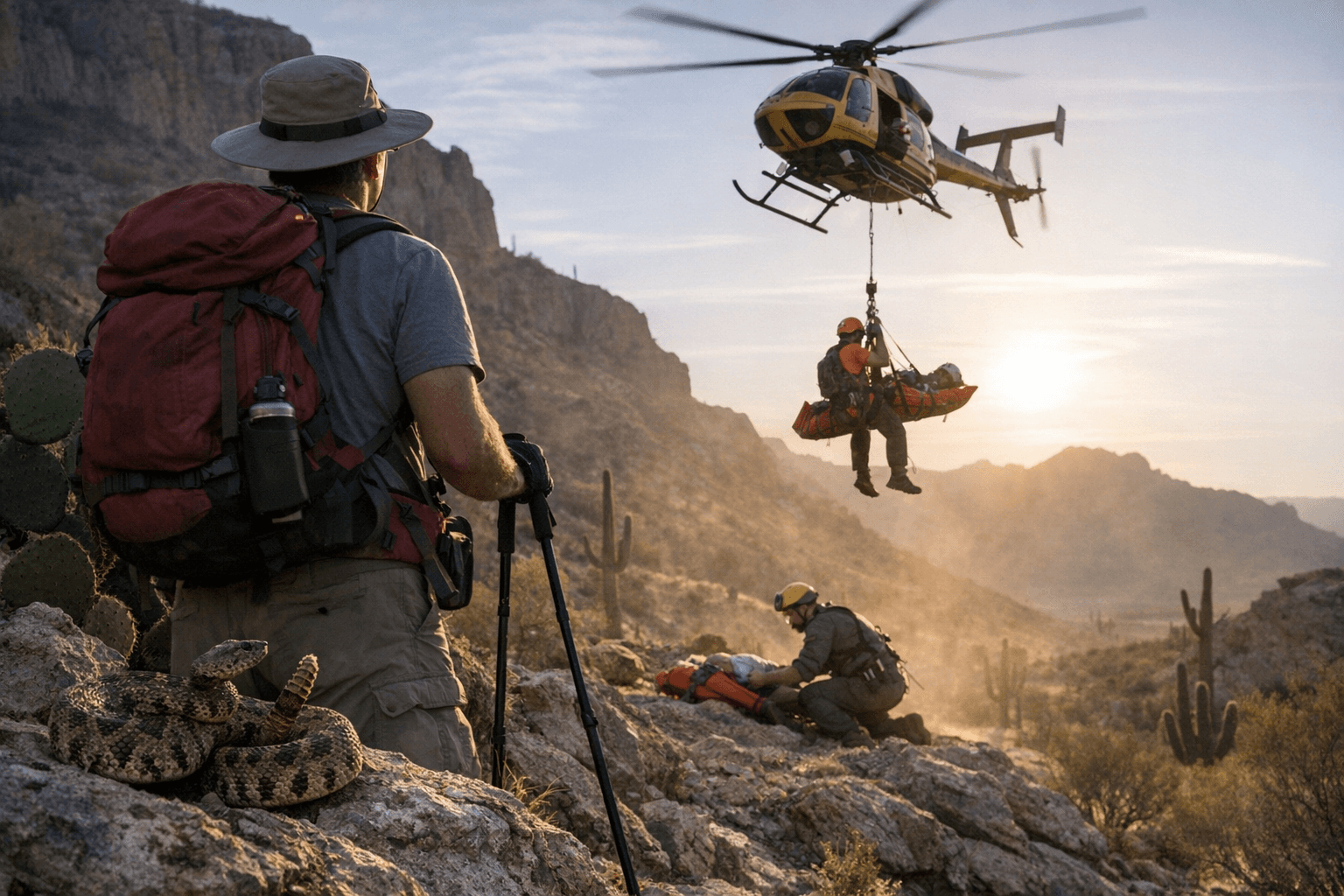
Four days ago, a man in his 30s was stung more than 100 times by bees near the summit of Lookout Mountain Preserve in north Phoenix. He had low blood pressure, couldn't make it down on his own, and required technical rescue teams from both Phoenix and Glendale to hike up the trail before the Phoenix Firebird helicopter hoisted him off the mountain. He arrived at the hospital in critical condition. Two days before that, on the night of April 2, two campers at St. Mary's Glacier near Idaho Springs reported being actively stalked by a mountain lion. One camper hiked out alone to call for help; the other stayed behind. Sgt. Aab and Deputy Bertrand of the Clear Creek County Sheriff's Office loaded onto an ATV, then hiked a full mile through snowy, dark terrain to reach the second camper and bring them out.
These weren't freak events. They were the entirely predictable result of spring conditions in the mountain West: warming temperatures push bees to establish new hives near water sources and rocky outcroppings along popular trails, and mountain lions are more actively patrolling territories as prey animals move upslope. If you have a Southwest trip booked right now, both scenarios deserve a place in your planning.
The Bee Problem Is Worse Than Most Hikers Think
The species most commonly involved in mass-sting incidents across Arizona and the broader Southwest is Africanized honey bees, and their behavior near established hives is categorically different from what most people expect. A single disturbance can mobilize hundreds of bees within seconds, and the venom load from 100-plus stings can cause cardiovascular collapse and symptoms that closely mimic anaphylaxis even in people with no known bee allergy. The Lookout Mountain incident made this concrete: the victim was alert and speaking when crews reached him, but his blood pressure had already dropped to critical levels.
The practical decision point for trip leaders is terrain. At Lookout Mountain, emergency crews treated the hiker on-site with medication and IV fluids before the helicopter hoist because ground extraction to the trailhead wasn't fast enough. If you're operating in areas where steep or technical terrain limits rapid descent, your plan cannot rely on a victim walking out. It has to include air medical from the start.
Before your trip:
- Confirm whether your operating area has air medical coverage and what the response window looks like.
- Ask every participant directly about insect allergies during pre-trip screening. A life-threatening allergy means an epinephrine autoinjector is non-negotiable gear, not optional.
- Brief your group: bees nest near water sources. When you find a water source on a desert or canyon route, approach slowly and look before crowding in.
If a swarm attacks, the directive is simple and needs to be drilled in advance: run in a straight line away from the hive, cover your face, and don't stop. Do not swat, do not jump in water (bees will wait), and do not attempt to help a companion mid-swarm. Get clear first, then render aid.
Mountain Lions: The Dawn and Dusk Window
Mountain lion activity peaks at dawn and dusk, which is exactly when most desert and canyon hikers are on the trail trying to beat the heat. The St. Mary's Glacier rescue unfolded at 10 p.m., illustrating that the risk window extends well into darkness on routes where people camp or run late. What the campers did right: one of them separated to seek help while the other held position, giving rescuers a contact point at the trailhead. What the terrain demanded: a one-mile winter hike in the dark just to reach the second person.
The National Park Service guidance on mountain lion encounters is direct and it aligns precisely with what actually works in the field. Do not run. Running triggers chase behavior. Instead:
1. Stop and face the animal.
2. Make yourself appear large: raise your arms, open a jacket, hold trekking poles wide.
3. Speak loudly and firmly; maintain eye contact.
4. If the lion approaches, throw sticks, rocks, or gear toward it without turning your back.
5. Pick up small children immediately. Keep dogs leashed; a dog darting away can trigger a pursuit response that pulls the lion toward your group.
6. Retreat slowly, keeping the animal in view.
For group leaders, the most important structural decision is keeping children and smaller adults at the center of the group on dawn and dusk routes, not at the front or straggling at the back. Group size itself is a deterrent. A party of six moving together with noise and eye contact presents a fundamentally different risk profile than two people hiking quietly through brushy terrain at first light.
Report every sighting to park staff or local land managers. The St. Mary's Glacier incident generated a formal rescue record. Those records drive public advisories that can reroute or delay trips for the next wave of visitors.
The Decision Matrix Every Trip Leader Needs
The most useful thing an outfitter or trip leader can build right now isn't a checklist. It's a decision matrix with trigger points that tell you whether to reroute, stage and monitor, or initiate immediate evacuation. A reasonable framework:
- Reroute: Confirmed active hive on the planned approach trail within the last 48 hours, or a mountain lion sighting with stalking behavior reported on the specific route segment you're using.
- Stage and monitor: A possible sighting with no behavioral indicators, or a hive reported more than a half-mile off-route.
- Evacuate: Any participant showing anaphylaxis symptoms (facial or throat swelling, wheezing, difficulty breathing, confusion) or any group member incapacitated by stings. Active stalking behavior with lion maintaining proximity to the group also triggers evacuation, not waiting.
The value of committing to these triggers in writing before a trip is that it removes in-the-moment ambiguity. In both the Lookout Mountain and St. Mary's Glacier incidents, the rescues required external resources to hike into the problem. That response time is fixed by geography. Your job is to compress the time between incident and the call that starts that clock.
Training and Gear That Actually Moves the Needle
Staff leading Southwest wilderness trips should hold current wilderness first-aid certification with specific training on epinephrine use and anaphylaxis management. That's the floor. Hazard recognition for wildlife and de-escalation techniques for animal encounters should be covered in staff orientation, not left to improvisation.
Minimum gear for any group leader on a remote Southwest route:
- Epinephrine autoinjectors (at least two, for known allergy carriers and as group backup)
- A comprehensive first-aid kit stocked for envenomation and trauma
- Communication gear capable of summoning medevac from your specific operating area; cell coverage is patchy on canyon routes and absent in much of the backcountry
Client briefings at check-in are where most of this gets tested in practice. Covering food storage, wildlife approach distances, what to do if they see a predator, and what to do if bees attack takes about five minutes. It also sets the tone that your operation takes these hazards seriously.
Where to Focus Right Now
Spring 2026 in the Southwest means active bee season, mountain lion territorial movement, and high trail traffic converging on the same geography. The Lookout Mountain incident happened at a popular Phoenix preserve, not a remote backcountry zone. The St. Mary's Glacier rescue happened on a trail accessible by ATV, and it still required a night hike in snow to resolve. Distance and terrain amplify every delay.
Build medevac response times into your pre-trip client paperwork. Confirm insurance coverage for air medical. Use pre-trip emails and sign-in packets to lower the chance of a client making a bad decision at a bee-covered water source or pushing solo through a high-lion-activity corridor at dusk. The incidents that ended in rescues this week were survivable. The ones that aren't are usually the ones where the group didn't know what to do in the first thirty seconds.
This article was produced by Prism’s automated news system from verified source data, official records, and press releases, then run through automated quality and moderation checks before publishing. The system is built and supervised by the people who set the standards it runs under. Read our full AI policy.
Did this article answer your question?