Moab to Remove Unenforceable OHV Speed Limit Signs, Frustrating Residents
Moab's "OHV 15 MPH" signs are coming down after the city confirmed they were never legally enforceable, leaving neighborhood speed rules uncertain with Easter Jeep Safari underway.
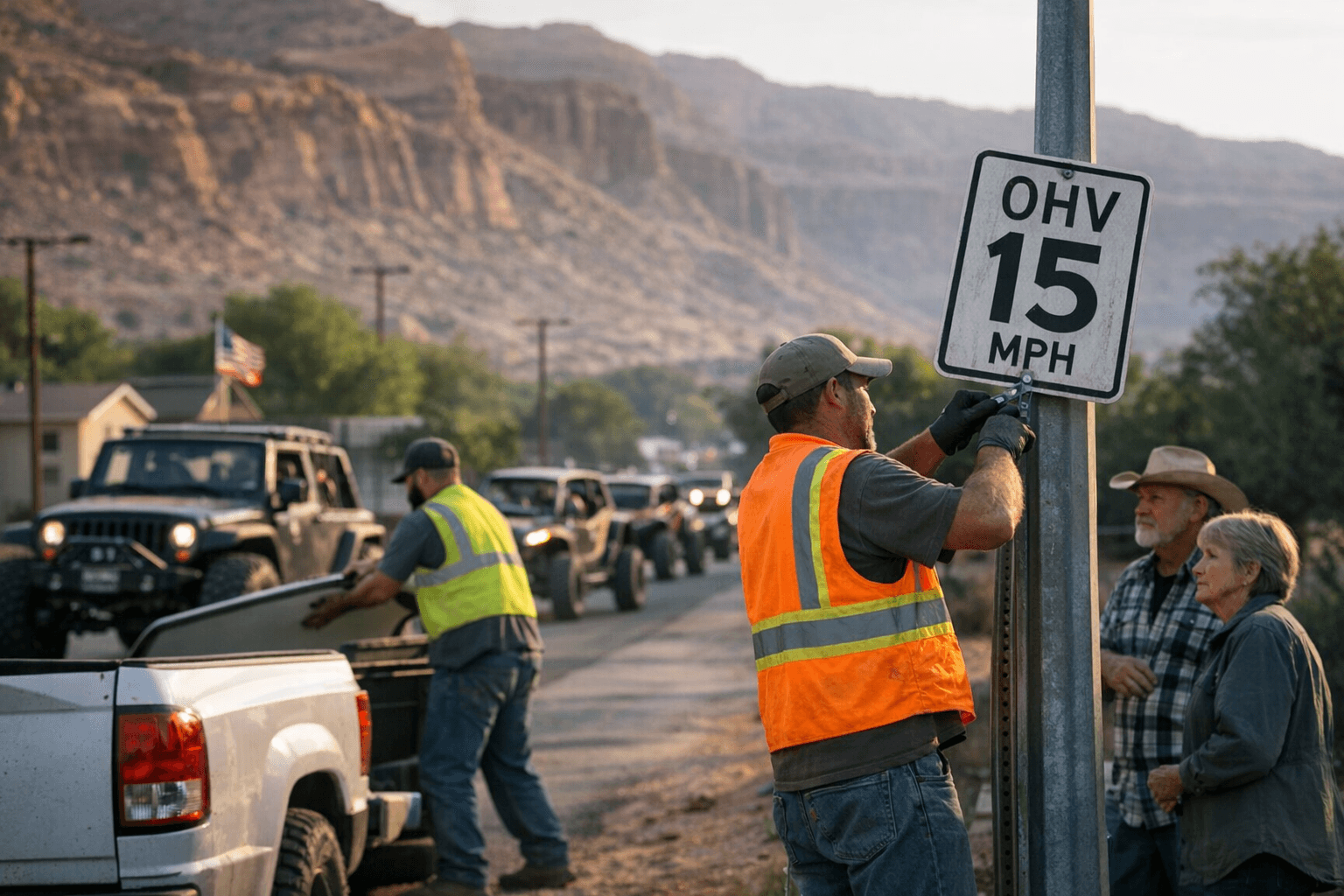
Moab's "OHV Speed Limit 15 MPH" signs, the familiar markers that have lined the city's residential corridors for years, are coming down. City Manager Michael Black confirmed to the City Council at a March 24 meeting that the signs were never legally enforceable under Utah state law: they use the term "OHV" rather than the state-required designation "street-legal ATV," and Utah law prohibits municipalities from setting speed limits for a specific vehicle class. Every sign is, legally speaking, a suggestion.
The announcement is more than administrative housekeeping. It lands as Easter Jeep Safari fills Moab with street-legal UTVs and ATVs, the exact moment when residential corridors like Mill Creek Drive, which runs adjacent to Sand Flats Recreation Area and funnels OHV traffic directly from trail to town, absorb the heaviest volume of the season.
Without the 15 MPH signs, standard posted residential speed limits take over. In most Moab neighborhoods, that means 25 MPH applies to your UTV unless another sign says otherwise. Mayor Joette Langianese urged the council to avoid that gap entirely, recommending the city post 20 MPH signs simultaneously with the removals rather than risk drivers running 25 to 30 MPH through neighborhood streets. Whether that happens before the 15 MPH signs come down has not been determined.
If you're unloading in Moab right now, absent a specific posted sign, 25 MPH is your legal ceiling on residential streets until replacement signage goes up. Mill Creek Drive and the Sand Flats-adjacent corridors are the highest-friction zones and the first likely targets for new traffic calming infrastructure, including neckdowns and multi-use pathways. Noise, speed, and improper parking are the three complaint categories that translate most directly into political pressure for tighter restrictions. Enforcement is in flux, but the larger risk right now is not a citation; it's accelerating the community backlash that ultimately restricts where your rig can travel through town.
Mill Creek Drive residents have been pushing back for years. At the March 24 meeting, one neighbor testified that OHV traffic had fundamentally transformed the street's character, citing chronic noise and safety concerns. Resident Bill Agee pressed for specifics: a concrete framework with set timelines, enforcement mechanisms, key performance indicators, and contingency plans, urging the council to "support us" as a community rather than present a vague outline.
The sign removal is the latest episode in a years-long conflict between Moab's desire to regulate OHV behavior and the state's inclination to constrain that authority. A 2022 state bill pulled back local control over street-legal off-road vehicles, and a 2024 lawsuit challenging the city's regulatory approach was dismissed. The 15 MPH signs were, in retrospect, the city improvising a deterrent after the law closed its formal options.
The council has not yet set a removal timeline or finalized what, if anything, replaces the signs before they come down. That unresolved gap, not the removal itself, is what will define visitor-resident friction in Moab through the spring.
This article was produced by Prism’s automated news system from verified source data, official records, and press releases, then run through automated quality and moderation checks before publishing. The system is built and supervised by the people who set the standards it runs under. Read our full AI policy.
Did this article answer your question?