National Park Service Warns Glen Canyon Visitors of Quicksand Near Lake Powell
Quicksand swallowed a Phoenix hiking guide to his waist at Grand Staircase Escalante — now the NPS is warning Glen Canyon's 1.25 million acres have the same hazard.
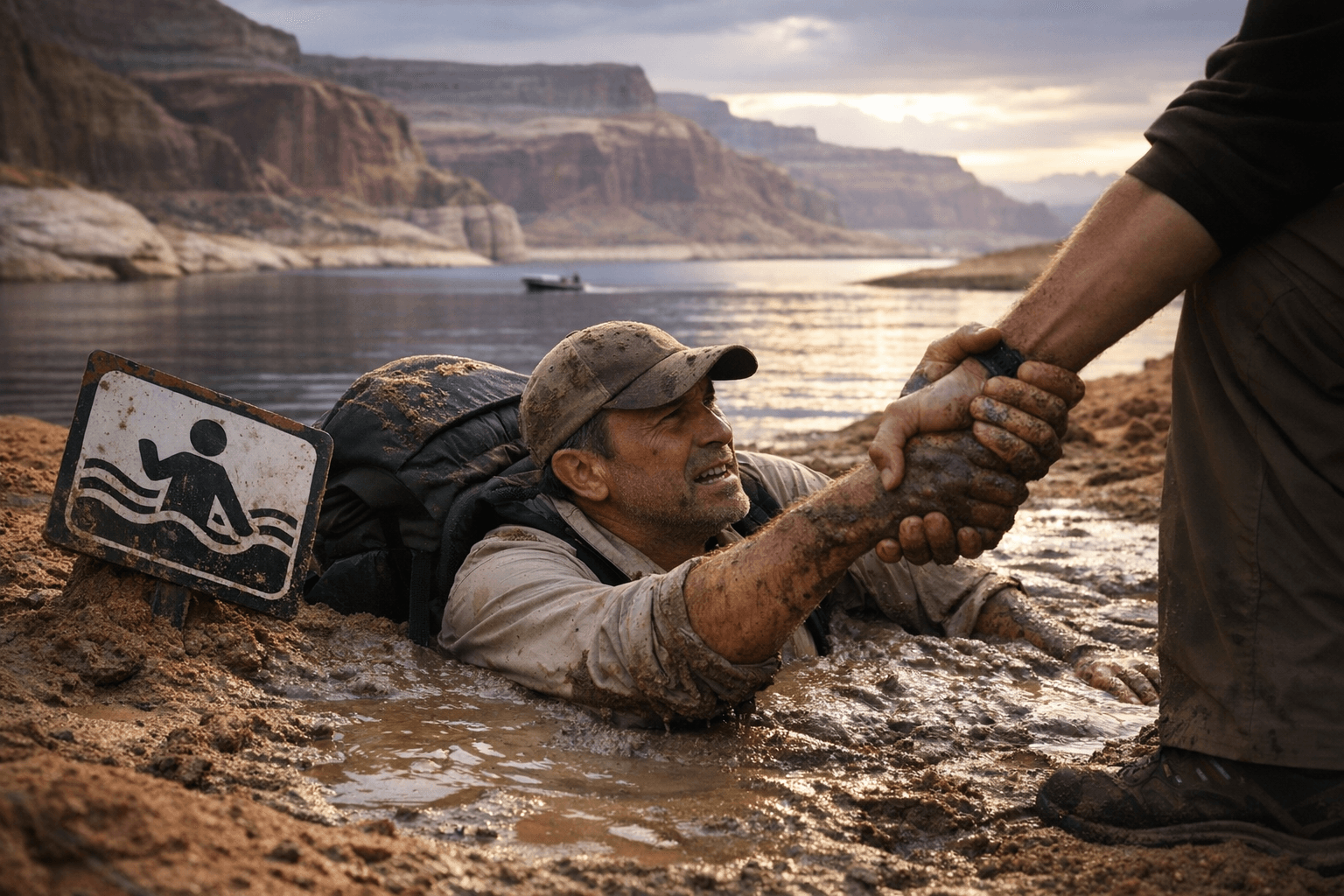
Ground that looks dry and firm near Lake Powell's shoreline can swallow a hiker without warning, and the National Park Service posted a formal alert March 3 telling Glen Canyon National Recreation Area visitors to beware.
The warning covers more than 1.25 million acres of canyon country stretching from Lees Ferry in Arizona to the Orange Cliffs of southern Utah, a landscape that includes Lake Powell, the second-largest man-made lake in the United States, as well as the iconic Horseshoe Bend along the Colorado River. Rangers attributed the hazard in part to dropping water levels at Lake Powell, which have exposed new shorelines and left saturated drainages throughout the park primed for quicksand.
"Quicksand may be present near the shoreline and in drainages throughout the park. It can appear dry and firm on the surface but may suddenly give way," the NPS wrote in the alert. "Recognize unstable, shifting or unusually soft ground, and use caution when entering through these areas."
The physics work against the unprepared. Quicksand is a mixture of sand and water, or sand and air, that appears solid until disturbed, at which point the grains lose friction and collapse. Staying upright and struggling accelerates the sinking. "People who are caught in supersaturated sand remain buoyant — people don't sink in quicksand — allowing them to float and wriggle themselves to safety," Jim Britt, conservation and forestry spokesperson at the Maine Department of Agriculture, previously told The Associated Press. The NPS echoes that logic: stay calm, avoid sudden movements, and lean back to spread body weight.
Matt Bloomfield, a professional hiking guide from Phoenix, learned that lesson firsthand during a trip to Grand Staircase Escalante in Utah last year. He was in it up to his waist before he understood what was happening. "So then we started to kind of squish around in it and noticed that there was a lot of quicksand around," Bloomfield said. "It kind of shocked me at first because it was like up to my waist when I first fell in." Standing upright made things worse. His escape came from going horizontal: "First thing I was trying to do is just kind of flatten myself. And then I was able to kind of lean forward and then get my arms out in front of me. So from here I was able to kind of wiggle my legs and get them closer to the surface and then just kind of army crawl my way out."
Local rangers advise staying close to canyon walls and never hiking alone in affected areas. Trekking poles or sturdy branches can provide the leverage needed to work free with slow, controlled leg movements. The NPS lists specific warning signs to watch for: unexpected water seepage, shifting or vibrating soil, dry-looking surfaces that feel soft or spongy, depressions in the ground, and wet or unusually smooth ground. While quicksand is rarely deep enough to fully engulf a person, escaping is physically exhausting, and the combination of prolonged exposure, desert heat, and dehydration can turn a difficult situation fatal.
Glen Canyon is also dealing with a second hazard simultaneously. Harmful algal blooms, caused by cyanobacteria overgrowth in warming water, have been detected in multiple areas of Lake Powell at concentrations the NPS described as "at the high end of safe exposure levels." The agency's guidance: "Use caution and avoid unnecessary exposure to reservoir water if recreating."
The dual warnings arrived just as spring break visitation was ramping up. Checking the NPS park alerts and conditions page before any trip into Glen Canyon is the clearest way to know where both hazards currently stand.
This article was produced by Prism’s automated news system from verified source data, official records, and press releases, then run through automated quality and moderation checks before publishing. The system is built and supervised by the people who set the standards it runs under. Read our full AI policy.
Did this article answer your question?