Southwest Colorado and Utah Road Trips Pair Scenic Byways With Adventure Activities
Two of the American West's most dramatic landscapes become one seamless adventure when you link Southwest Colorado and Southeast Utah by road.
Few corners of the American West reward slow travel the way Southwest Colorado and Southeast Utah do. The red-rock canyons, high-desert plateaus, and mountain passes that define this region aren't just scenery to admire through a windshield; they're access points to some of the most concentrated adventure terrain on the continent. The roads themselves are part of the experience, threading through landscapes that shift from alpine spruce forests to sandstone slickrock within a single afternoon's drive. What makes this region especially compelling for adventure travelers is the way scenic byways double as trailheads, put-ins, climbing approaches, and wildlife corridors, so the drive is never just the means to the destination.
The Case for Linking These Two Regions
Southwest Colorado and Southeast Utah share a geographic and cultural logic that makes them natural road-trip partners. The Four Corners area at their intersection is one of the few places in North America where four states meet at a single point, and the landscape radiating outward from it carries a distinct character: deep canyon systems carved by the Colorado River and its tributaries, mesa tops that rise abruptly from valley floors, and public land stretching in every direction. For adventure travelers, that translates to an almost absurd density of opportunity. A single loop can move from a climbing crag outside Moab to a whitewater stretch on the San Juan River to a mountain biking network in the Dolores River valley without ever covering ground that feels redundant.
Scenic Byways as the Backbone
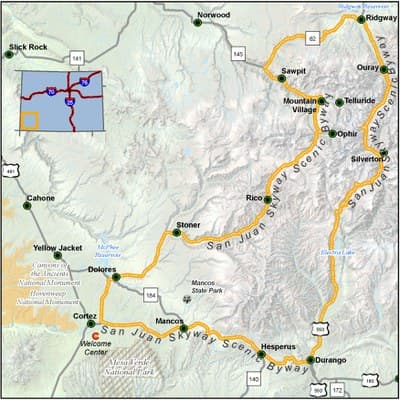
The designated scenic byways in this corridor aren't marketing designations; they exist because the roads themselves pass through places that would otherwise require a backcountry permit and a week on foot. Utah's Highway 128, tracing the Colorado River northeast of Moab through Castle Valley, puts sandstone towers and river beaches within arm's reach of the pavement. Colorado's San Juan Skyway, a 236-mile loop through Durango, Silverton, Ouray, and Telluride, crosses five mountain passes and descends through three distinct ecosystems. The Unaweep/Tabeguache Scenic and Historic Byway follows ancient canyon geography that confused early geologists and still carries a sense of deep geological time.
Treating these byways as connective tissue rather than destinations in themselves changes how you plan the trip. Instead of driving straight to a trailhead, you build your itinerary around the roads, identifying where each byway brushes against a river, a trail network, or a wildlife habitat, and then stopping there with intention.
Adventure Activities by Terrain Type
The hiking in this region spans an enormous range of commitment levels and landscapes. Day hikes off the San Juan Skyway, particularly around Ouray and the Yankee Boy Basin area, access wildflower meadows and cascading waterfalls that sit above 11,000 feet. In Southeast Utah, canyon hiking through the labyrinthine drainages near Canyonlands National Park requires route-finding skills and water discipline but rewards with slot canyon corridors and rim views that extend for 50 miles in clear conditions.
Rock climbing concentrates around Moab, where the sandstone walls of Indian Creek have earned a global reputation among crack climbers. The continuous parallel cracks splitting the Wingate sandstone formations there are considered some of the best splitter crack terrain anywhere, drawing climbers who train for months specifically to attempt routes in that canyon. The San Juan Mountains in Colorado offer alpine climbing on routes that gain significant elevation quickly, with technical terrain on peaks like Mount Sneffels above Ouray.
River access is a defining feature of both regions. The Colorado River through Moab runs sections suited to everything from casual float trips to Class III whitewater depending on seasonal flows. The Dolores River in Southwest Colorado, particularly during spring runoff, draws kayakers and rafters through a canyon that remains remarkably remote despite its proximity to the highway. The San Juan River offers a classic multi-day desert float through Monument Valley country, combining river travel with archeological sites along the banks.

Mountain biking has become one of the primary draws for the entire corridor. The Whole Enchilada trail system outside Moab descends roughly 7,800 feet over 26 miles, combining high-alpine singletrack with red-rock riding in a run that mountain bikers treat as a bucket-list objective. In Southwest Colorado, the Monarch Crest Trail and the trail networks around Telluride and Ridgway offer sustained alpine riding with views that extend into multiple states on clear days.
Wildlife watching threads through all of these activities rather than requiring a separate itinerary. Pronghorn antelope are visible from highway pullouts across the Great Sage Plain. Peregrine falcons nest on the canyon walls above the Colorado River corridor. Elk migrations in the San Juan Mountains concentrate in predictable meadow systems during fall and early spring, and patient observers positioned at the right elevation around dawn can watch herds move through terrain that hasn't changed much since the Ancestral Puebloans tracked the same animals.
Planning a Loop That Works
The most functional road-trip structure for this region is a loop anchored by Moab, Utah, on the east end and Durango, Colorado, on the south end. Both towns have evolved into genuine adventure infrastructure hubs with gear rental, skilled guide services, quality food, and accommodation options that range from dispersed camping on BLM land to boutique hotels. The drive between them via U.S. 191 and U.S. 160 through the Navajo Nation takes roughly three hours without stops, giving you a clean closing leg after extending north through Canyonlands country or west into canyon country.
A practical approach is to build the loop over five to seven days, assigning each byway segment a primary activity and leaving one buffer day for weather or for following a trailhead sign that looks promising. The San Juan Skyway alone warrants two full days if you intend to actually stop and move through the landscape rather than photograph it from overlooks. Adding a night in Ouray positions you for an early start on a climb or a hike before the afternoon thunderstorms that build reliably over the peaks in summer.
Timing and Conditions
Spring and fall offer the most balanced conditions across both regions. Summer heat in the Utah canyon country regularly exceeds 100 degrees Fahrenheit by midday, pushing most serious physical activity to early morning windows. The mountain terrain in Southwest Colorado runs in the opposite direction, with afternoon thunderstorms from July through September making above-treeline activity genuinely dangerous after noon. Spring, particularly late April through early June, opens river flows, keeps temperatures in a workable range, and catches the desert in bloom. Fall, from mid-September through late October, delivers stable weather, cooler temperatures, and the aspen color change across the San Juan Mountains that draws its own devoted following.
Winter closes the high passes on the San Juan Skyway and makes some of the canyon roads impassable, but it also empties the trailheads and delivers a quality of solitude in the red-rock country that summer visitors rarely experience. For travelers willing to layer up and adjust expectations, a winter loop through this corridor has its own logic and its own rewards.
This article was produced by Prism’s automated news system from verified source data, official records, and press releases, then run through automated quality and moderation checks before publishing. The system is built and supervised by the people who set the standards it runs under. Read our full AI policy.
Did this article answer your question?