Hamptons tennis champions win silver cups, not big cash prizes
Champions in Hamptons club tennis usually take home a silver cup or engraved medal, and the real prize is clubhouse status.
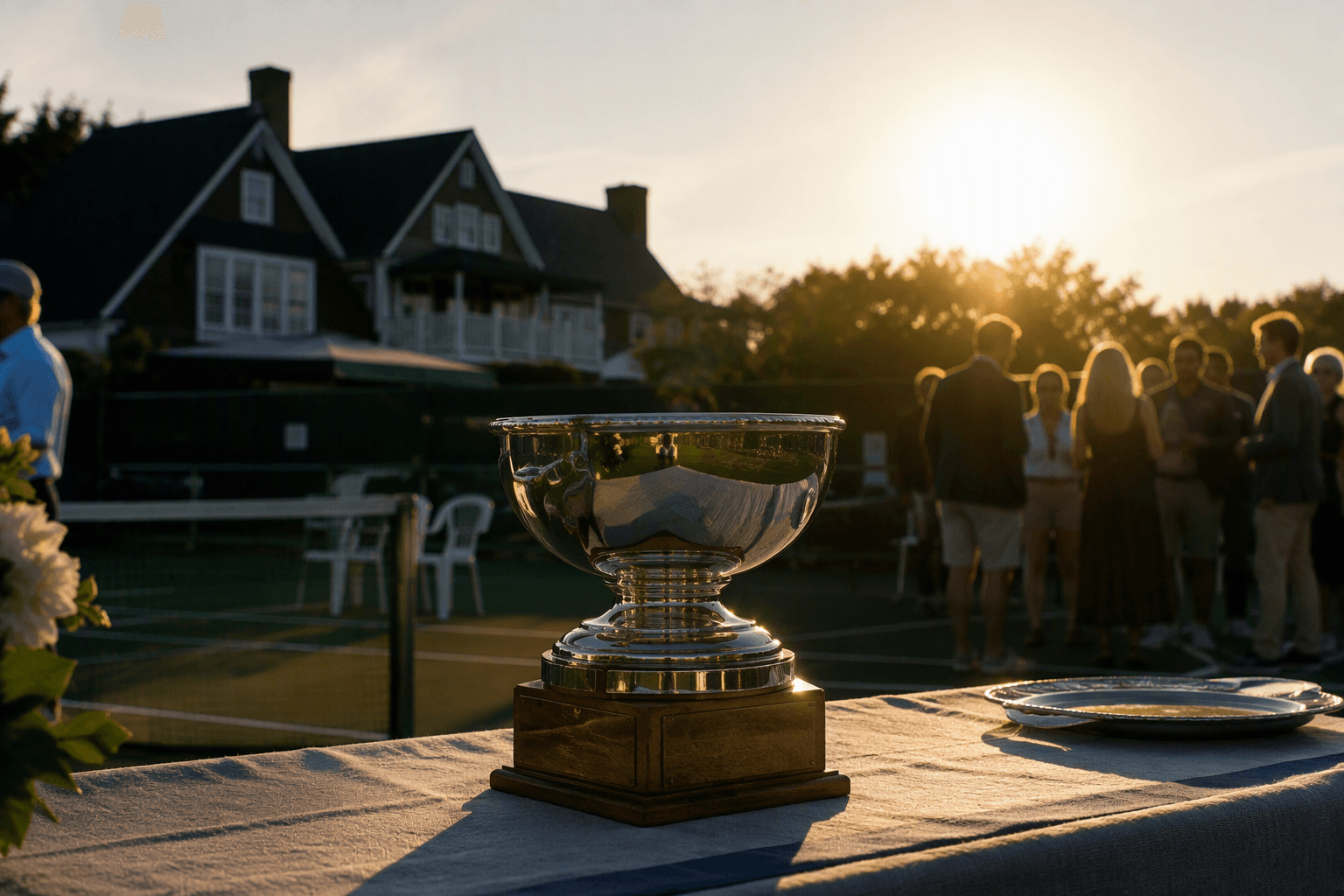
The silver cup matters in the Hamptons because it is never just silver cup. At Southampton Bath & Tennis Club, one Social Life Magazine scene captures the whole idea: the trophy was sitting on the bar while the woman who won it hours earlier was already back on Court One, drilling forehands with her teaching pro. In this tennis world, winning is not the end of the story. It is the next step in a summer-long social order built around club championships, member-guest events, ladders, and the kind of recognition that lasts long after the draw is forgotten.
What the prize really means
Hamptons club champions typically do not leave with the kind of money that defines the pro game. They leave with a silver cup, an engraved medal, or some other modest piece of hardware, and that difference tells you a lot about the culture. The award works as status, memory, and proof of belonging all at once, which is why it often ends up on a bar, a mantel, or in a clubhouse display rather than in a bank account.
That small trophy has a social job to do. It becomes a conversational object, a record of who played well in a given summer, and a signal that someone has earned a place in the club’s informal hierarchy. In a place where court access, seasonal membership, and reputation all matter, the hardware is less about prize money than about who gets remembered when the season speeds by.
Why Hamptons tennis feels different from pro tennis
The Hamptons version of tennis is built around rituals, not ranking points. Club championships, member-guest events, and ladders keep the competition circulating through the same summer community, so the prize has to function as a badge of both ability and etiquette. A title can separate one player from the pack, but it can also fold that player deeper into the club’s social life.
That is why the image of a champion returning to Court One after the ceremony matters so much. At many Hamptons clubs, a win does not mean stepping away from the work. It often means staying in it, using the title as a reason to sharpen technique, clean up match play, and come back stronger the next weekend. The trophy is the proof of progress; the next lesson is the response.
Southampton Bath & Tennis Club shows how the system works
Southampton Bath & Tennis Club is a useful example because it sits right at the overlap of tennis and social club culture. ProPublica’s nonprofit record lists Southampton B & T Club Inc as tax-exempt since March 1995 and classifies it as a social and recreational club, which fits the role it plays in the local tennis calendar. The club’s own site lists it at 212 Gin Lane, Southampton, NY 11968, with the phone number 631-283-1188.
Those details matter because they place the prize inside a real community structure, not just a tournament bracket. A silver cup at a club like this is part of the room, part of the season, and part of the story members tell about themselves. The award is visible evidence that the club is not just where people play, but where they are known.
The Meadow Club proves the tradition runs deep
The Hamptons prize culture has a long memory, and The Meadow Club of Southampton shows just how old that memory is. By August 9, 1947, The New Yorker was already noting that the club had held its fifty-seventh annual invitation tournament, which puts the tradition firmly in the middle of the twentieth century and well before today’s summer tennis scene.
The Tennis History Library adds the sharper historical frame: the Southampton Invitation was founded in 1887, was abolished in 1971, and was played at The Meadow Club on grass courts. Social Life Magazine describes the Meadow Club as having 137 years of grass-court elegance, a phrase that gets at the same point from a different angle. Here, the prestige of the setting has always been part of the prize.
What club trophies signal across tennis communities
The Hamptons are not alone in turning cups into seasonal ritual. Southampton Tennis Club in Ontario says it has held Cups Day every July and August since 1956, which shows how deeply the trophy tradition runs in recreational tennis more broadly. Across clubs, the cup is a way to mark continuity: one summer links to the next, and the winners become part of the club’s calendar.
In the Hamptons, though, the symbolism lands with extra force because the season itself is so social. A club championship medal can say as much about belonging as it does about backhands. It marks who showed up, who handled pressure, and who earned a place in the summer narrative that members remember when the courts empty out.
How to read a Hamptons club championship
If you want to understand what a title means here, look beyond the scoreboard. The real clues are usually small and easy to miss:
- a silver cup on the bar or in the clubhouse
- an engraved medal that gets talked about like a family keepsake
- the winner heading back to a lesson or practice session the same day
- recurring events like championships, ladders, and member-guest matches that keep names moving through the club all season
That pattern is the whole point. In Hamptons tennis, the award is rarely the finish line. It is the object that keeps the match alive in the clubhouse, where status, memory, and club identity matter as much as the result itself.
This article was produced by Prism’s automated news system from verified source data, official records, and press releases, then run through automated quality and moderation checks before publishing. The system is built and supervised by the people who set the standards it runs under. Read our full AI policy.
Did this article answer your question?