Catalan-inspired tiny house blends family living with off-grid autonomy
Sagnier turns Catalan modernism into a family-ready tiny house with four fixed beds, water autonomy and a playful shell. Its whimsy is doing real work.
A tiny house that behaves like a family home
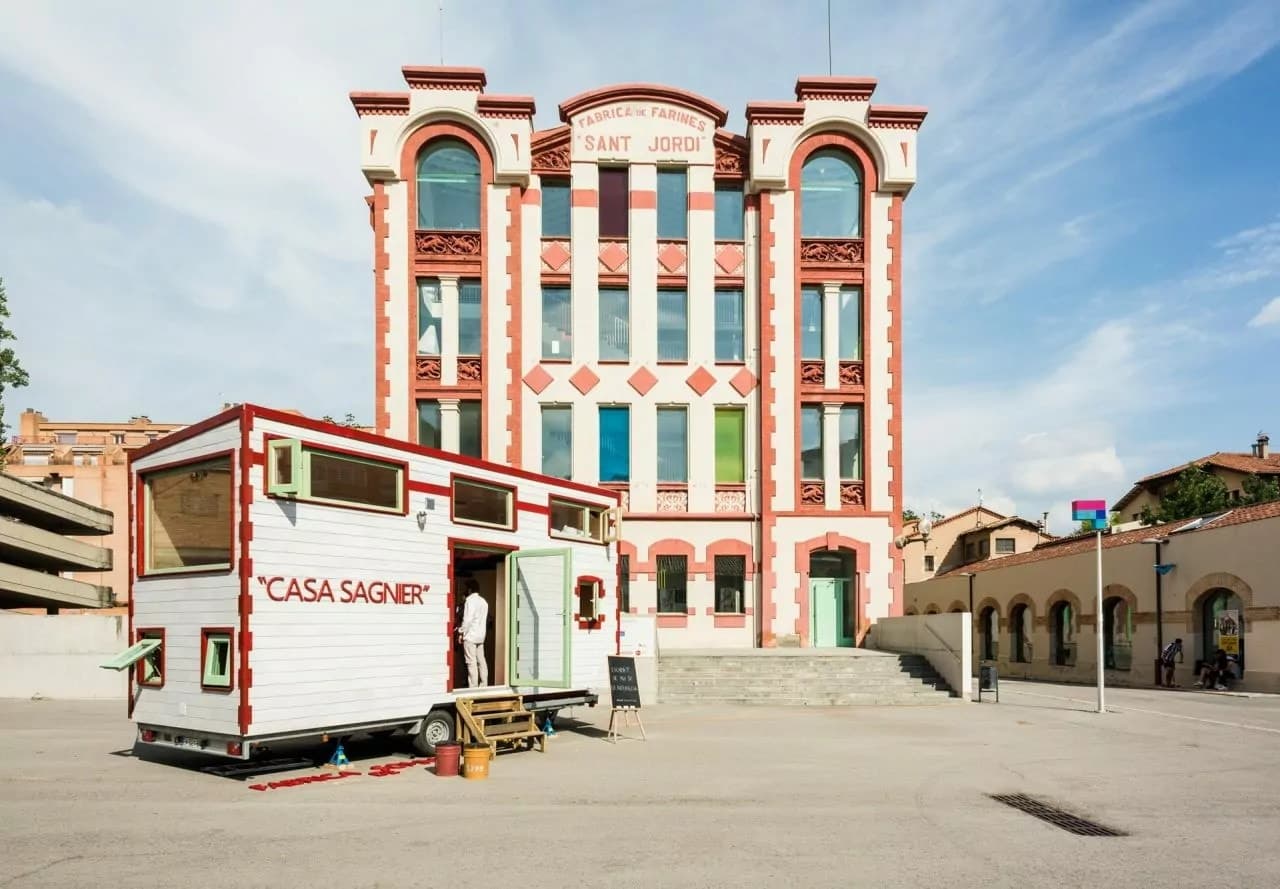
Sagnier looks like a colorful tribute to Catalan modernism, but the real story is how seriously it takes daily family living. The red-and-white exterior and pastel green window frames make it stand apart from the usual neutral tiny-house palette, yet the design is not just for show. It is built as a compact home for people who need privacy, sleep capacity and autonomy to work together in a small footprint.
That balance matters in tiny-house design, especially when the home is meant for children or shared living. Sagnier now serves as a vacation home for a family of four, and its layout is built around four fixed beds with room for up to six people. Fixed sleeping spaces change the whole rhythm of a tiny house: they remove the nightly conversion routine, keep the living area usable, and make the home feel settled rather than improvisational.
What makes the layout practical day to day
The biggest family-friendly move here is simple: the house is not asking you to rebuild the bedroom every night. Four fixed beds give the home a stable sleeping structure, which is a major advantage when children are involved or when guests are part of the picture. In a tiny house, that kind of permanence can be the difference between a charming stay and a cramped one.
The rest of the shell supports that same logic. Serena.House describes Sagnier as completely ecological and autonomous in energy and water, with natural-material insulation, custom double-glazed wood windows, ecological paints and breathable walls. Those choices are not decorative add-ons; they help the home stay comfortable, quiet and resilient in a compact volume, which is exactly what a family needs if the house is going to be used as a real vacation base rather than a novelty stay.
A few of the core features tell the story plainly:
- 1000-liter drinking-water tank
- complete solar system
- dry toilets and phytofiltration
Those systems make the home self-sufficient enough to function as an off-grid tiny house, while also reducing the need for constant intervention from the people using it. For a family, that translates into less hassle around water, power and waste, and more room to actually live in the space.
Why the Catalan reference gives the house its shape
The architectural tribute is not random. Serena.House says Sagnier was created as a tribute to Catalan modernism and to the Farinera de Vic, the historic building by Enric Sagnier that helped inspire the tiny house’s look. The reference gives the project a clear identity, and it helps explain why the house leans into color and ornament instead of the stripped-back minimalism that dominates much of tiny-house culture.
The original Farinera Costa de Vic was built between 1896 and 1897 and is described by MNACTEC as one of the most notable examples of Catalan Modernist industrial architecture. It was designed by Enric Sagnier, later had multiple industrial uses, ceased flour production in 2007, and was acquired by the city of Vic in 2009, which transformed it into La Farinera, Centre d’Arts Visuals de Vic. That history matters because the tiny house is borrowing more than a facade palette. It is borrowing a sense of place, craftsmanship and local memory.
The visual echo is deliberate. By pulling from a landmark associated with sculptural decoration and historic industrial identity, the tiny house turns architecture into storytelling. The result is a home that children can enjoy exploring, but also one that signals its origins in a very specific cultural landscape.
From prototype to lived-in hospitality
Sagnier did not appear out of nowhere. It sits inside a longer Serena.House timeline that starts with the 2016 DIY construction of Les Abers, the first prototype. That was followed by a 2017 win for the Loire-Atlantique sustainable tourism award, then the 2018 construction of Stendhal, described as Spain’s first off-grid tiny house. By 2020, more than 500 people had spent a night in the company’s tiny houses, which shows that the concept had moved from experiment to repeatable hospitality.
That timeline helps explain why Sagnier feels resolved rather than speculative. Serena.House says the project supported local small farmers as part of its sustainable tourism program, so the house belongs to a wider ecosystem of food, place and low-impact travel. The result is a tiny house that does not just present sustainability as a mood. It links autonomous living to a real program of tourism and local support.
The fact that Sagnier is now a vacation home for a family of four is the strongest sign that the project found a second life beyond prototype status. It still carries the playful, almost storybook look of a homage piece, but its daily usefulness is what lets that look matter.
What Sagnier says about tiny-house design now
Sagnier is a useful reminder that whimsy and function do not have to fight each other. The colorful exterior and historic references give the house its personality, but the family layout, fixed beds and off-grid systems are what make it livable. In other words, the architecture may be the hook, yet the housing logic is the reason it works.
That is the real lesson here: a tiny house can be culturally expressive without becoming impractical. Sagnier proves that when the shell is tied to a place, and the interior is built for water, power, sleep and shared use, the result is more than a pretty object. It becomes a compact home with enough identity to charm you and enough planning to hold up to family life.
This article was produced by Prism’s automated news system from verified source data, official records, and press releases, then run through automated quality and moderation checks before publishing. The system is built and supervised by the people who set the standards it runs under. Read our full AI policy.
Did this article answer your question?