Clever Tiny Homes' 2026 Guide Covers Everything From Financing to Floor Plans
New ADU laws, shifting zoning rules, and all-in costs from $60K to $180K+ make 2026 the most navigable year yet for tiny home planning, if you know where the traps are.

California's AB 1332 required every city in the state to establish a pre-approved ADU plan program by January 1, 2025, resetting the permitting math for anyone planning a foundation-based tiny home. That same legislative wave carried SB 543, which aligns JADU rules with ADU rules and clarifies square-footage standards, effective January 2026. Florida's Senate showed unanimous support in 2026 for legislation easing the path for small backyard homes, with cities like Orlando and Miami actively updating zoning codes to accommodate higher-density tiny home development. The regulatory window is opening in more jurisdictions than at any prior point - but the structural decision you make before you pull a permit determines which set of rules, lenders, and insurers you'll be navigating for years.
Foundation or Wheels: The Decision That Reshapes Everything
The first fork in any tiny home project is the most consequential: Tiny House on Wheels (THOW), park-model RV, prefab modular, or site-built foundation home. Each carries a distinct legal identity with real financial consequences downstream.
Park-model RVs are certified to ANSI/RVIA A119.5, the standard updated in its 2025 edition, and are most often sited in RV parks or campgrounds for seasonal use. By definition, they are not meant to be affixed to real property and are neither designed nor intended for use as permanent residences. That matters enormously for financing: park model RVs are excluded from the definition of a manufactured home under HUD regulations, which puts them outside the reach of HUD-backed mortgage products. Prefab modulars built on permanent foundations are subject to state building codes and can qualify for conventional financing. THOWs fall under RVIA standards rather than residential building code when certified, and site-built foundation homes under 400 square feet fall under IRC Appendix Q.
The most common way to finance a THOW or park model is through personal loans, which can provide between $1,000 and $100,000 within a few days, though higher interest rates and shorter terms of 12 to 60 months are the trade-offs. RV loans are available for RVIA-certified units, but require a credit score of 660 to 700 and a down payment of 10 to 20%. For foundation builds, FHA loans require at least 3.5% down and require a permanent foundation; most lenders won't provide loans under $50,000. Builder-direct financing currently carries in-house rates ranging from 7.5% to 14.9% depending on credit profile and loan term, with flexible repayment periods of 5, 10, or 15 years.
Decoding Appendix Q: What the Code Actually Allows
Appendix Q was approved for inclusion in the 2018 International Residential Code to provide regulations and standards for tiny houses on a foundation that are 400 square feet or less. It relaxes various requirements in the base code specifically as they apply to compact construction.
The IRC is in use or adopted in 49 states, the District of Columbia, Guam, Puerto Rico, and the U.S. Virgin Islands. The specifics define what floor plans are actually viable. Habitable space and hallways must have a finished ceiling height of not less than 6 feet 8 inches. Lofts operate under a separate set of rules: a loft is defined as a floor level located more than 30 inches above the main floor, open to it on at least one side, with a ceiling height maximum of 5 feet. Lofts must have a minimum floor area of 35 square feet and a minimum dimension of 5 feet in any horizontal direction. Appendix Q also provides relaxed requirements for compact stairs, handrails, headroom, ladders, and guard and emergency escape opening requirements of lofts.
One critical variable: as a model code, the IRC is intended to be adopted in accordance with the laws and procedures of each governmental jurisdiction. During adoption, some jurisdictions amend the code to reflect local practices and laws, and some states handle adoption statewide while others manage it at the city or county level. Always verify your specific jurisdiction's adopted version before finalizing any floor plan that depends on Appendix Q accommodations.
Floor Plans: Lofted vs. Single-Level
The loft-versus-single-level decision is more than aesthetic. Lofted designs maximize usable square footage in footprints under 250 square feet, but the steep stair or ladder accessing a sleeping loft creates real barriers for anyone with limited mobility. Single-level plans require more floor area to accommodate a dedicated sleeping space, increasing cost, but they open the door to meaningful accessibility retrofits: wider 32-to-36-inch doorways, zero-threshold entries, roll-in showers, and blocking in bathroom walls for grab bars. For older adults planning to age in place, these aren't optional additions - they're the foundation of a workable long-term layout.
Common plan categories include:
- The open studio: kitchen, living, and sleeping in one undivided space, typically 150-250 sq ft, lowest cost to build
- The lofted THOW: main-level living and kitchen with sleeping loft above, the most popular configuration for mobile builds
- The split single-level: sleeping area behind a partition wall in a 250-400 sq ft foundation build, better suited to couples or long-term occupancy
- The accessible layout: step-free entry, wider hallways, wet bath or roll-in shower, built explicitly for year-round permanent living
Insulation and Mechanical: Year-Round Livability
A tiny home is only as practical as its mechanical systems. Inadequate insulation or an undersized HVAC system is the most common reason new owners face brutal first winters or punishing summer cooling bills. For year-round occupancy, closed-cell spray foam in walls and roof cavities, combined with a mini-split heat pump, provides the most efficient combination across most U.S. climate zones.
Electrical load sizing is a consistent oversight. A panel sized for minimal loads won't handle a mini-split, induction cooktop, on-demand water heater, and EV charger running concurrently. That calculation needs to happen with a licensed electrician before the build begins, not after. For off-grid or semi-off-grid placements where utility connection costs are prohibitive, solar with battery storage and a propane backup significantly increases upfront cost but eliminates monthly utility overhead. Off-grid systems are one of the three primary cost drivers in any tiny home build, alongside custom joinery and premium fixtures.
What It Actually Costs in 2026
Pricing across the market currently breaks into recognizable bands:
- Entry-level kit or DIY-assisted builds with minimal custom work: $45,000-$75,000
- Mid-range THOW from an established builder with standard finishes: $80,000-$130,000
- High-spec THOW with premium energy systems and custom cabinetry: $130,000-$180,000+
- Foundation ADU or modular with full site prep: $120,000-$250,000+ depending on land work, permitting, and utility hookups
- Premium custom builds from high-end builders can run $330 or more per square foot, incorporating quality-sourced materials, motorized furniture, designer lighting, and full off-grid systems.
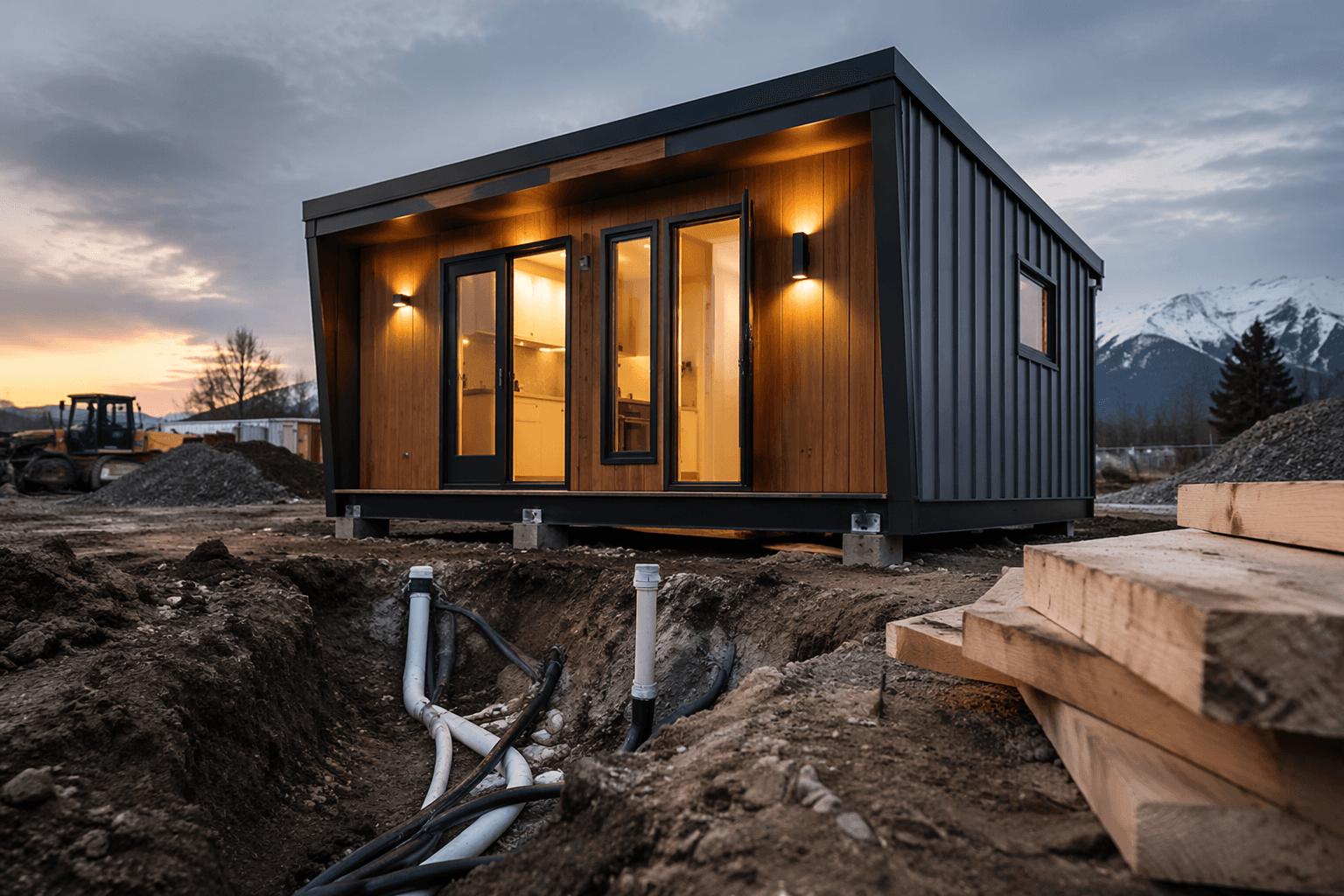
Land, utility connections, and site prep are commonly excluded from shell pricing and routinely add $20,000-$60,000 to a project's all-in cost before the first wall goes up. Permit costs vary significantly by jurisdiction - budgeting $3,000-$15,000 for the permitting process alone is realistic in regulated markets. Builder lead times for custom THOWs from established shops currently run 6-18 months. Factory-built modular options compress that window substantially and reduce build variance, making them the more defensible choice for buyers working against a hard deadline or a fixed budget.
The 5 Decision Traps That Stall Projects
Even thoroughly researched projects consistently trip over the same five obstacles:
1. Buying a shell before a site feasibility check. Zoning classifications, setback requirements, utility availability, and septic capacity all need to be confirmed before any money changes hands.
A site that looks buildable on Google Maps can fail on any single dimension once a planner reviews it.
2. Skipping pre-approved ADU plan programs. Under California's AB 1332, every city was required to have a pre-approved plan catalog in place by January 2025.
Using a pre-approved plan can eliminate months from the permitting review process, but a majority of buyers never ask whether one exists.
3. No contingency for permit delays. Review timelines are unpredictable, particularly in jurisdictions actively updating codes to accommodate new ADU and tiny home categories.
Building at least 10-15% budget contingency protects a project when a stalled permit review becomes a 90-day delay.
4. Misreading the chassis classification. Buyers who assume a THOW or park model will qualify for the same insurance and mortgage products as a foundation ADU face expensive corrections mid-project.
The ANSI/RVIA A119.5 classification that governs park models explicitly places them outside HUD manufactured home protections, a distinction with direct legal and financial weight.
5. Underestimating utility connection costs. Water, sewer, and electrical hookups rarely appear in builder shell pricing.
In rural placements, well drilling or septic system installation can add $15,000-$40,000 before a single piece of framing is erected.
The Practical Starting Point
Before committing to a design, the most protective step is a site-specific consultation with a local architect or planner who knows your jurisdiction's currently adopted codes, not just IRC model language, but local amendments. In active ADU markets, codes are updating quickly enough that guidance from 18 months ago may not reflect current requirements.
Assembling a realistic project timeline means accounting for pre-design site work, permit submission and review cycles, utility assessment, inspections, and any required infrastructure upgrades - not just the build itself. For buyers choosing the factory-built or modular pathway to control timelines, the design-to-delivery window can be compressed significantly, but site prep and permitting remain outside any builder's control. The tiny home category is more legally accessible in more jurisdictions than it has ever been; the risk is in assuming accessibility equals simplicity before the verification work is done.
This article was produced by Prism’s automated news system from verified source data, official records, and press releases, then run through automated quality and moderation checks before publishing. The system is built and supervised by the people who set the standards it runs under. Read our full AI policy.
Did this article answer your question?