Monterey tiny house packs style and essentials into 208 square feet
At $32,000, Monterey's 208-square-foot Minimalist looks like a bargain only until you weigh the trailer, zoning, and siting math. The finish is real, and so are the tradeoffs.
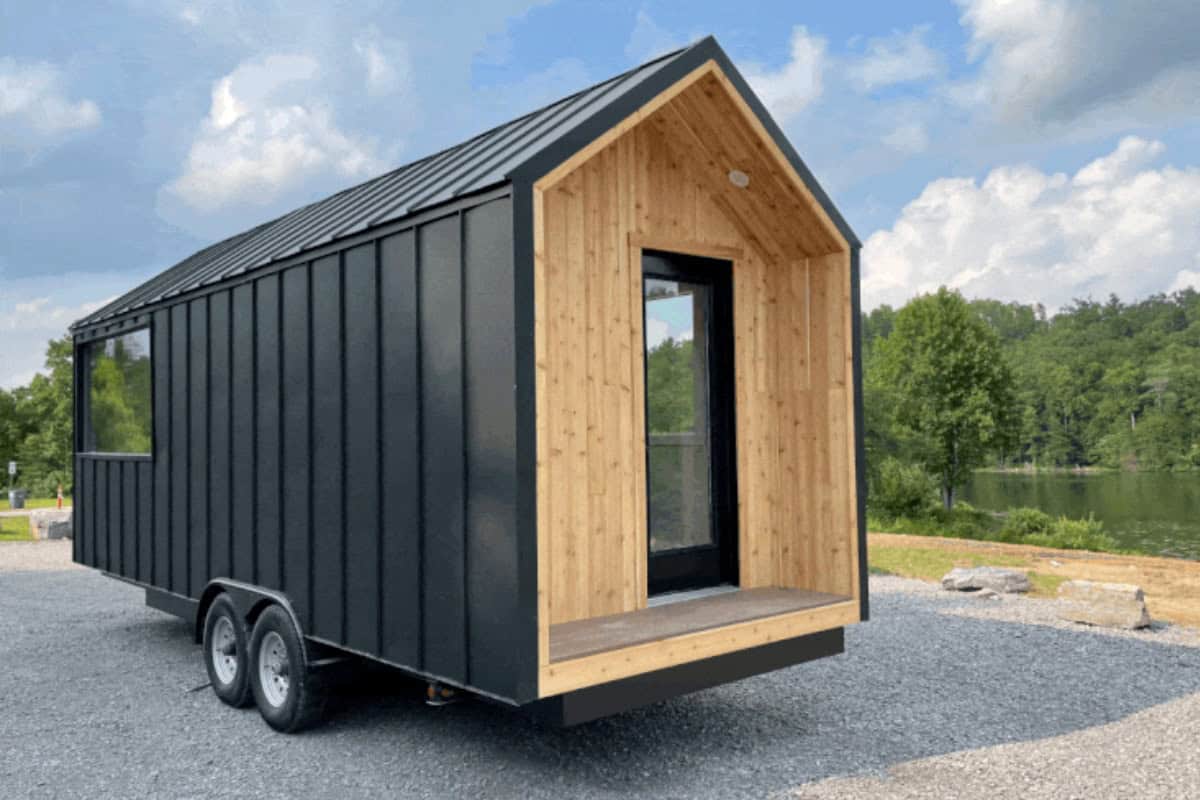
The word “affordable” gets a workout in tiny-house listings, but Monterey’s Minimalist earns it only on the sticker. Built by Modular Dwelling, this 2026 tiny house on wheels measures 8 feet wide, sits on a double-axle trailer, and packs 208 square feet into a footprint that looks far more polished than stripped down. The price, $32,000, puts it in the rare category of finished tiny homes that still feel reachable, but the real lesson is that a low entry price is not the same thing as a low total cost.
What the $32,000 actually buys
This is not a shell or a rough-in. The home is presented as a completed, move-in-ready tiny house with a one-bedroom, one-bath layout, a loft, and a kitchen that is fully fitted for everyday use. Tiny House Marketplace lists the same Monterey home at $32,000, with the same 208-square-foot size and the same 1 bed, 1 bath configuration, which reinforces that this is being sold as a finished housing unit, not a DIY project waiting for a buyer to complete it.
That distinction matters in the tiny-house market. A low price can be misleading if it leaves out the expensive parts of ownership, and this listing keeps the focus on the built structure itself. What it does not include, at least in the public framing of the home, is the wider set of costs that often make or break a tiny-house budget: the place where it will sit, the local approvals it needs, and the infrastructure decisions that determine whether it can function as a long-term home.
A modern exterior that leans polished, not rustic
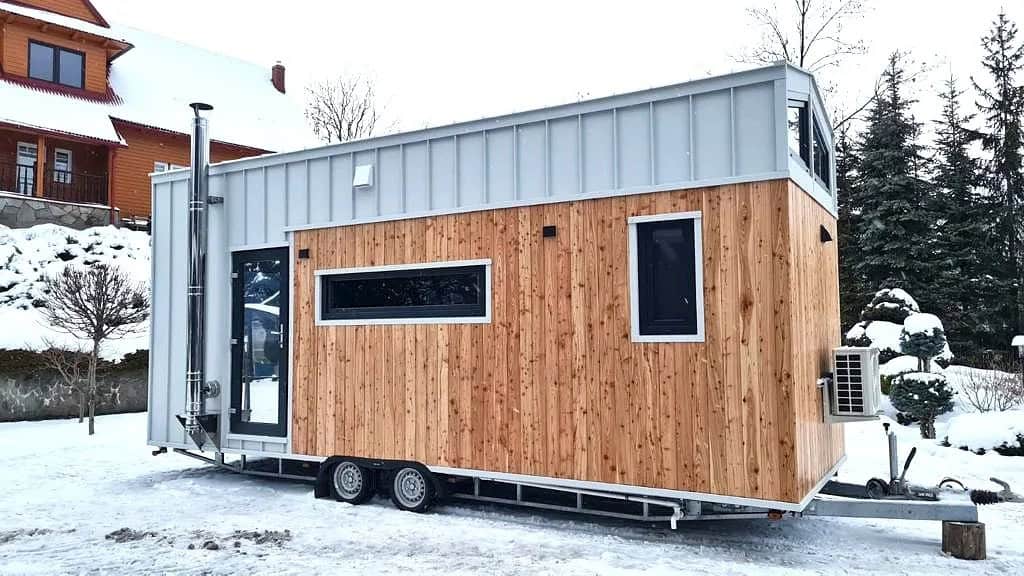
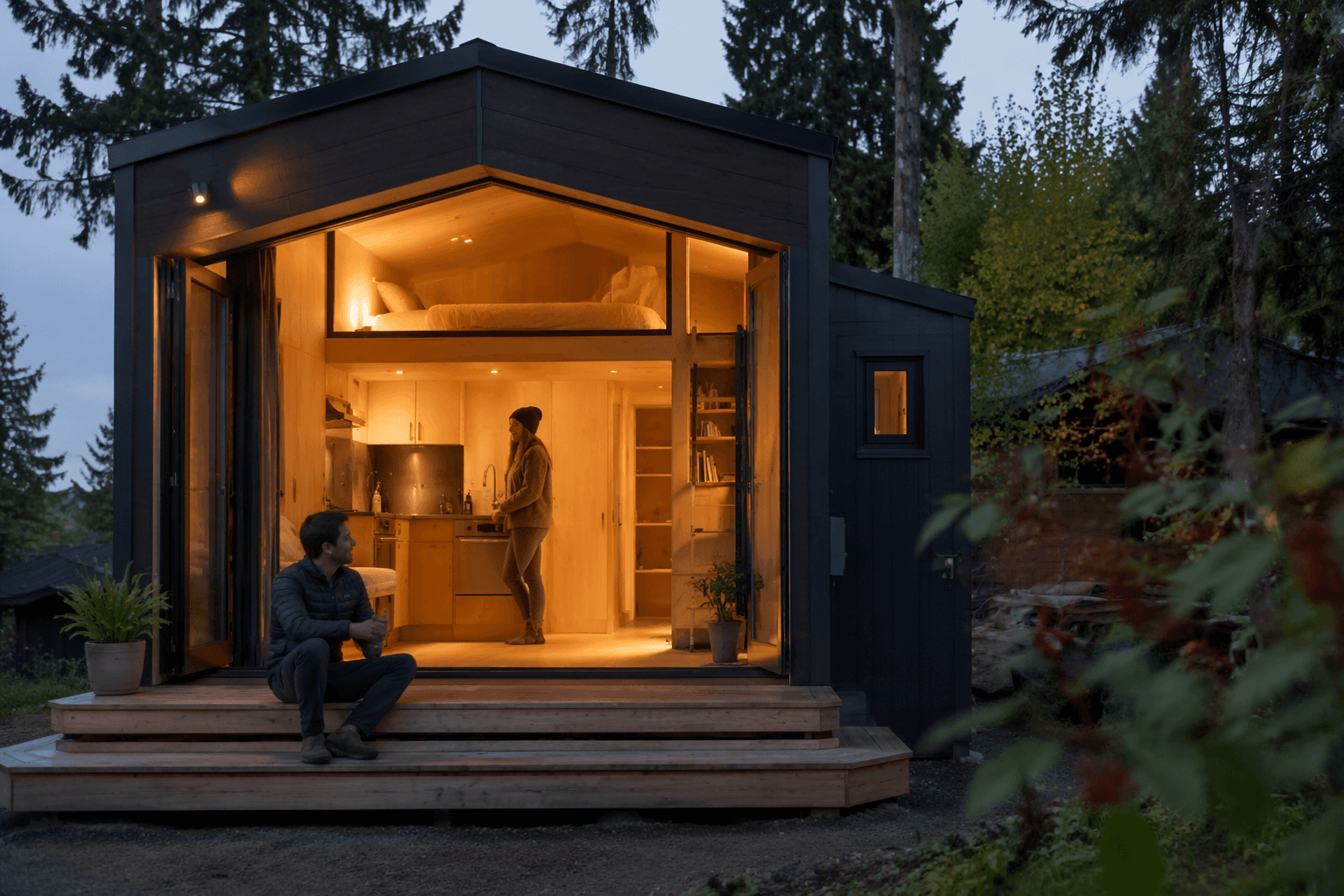
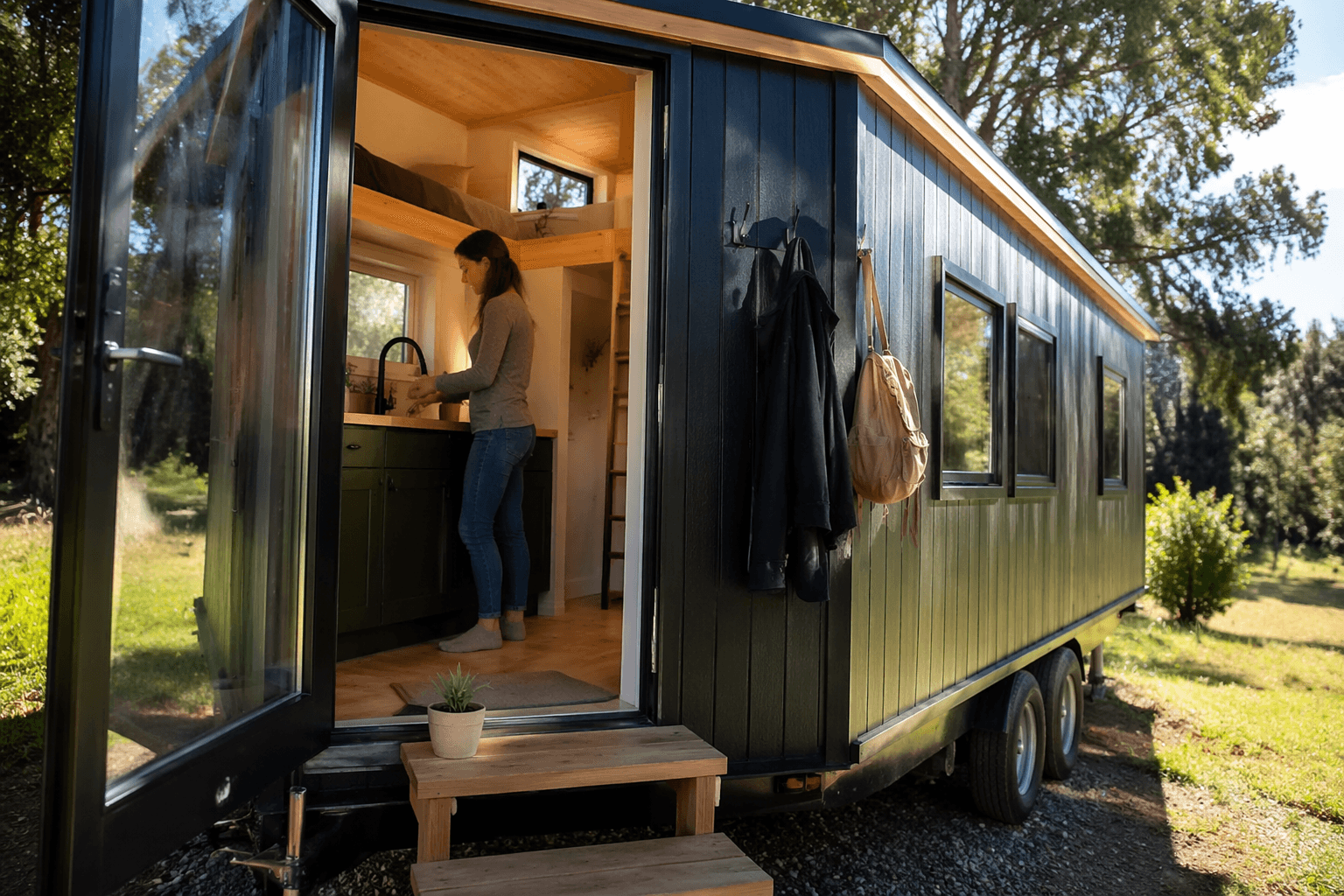
The first impression is intentionally sleek. Matte black standing-seam-style siding, a mono-pitch roofline, and a cedar-clad entry alcove with a covered porch give the house a contemporary profile that reads more urban than cabin-like. The entry alcove does useful work too, creating a sheltered threshold for shoes, coffee, or a quick pause outside before stepping in.
That kind of exterior is part of why this home stands out in a crowded field of tiny builds. It does not rely on rustic shorthand or reclaimed-wood nostalgia to signal charm. Instead, it uses sharp lines and restrained materials to make the small footprint feel deliberate, which is exactly the kind of visual discipline buyers often want when they are paying for a finished unit rather than a project.
Inside, light does the heavy lifting
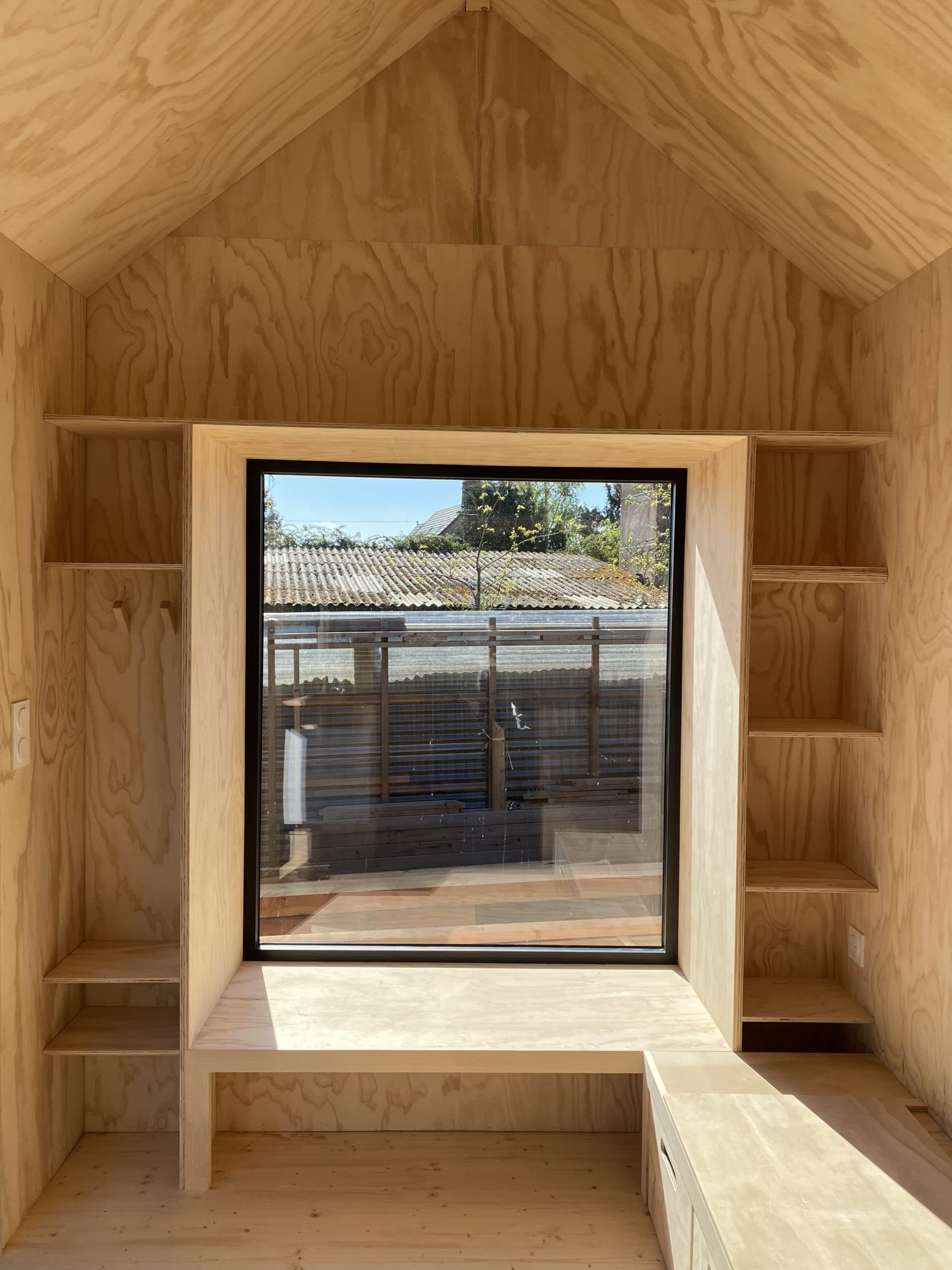
Once inside, the palette flips from dark and crisp to bright and airy. A vaulted stained-wood ceiling, whitewashed plank walls, and light flooring open up the 208-square-foot plan in a way that makes the rooms feel less compressed. Large windows on multiple walls, including two large windows in the living area, bring daylight deep into the main room and keep the interior from feeling boxed in.
The kitchen is only six feet long, but it is not an afterthought. Matte black lower cabinets, a butcher-block counter, a black gooseneck faucet, an undermount sink, an induction cooktop, and upper storage give the galley enough function for real daily use, even if it will never behave like a suburban kitchen. That is the essential tiny-house tradeoff in plain view: you get a complete kitchen, but you give up length, spread, and the easy sprawl of conventional housing.
The bathroom and loft keep the plan flexible
A sliding barn door opens to a bathroom with a shower, vanity, and flush toilet, which is the kind of compact but complete setup that makes a tiny house feel livable rather than merely photogenic. The loft above the bath adds flexibility, serving as sleeping space or storage depending on how the owner wants to use the house. In a footprint this tight, that kind of overlap is not a luxury, it is the design language of the whole unit.
The listing also notes off-grid capability, which broadens the house’s appeal beyond a single type of buyer. The same structure can be imagined as a full-time residence, weekend retreat, guest house, or Airbnb rental, and that range is part of the value proposition. A tiny house that can slide between personal use and income use has a different market life than one that only works as a novelty cabin.
Why the builder and the address matter
Modular Dwelling is based at 400 Dripping Springs Rd, Monterey, TN 38574, and the company describes its buildings as customizable modular structures for living, working, or relaxing. It also says its units can be finished with kitchens and bathrooms so they can serve as living spaces, which fits the Minimalist’s fully outfitted presentation. Local online business posts from 2025 and 2026 showing ongoing tiny-home updates and sales contact information suggest that this is part of an active Monterey builder ecosystem, not a one-off build dropped into the market by accident.
That local context matters because tiny-house buyers are often buying more than a floor plan. They are buying into a builder’s approach, a local supply chain, and whatever support may exist after the sale. A house this compact depends on the builder’s ability to make the small details feel finished, from the porch threshold to the bathroom door to the window placement that keeps the interior bright.
The legal and regulatory reality check
The phrase “affordable tiny house” gets shaky when local rules enter the picture. Tennessee Department of Transportation guidance from 2017 treated tiny houses as portable modular units or mobile homes used for human habitation, and NOAH notes that many jurisdictions use ANSI 119.5 and NFPA 70 for tiny-house construction. NOAH also points out that the 2024 IRC code hearings recognized the term and define lofts, which shows how the category is still being formalized even as the market grows.
That legal backdrop is where the hidden costs often live. Permanent occupancy usually depends on county rules, septic approval, and whether the unit is treated as a wheeled structure or a foundation-based dwelling. For a buyer looking at a $32,000 price tag, those questions can matter as much as the cabinetry, because the house only becomes truly affordable when it can legally and practically be used the way the buyer intends.
How this fits the wider tiny-home market
The broader market helps explain why a polished 208-square-foot build is getting attention. Research and Markets puts the tiny homes market at USD 14 billion in 2026, rising to USD 17.73 billion by 2030 at a 6.1% CAGR. RubyHome’s analysis of 2,600 tiny homes puts the average size at 225 square feet, while the typical single-family home purchased in 2024 measured 2,146 square feet.
Seen against those numbers, the Minimalist lands just below the average tiny home size, but far above the idea of a cramped shed dressed up as housing. It is small, yes, but it is also composed, finished, and specific about its purpose. That is why the $32,000 figure works best as a reality check: it is a genuine entry point, not proof that the rest of the tiny-house equation will be simple.
This article was produced by Prism’s automated news system from verified source data, official records, and press releases, then run through automated quality and moderation checks before publishing. The system is built and supervised by the people who set the standards it runs under. Read our full AI policy.
Know something we missed? Have a correction or additional information?
Submit a Tip