Tiny House Mountain XL adds rooftop deck and luxury finishes
The Mountain XL turns 112 square feet into a retreat with a cedar rooftop deck, walnut counters, and a lofted layout that feels far larger than its footprint.
A tiny house that refuses to feel tiny
The Mountain XL makes its case fast: 112 square feet of primary living space, a loft, and a layout that feels designed to challenge every assumption about what a tiny house has to give up. Built by Comak Tiny Homes and fully towable, the 16-foot-by-8.5-foot home is pitched as an eco-conscious, high-end option for buyers who want compact living without the stripped-down look.
That positioning matters because the Mountain XL is not trying to win on austerity. It is built to feel finished, polished, and deliberately expansive, even before you climb to the roof deck or step into the bathroom. In a market where so many tiny homes lean hard on simplicity, this one argues that small can still read as luxury.
The rooftop deck is the move that changes everything
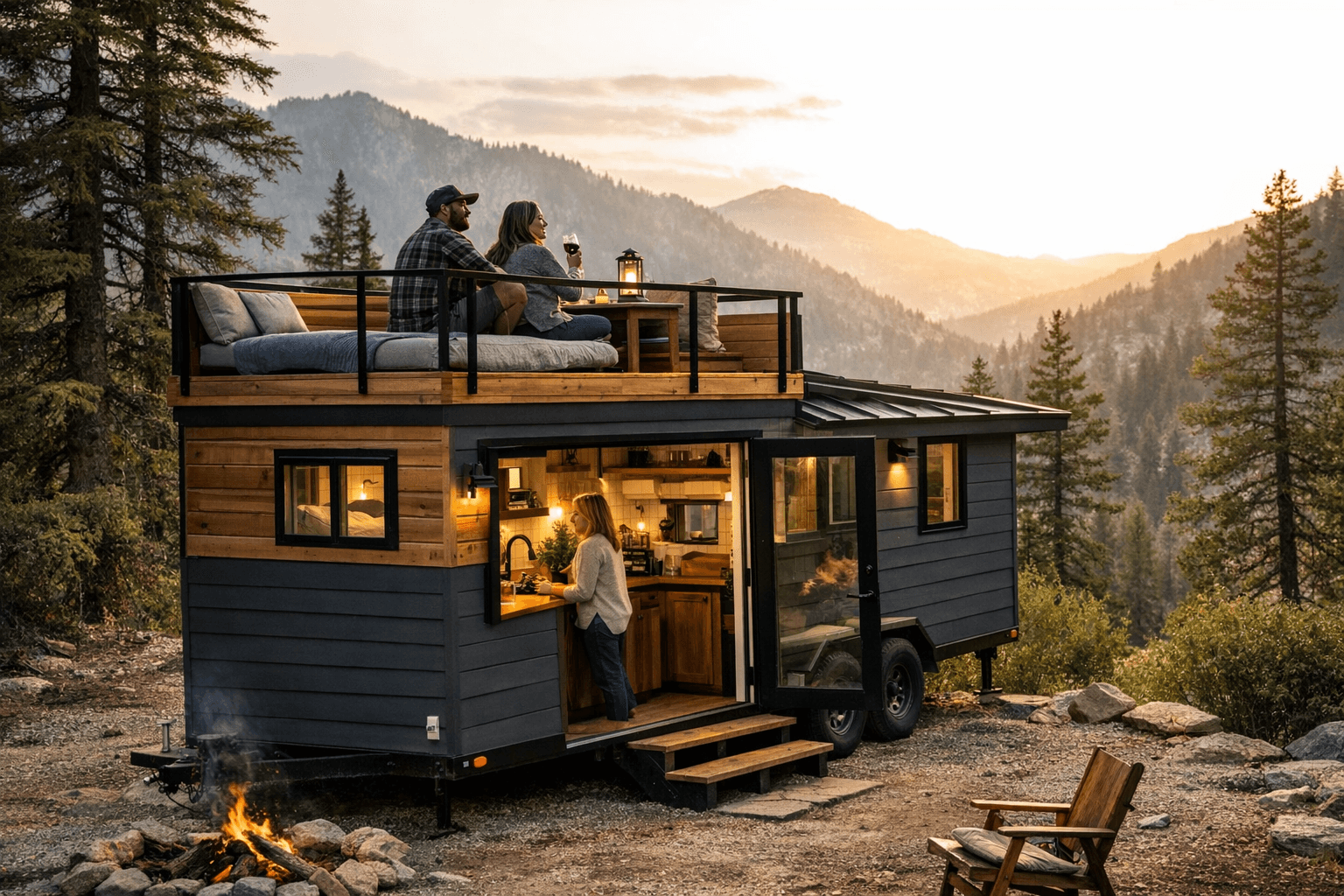
The clearest proof point is overhead. The Mountain XL’s rooftop deck measures 8.5 by 6 feet and is finished in cedar planks, reached by a telescoping ladder and enclosed with stainless steel cable railings. That addition does more than create another place to sit outside; it rewrites how the home is experienced.
In practical terms, the deck effectively doubles usable living area and answers one of the most persistent tiny-house complaints: the boxed-in feeling. Instead of forcing all activity into a narrow interior, the design opens the home vertically and gives the owner a second zone for coffee, evening lounging, or simply getting out into the air without leaving the footprint behind.
That is a smart design lesson for the tiny-house world. When floor area is fixed at 112 square feet, the real gains come from adding function in other directions, and the Mountain XL does that with a roof plane that acts like an outdoor room rather than a decorative extra.
Luxury shows up in the finishes, not just the concept
Inside, the kitchen sets the tone immediately. Live-edge black walnut and epoxy countertops create a more crafted look than the usual compact galley finish, while the composite stone sink and touchless faucet add a level of polish that feels closer to a boutique apartment than a stripped utility cabin.
The material palette stays consistent throughout the build. Custom cedar planking brings warmth and texture, and the overall effect is more retreat than trailer. That visual strategy matters in a tiny home because the surfaces are doing a lot of work: dark wood, clean edges, and tactile finishes make the room feel intentional rather than cramped.
The bathroom continues that approach with a 32-by-32 cedar-plank shower, a detail that may sound small on paper but carries a lot of weight in a compact home. In a space this limited, one well-finished fixture can change the emotional read of the entire interior, and this shower does exactly that.
The systems underneath support the comfort story
The Mountain XL’s upscale feel is not only about visible finishes. Its shell uses hemp wool insulation, a choice that aligns with the home’s eco-conscious positioning while helping maintain a more comfortable interior. The frame relies on light-gauge steel, and the home sits on a 2021 10k tandem drop-axle trailer, an important reminder that tiny-house design still has to balance strength, weight, and towability.
That technical package supports the livability claim. A 12k BTU minisplit handles climate control, while on-demand propane hot water keeps the home functional without wasting space on oversized equipment. These are the kinds of systems that quietly separate a lifestyle tiny house from a novelty build, because comfort depends on what is built in behind the scenes as much as what is visible from the doorway.
The roofline and loft also get thoughtful treatment. A Velux egress skylight over the loft brings in light and adds a safety-minded exit point, while a second fixed skylight over the bathroom keeps the compact footprint from feeling sealed off. In a tiny home, daylight is a design tool, and the Mountain XL uses it to make the interior feel taller, brighter, and less enclosed.
Why this layout feels larger than the square footage
The Mountain XL’s real design lesson is that size is only part of the equation. The 16-foot-by-8.5-foot shell gives the home its hard limits, but the rooftop deck, loft, skylights, and warm material choices all push against those limits in different ways. The result is a home that reads as a sequence of experiences rather than a single box.
That sequence matters for how people use tiny homes today. The loft creates a separate sleeping zone, the skylights keep light moving through the interior, the kitchen feels built rather than improvised, and the rooftop deck expands daily life upward. Each move addresses a familiar tiny-house pain point without asking the owner to abandon the compact footprint.
For builders and buyers watching the market, that is the bigger signal. The Mountain XL shows how tiny homes are increasingly being sold not as a sacrifice, but as a refined lifestyle product where craftsmanship, sustainability, and outdoor connection do the heavy lifting. It is tiny in floor area, but it is designed to feel generous where it counts, and that is exactly the kind of shift reshaping the category.
This article was produced by Prism’s automated news system from verified source data, official records, and press releases, then run through automated quality and moderation checks before publishing. The system is built and supervised by the people who set the standards it runs under. Read our full AI policy.
Did this article answer your question?