Véronique Tiny House Flips Bedroom Below Living Space for Better Privacy
A 134.5-square-foot French tiny house flips the bedroom to ground level, producing real gains in egress compliance, thermal comfort, and privacy that lofted layouts can't match.
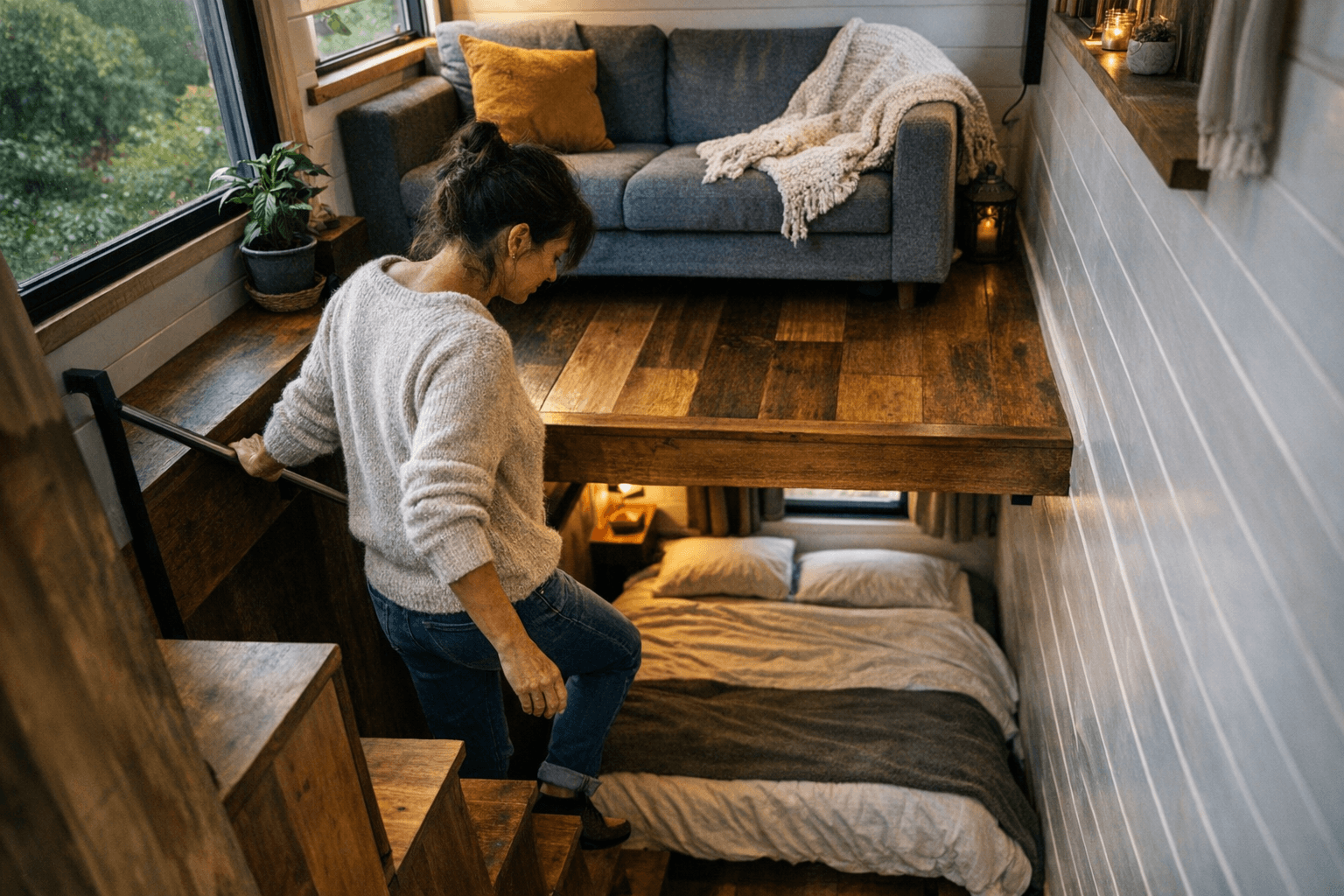
The loft ladder is one of tiny house living's most persistent compromises: awkward at midnight, borderline dangerous for children, and completely useless as an emergency exit. The Véronique, a 19-foot towable home designed by France's Lou Tiny House, dispenses with it entirely. Its "upside-down" layout drops the bedroom to the lower level and elevates the living room above, a sequence that reshuffles not just daily convenience but three building-performance variables that matter to anyone planning year-round occupancy: egress compliance, thermal stratification, and moisture control.
What the Véronique Actually Is
Built on a double-axle trailer measuring 5.80 m (19 ft) and finished in spruce cladding under a metal roof, the Véronique compresses 12.5 square meters (134.5 square feet) of floor space into a layout that would look familiar to anyone who has lived in a split-level apartment. The ground-level bedroom has a low ceiling but sits at walk-in height, accessible without climbing anything. A set of removable steps leads to the upper living room, which holds a sofa and a table and doubles as a workspace. The kitchen sits at the intermediate level, anchored by a farmhouse-style sink and a four-burner propane stove with oven. A fully equipped bathroom rounds out the plan.
The home was built for Véronique, an accomplished musician whose instrument collection, including a double bass, a cello, a piano, and five violins, demanded custom storage that would have been impossible to reconcile with a conventional loft plan. Lou Tiny House solved it with a built-in shelving unit positioned between the bedroom and the kitchen, using the transition zone between levels as functional storage rather than dead circulation space. The home has been delivered to its owner in France's Cantal mountains.
The Egress Advantage Nobody Talks About
Standard loft bedrooms in tiny houses almost universally fail emergency egress requirements under residential building codes, because a sleeping space reached by a fixed ladder offers no compliant emergency exit path. The Véronique's ground-floor bedroom changes that equation in a measurable way.
Under the International Residential Code framework that governs most U.S. jurisdictions (and comparable French standards), a sleeping room requires an emergency escape opening with a minimum net clear area of 5.7 square feet, a minimum height of 24 inches, and a minimum width of 20 inches, with the sill no higher than 44 inches from the finished floor. Crucially, a grade-floor sleeping room earns a code reduction: the minimum net clear area drops to 5.0 square feet when the window opening is at or near ground level, because rescue personnel can reach it without ladders. That 0.7-square-foot reduction is not just arithmetic. It means a lower-level bedroom can use a narrower or shorter window profile and still pass inspection, giving designers more wall flexibility in a space where every inch matters.
The Véronique's bedroom is described as featuring a generous window row, which suggests Lou Tiny House is meeting or exceeding that threshold. Before copying this layout, confirm the window dimensions yield at least 5.0 square feet of net clear opening and that the sill height clears the 44-inch rule. In a towable unit parked on a raised foundation or deck platform, the effective grade changes, and so does compliance.
Thermal Stratification: The Upside-Down Layout's Quiet Win
Physics works in the Véronique's favor in a way conventional tiny house plans actively fight. Warm air rises. In a standard loft-bedroom layout, the sleeping space sits at the top of the thermal stack and accumulates heat overnight, which is the exact opposite of what most people need for quality sleep. The Véronique reverses that: the bedroom stays in the cooler lower zone, while the living and working space above benefits from rising warmth during winter days.
The home's primary heating source makes this more deliberate. Lou Tiny House mounted a passive solar heating system on the exterior, a panel array that looks like photovoltaics but functions as a solar thermal collector, drawing heated air through the structure via a fan or natural convection. New Atlas noted this is the first such system seen on a tiny house. The warm air introduced by that system rises naturally toward the upper living room, where it is most needed during working hours, while the bedroom remains insulated from peak afternoon heat gain. For backup, the Véronique includes a mini-split air-conditioning system and a wood-burning stove, giving three independent layers of thermal control across a footprint that most full-size HVAC systems would dismiss as a single zone.
In hot climates, the calculus shifts slightly: the lower bedroom will stay cooler in summer without mechanical cooling, which is a genuine energy benefit, but the upper living room will absorb more radiant heat through the roof assembly. In those conditions, roof R-value and ventilation detailing become critical. A metal roof with inadequate insulation underneath, combined with an elevated living space, is a recipe for uncomfortable afternoons regardless of how efficient the mini-split is.
Moisture Control: The Ground-Level Risk to Verify
Moving the bedroom to the lowest level of a towable unit introduces a moisture management challenge that loft layouts sidestep entirely. The subfloor of a tiny house on a trailer is exposed on its underside to ambient air, which in humid climates carries moisture that migrates upward through temperature differentials. A sleeping space at that level needs a robust vapor control strategy: a continuous vapor retarder on the underside of the floor assembly, adequate subfloor insulation to keep the surface above the dew point, and ventilation that prevents condensation from accumulating in the wall cavities adjacent to the bedroom.
In the Cantal mountains, where the Véronique has been sited, winters are cold and humid, which makes this a real rather than theoretical concern. Anyone replicating this layout in a similar climate should confirm the subfloor insulation specification before construction. A commonly cited benchmark for cold-climate tiny house floors is R-30 or higher; without knowing Lou Tiny House's spec for the Véronique, that figure is the minimum worth verifying with your builder.
Who This Plan Actually Suits
The upside-down layout delivers its clearest benefits to three groups.
- Families with young children, where the elimination of a loft ladder removes the most statistically significant injury risk in a compact home, and where the separated sleeping zone allows adults to maintain an active upper-level living room without disturbing sleeping children below.
- Privacy-conscious solo occupants or couples who want a bedroom that functions as a proper room rather than an elevated alcove visible from the main living space. The Véronique's ground-level bedroom is physically separated from the kitchen and living room by the instrument storage unit, creating a genuine zone boundary rare in this size class.
- Cold-climate occupants who can exploit natural thermal stratification to keep the sleeping space cool and the working space warm simultaneously, reducing mechanical heating demand during daylight hours.
The layout is less advantageous in hot, humid climates where ground-level moisture is a persistent problem and where a cooler lower zone offers less benefit when the whole structure needs air conditioning anyway. It also demands careful attention to stair safety: the removable steps connecting the lower and upper levels must meet minimum tread depth and riser height requirements if the home is inspected as a dwelling rather than an RV.
The Regulatory Friction Point
The Véronique arrives at a moment when the tiny house community is increasingly pressing regulators to treat towable homes with year-round design quality as residential dwellings rather than recreational vehicles. That distinction controls access to permanent utility hookups, applies different safety standards for egress and fire resistance, and determines which zoning overlays a parked tiny house can occupy.
The Véronique's combination of layered heating systems, passive solar technology, dedicated sleeping zones, and full kitchen and bathroom equipment makes it difficult to classify as a seasonal or recreational unit. That is precisely the regulatory grey zone that policymakers have been slow to address. As design quality in the towable sector rises, the practical distance between a well-built tiny house and a small permanent dwelling shrinks to the point where the RV classification begins to look like a procedural convenience rather than a meaningful distinction.
For buyers considering a layout like this, the path forward involves confirming three things before breaking ground or placing an order: that the jurisdiction where the home will be sited has an adopted pathway for THOW occupancy, that egress windows in the lower bedroom meet the local code threshold (5.0 or 5.7 square feet depending on grade), and that the heating and insulation specifications are documented in a way that will satisfy a residential inspector rather than just an RV compliance check. The Véronique demonstrates that the design quality is already there. The paperwork is the remaining gap.
This article was produced by Prism’s automated news system from verified source data, official records, and press releases, then run through automated quality and moderation checks before publishing. The system is built and supervised by the people who set the standards it runs under. Read our full AI policy.
Did this article answer your question?