Oregon Identifies 50-Year-Old Case, Naming Skeletal Remains as Montana Man
A skull, a scapula fragment, and a brown sweater found near Holcomb Peak in 1978 sat unidentified for 52 years — until an anonymous ancestry DNA upload cracked the case open.
Mark Smith left his home in Billings, Montana, in 1974 to travel and was not heard from again. The last known image of him is a photograph from his sister's wedding in September 1973. Smith's sister told the medical examiner's office that the family thought about him every day during the more than 50 years since he disappeared. On March 25, 2026, Oregon State Police announced what the family had spent half a century waiting to hear: Mark Smith had been found.
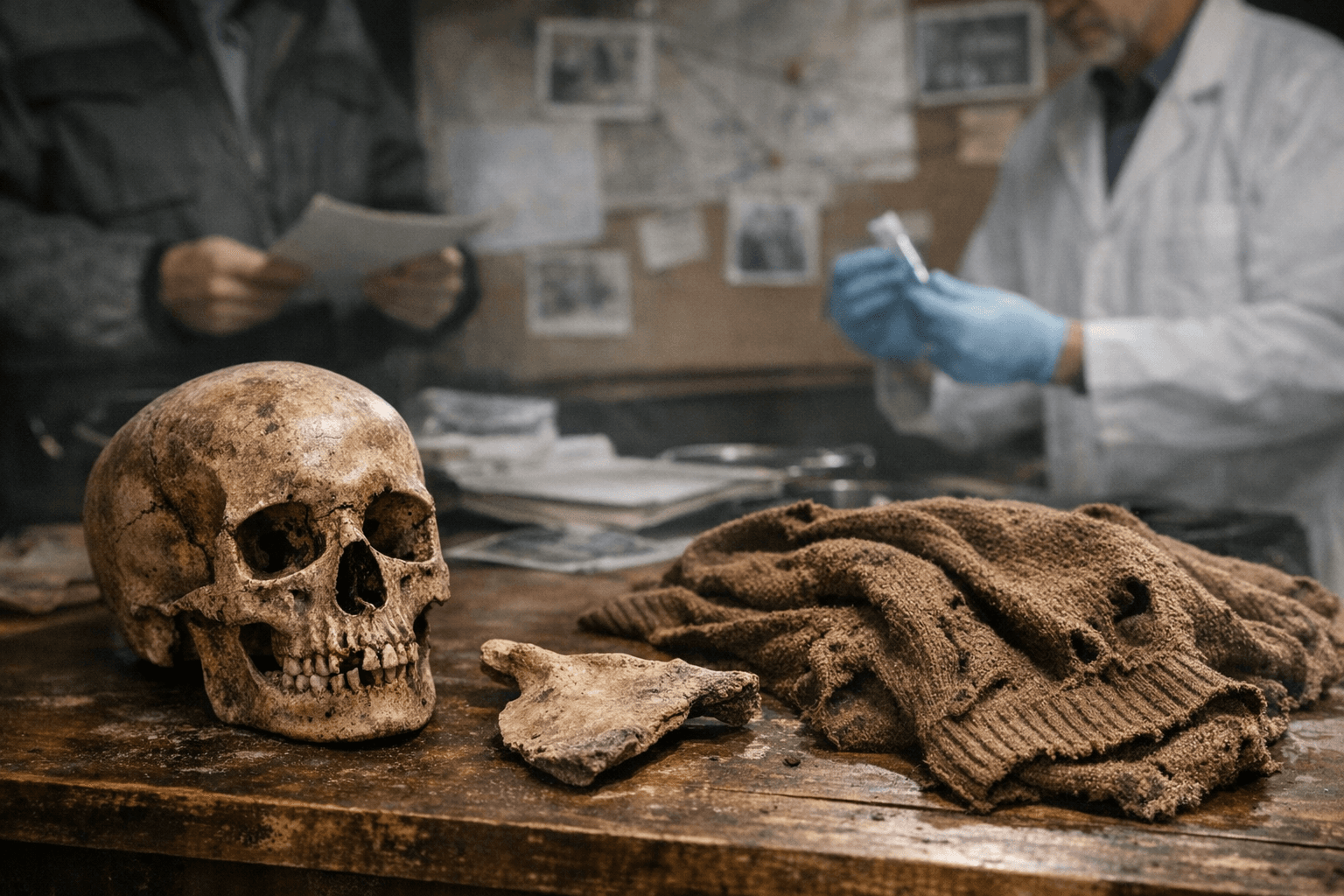
On May 9, 1978, a logging crew discovered the partial remains of a skeletonized young male near Williams, Oregon, in the area of Holcomb Peak. Only a skull and a scapula fragment were recovered. A piece of a shirt and remnants of a brown sweater were found near the remains and collected. Holcomb Peak is a 5,268-foot mountain in southern Oregon. The Josephine County Sheriff's Office responded to the scene, however no further remains were found. Despite their efforts, the remains could not be identified, and the case went cold.
The first forensic examinations only deepened the mystery. When a forensic pathologist and odontologist examined the skull and scapula, they came to the erroneous conclusion that they belonged to a 16- to 18-year-old girl. With no matching missing male profile and little to go on beyond two bones and some clothing, the case sat largely dormant for more than four decades.
The turn came in 2020. The state medical examiner's office sent the remains to the University of North Texas for DNA analysis and extraction, and that analysis confirmed the remains belonged to a male. Oregon State forensic anthropologist Hailey Collord-Stalder described how dramatically that finding reframed everything: "All we actually had was a cranium and part of his scapula, his shoulder blade." The sex reclassification reopened the investigative field entirely, but a name still proved elusive.
That changed in September 2025. Collord-Stalder described the breakthrough in precise terms: "Somebody uploaded their DNA kit to one of these ancestry sites, and the genealogist was like, 'Oh my gosh, I can finally build a tree.' That was the linchpin." The Human Identification Program worked with a Josephine County medicolegal death investigator who contacted the family of Mark Smith, confirmed that Smith had been missing since 1974, and his siblings each gave swabs of their DNA that were submitted for testing, along with a tooth from the remains.
On Feb. 25, 2026, DNA Labs International confirmed the family reference samples and tooth were a sibling-level match, allowing the Human Identification Program and the state medical examiner's office to formally identify the remains as those of Mark Smith. On February 26, 2026, the Oregon State Medical Examiner's Office Human Identification Program verified that unidentified remains found in Josephine County in 1978 were a match to Smith. Josephine County notified the family as soon as the positive identification was confirmed by a forensic pathologist.
It is worth noting that sources variously reported Smith's age at the time of his disappearance as either 17 or 19. The Oregon State Medical Examiner's Office confirmed the remains as those of Mark Smith, who was 19 when he disappeared after leaving his home in Billings, Montana. One outlet reported his age as 17, a discrepancy that has not been formally reconciled in public records.
Collord-Stalder described the family's reaction as anything but simple relief: "Mixed shock and grief all over again, and some sort of, at least not necessarily closure, but answers." Her own words on the institutional side of the case were equally pointed: "We are grateful that Mark has finally been returned to his family. This identification reflects years of persistence, scientific collaboration, and the evolving power of forensic genetic genealogy."
Initial attempts for genetic analysis were unsuccessful; however, DNA Labs International agreed to continue working on the case pro bono. That commitment, combined with a stranger's decision to upload a consumer DNA kit to an ancestry database, ultimately closed a 52-year gap between a family's last photograph and a final answer.
With the identification complete, the State Medical Examiner's Office and Josephine County are working with the family to ensure appropriate next steps and final arrangements. No evidence has been found to suggest foul play; however, the investigation into the circumstances surrounding Smith's death remains open.
This article was produced by Prism’s automated news system from verified source data, official records, and press releases, then run through automated quality and moderation checks before publishing. The system is built and supervised by the people who set the standards it runs under. Read our full AI policy.
Did this article answer your question?