Partial Remains Found on Sonoma Beach Identified as Banker Missing Since 1999
A tibia with surgical hardware found on a Sonoma beach in 2022 has been identified as Walter Kinney, a banker missing since 1999, whose other remains had washed ashore 23 years earlier.

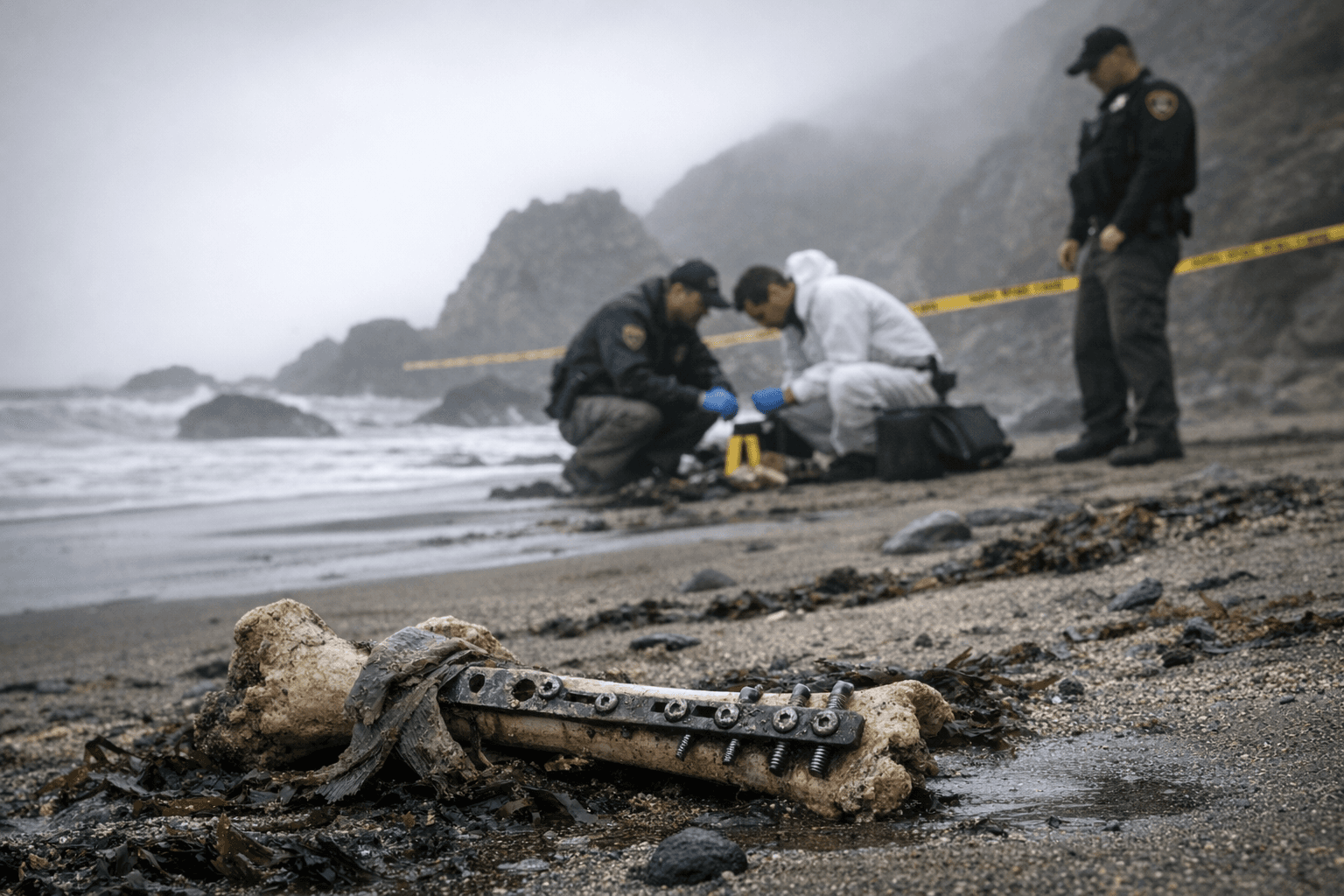
A visiting family stumbled onto something unexpected at Salmon Creek State Beach on June 17, 2022: a long bone protruding from the sand, later determined to be a tibia embedded with surgical hardware. Nearly four years later, that bone has been identified as Walter Karl Kinney, a Santa Rosa banker who was 59 years old when he vanished on August 10, 1999.
The identification came through a partnership between the Sonoma County Sheriff's Office and the DNA Doe Project, a Sebastopol-based nonprofit that uses forensic genetic genealogy to put names to unidentified remains. Investigators developed a DNA profile from the bone and uploaded it to the GEDmatch genealogy database in January 2026. Within just over a week, volunteer genealogists had zeroed in on Kinney as the likely match. The identification was publicly announced in late March 2026.
What makes the case particularly striking is that this was not the first time Kinney's remains were identified as a John Doe. Additional partial remains had washed ashore near Bodega Head, roughly five miles south along the Sonoma County coastline, in late 1999. Those remains were identified back in 2003, after Kinney's daughter contacted investigators. That earlier identification was achieved through X-ray matching: investigators obtained Kinney's medical records, noted documented foot problems, and matched those X-rays to the leg recovered at Bodega Head.
The 2022 bone at Salmon Creek sat unidentified for nearly three years before the Sheriff's Office formally partnered with the DNA Doe Project in May 2025. The critical link between the two cases came in January 2026, when DNA Doe Project researchers uncovered past reporting on the 1999 Bodega Head discovery and the 2003 identification, allowing investigators to connect both finds to the same individual. Traci Onders, a team leader at the DNA Doe Project, told reporters the case was "unusual — it's not often we see someone end up as a John Doe twice."
Kinney, born in San Diego in 1940, had made his home in Santa Rosa before disappearing. Reporting noted struggles with alcoholism and periods of incarceration that sometimes created long gaps in family contact, facts that complicated earlier efforts to trace his whereabouts after August 1999. His daughter, who had been instrumental in the 2003 Bodega Head identification, offered investigators a portrait of the man behind the case number. She described Kinney as "smart, sensitive, almost to a fault," and said "this world was just too harsh a place for him."
Sheriff Eddie Engram acknowledged the nonprofit's role in an official statement: "Thank you to the DNA Doe Project for helping us put a name to the human remains found at Salmon Creek Beach. We value this partnership as we continue working together to identify remains found in Sonoma County."
The DNA Doe Project, founded in 2017 by Margaret Press, has worked on more than 250 cases since its founding. The organization solved its first case in March 2018 when it identified "Buckskin Girl," a murder victim found in a ditch in Troy, Ohio in 1981, as Marcia Lenore Sossoman (King). As of December 2023, investigative genetic genealogy had collectively resolved 651 criminal cases, identifying 464 decedents and 318 perpetrators.
The Kinney case closes the missing-person chapter for a family that went more than 25 years without answers. How Kinney ended up in the waters off Sonoma County remains an open question for investigators.
This article was produced by Prism’s automated news system from verified source data, official records, and press releases, then run through automated quality and moderation checks before publishing. The system is built and supervised by the people who set the standards it runs under. Read our full AI policy.
Did this article answer your question?