Queens Man Charged With Murder After Fatal Flushing Arson Killed Four
A Queens man told police he torched a Flushing building because he "needed to get his anger out" after losing his food processing job, killing 3-year-old Sihan Yang and three others.
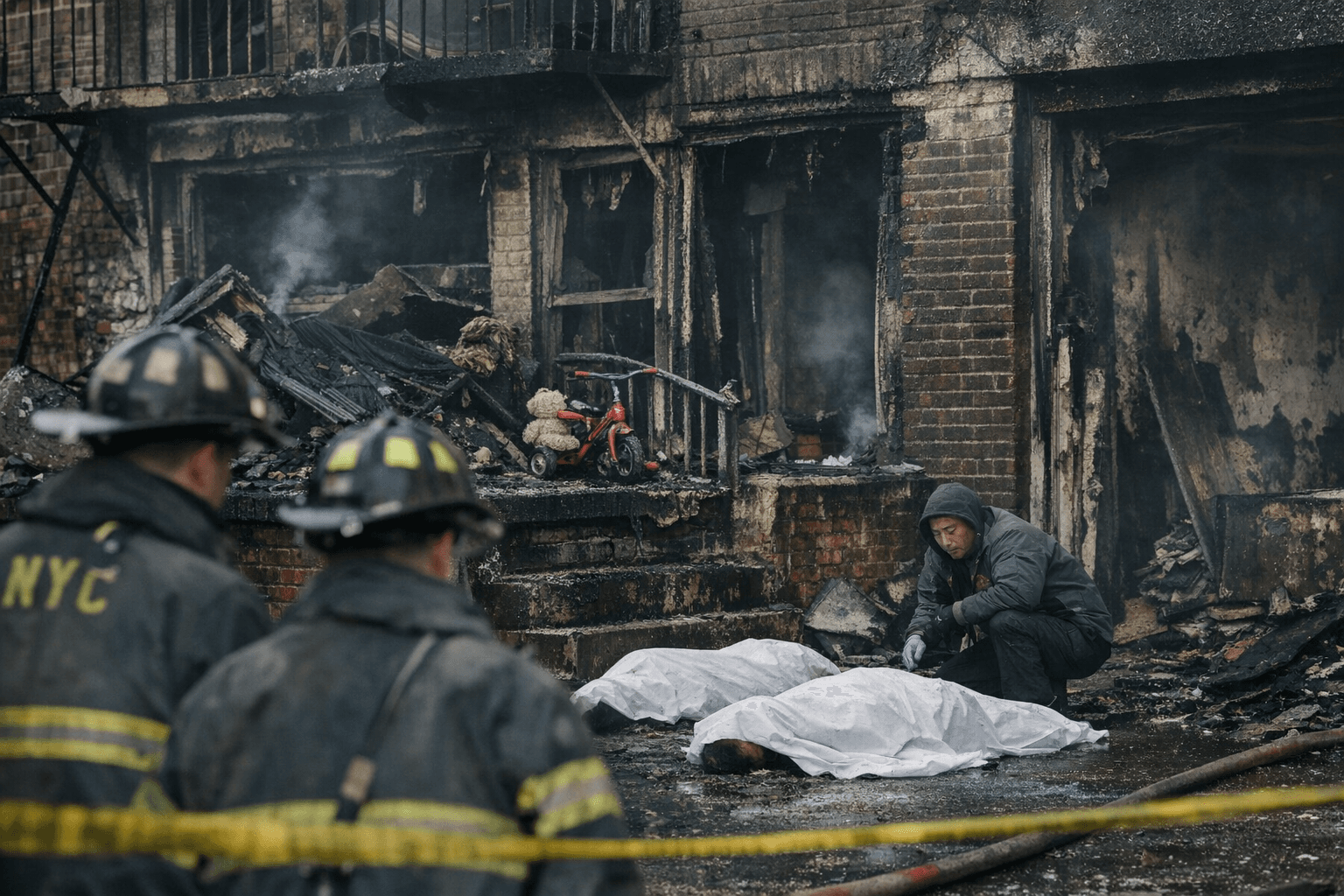
The surveillance footage told the story before Roman Amatitla ever spoke to police. On the evening of March 16, the 38-year-old Queens man entered an apartment building on Avery Avenue in Flushing three separate times, crossed the street to a gas station where he shoplifted a beer while buying another and picked up a book of matches, then returned a fourth time. Investigators say he lit a piece of paper and fed it into the garbage at the base of the first-floor stairwell. Then he walked outside and watched the building burn, beer in hand.
Four people died. Sihan Yang was 3 years old. Chengri Cui was 50. Shin Chie Ming was 61. Hong Zhao, 64, jumped from a window to escape the smoke and flames and died at a hospital from injuries sustained in the fall. Two firefighters were hospitalized when the second floor collapsed. The Office of the Chief Medical Examiner ruled all four deaths homicides.
Amatitla was arraigned Thursday on eight counts of murder, 12 counts of assault, eight counts of arson, and four counts of petit larceny. He pleaded not guilty and is being held without bail, with his next court appearance set for Monday. If convicted, he faces 25 years to life.
According to the criminal complaint, Amatitla told police he had gotten into a fight at work, had been fired from his food processing job, and "needed to get his anger out." He acknowledged to investigators that he knew he was going to harm people. He had no prior criminal record and no prior relationship with the victims or the building they lived in.
Queens DA Melinda Katz called it "one of the greatest crimes this borough has seen in a very long time" and said Amatitla "set it on fire and watched it as it burned, drinking some beers." Defense attorney Vivian Cedeno, speaking outside court, responded: "Our client has been charged, but a charge is not a conviction. We intend to vigorously defend him, and I would ask that we let the legal system play out, because right now, he's presumed innocent."
The physical evidence underpinning the arson determination is significant from a forensic standpoint. Fire Marshal investigators distinguish intentional fires from accidental ones through burn-pattern analysis: accelerants create a rapid, non-linear spread inconsistent with heating failures or electrical shorts. Here, law enforcement confirmed accelerant use and that the fire was set from inside the building. The flames covered the first and second floors fast enough to trap residents above and force others to jump. The surveillance footage documenting Amatitla's deliberate supply run for matches before each re-entry seals the premeditation argument prosecutors will build their case around.
The building carried its own compounding liabilities. Records show the three-story structure had accumulated nearly 60 violations over 30 years, with 16 still open at the time of the fire. Many were related to illegal apartment conversions and overcrowding. A 2020 inspection found the two-family home had been converted into multiple single-room units with extra beds, raising concerns about safety in case of emergencies. Those conditions, which limit evacuation options and accelerate smoke spread, raise a line of accountability that extends beyond Amatitla's individual prosecution. Whether housing regulators face scrutiny over those 16 open violations is a question the case has yet to fully surface.
This article was produced by Prism’s automated news system from verified source data, official records, and press releases, then run through automated quality and moderation checks before publishing. The system is built and supervised by the people who set the standards it runs under. Read our full AI policy.
Did this article answer your question?