Atlantic Bluefin Tuna Shifting Northward as Ocean Warming Reshapes Habitat
New research projects Gulf of Mexico bluefin spawning habitat could collapse by 70% as warming oceans push Thunnus thynnus toward Greenland and northern Europe.
Bluefin habitat in the Gulf of Mexico could lose up to 70% of its suitability for adult fish under the most pessimistic greenhouse-gas emissions scenario, while the Mediterranean faces a 27% decline, according to new modelling and observational work published in Fish and Fisheries by an international team led by researchers at AZTI, the Spanish scientific and technological centre based in Pasaia, Spain.
The study, titled "Navigating future waters: The resilience of the Atlantic bluefin tuna under climate change," projects a progressive northward shift in Atlantic bluefin tuna (Thunnus thynnus) distribution as ocean temperatures rise throughout the 21st century. Lead author Maite Erauskin-Extramiana put it plainly: "climate change is already reshaping the balance between feeding areas, spawning grounds and fishing activity."
The projections are built on advanced models combining environmental data, recorded bluefin occurrences, prey distribution, and fishing activity across multiple climate scenarios running through to the end of the century. As suitable habitat contracts in tropical and temperate zones, the models identify emerging high-latitude refugia zones across northern Europe, the northeastern Atlantic, and waters surrounding Greenland. Those gains are not incidental. Key prey species including sardines, mackerel, and squid are themselves expected to shift poleward, creating new feeding overlap zones particularly in boreal regions.
The two losses that will hit closest to home for anyone following the bluefin fishery are the Mediterranean and the Gulf of Mexico. Both are the species' principal spawning grounds, and the projected declines under worst-case emissions directly threaten long-term reproductive success. The Gulf of Mexico, which the U.S. government currently refers to as the Gulf of America, faces the steeper drop at up to 70%. Losses of that magnitude would fundamentally alter where the next generation of giants comes from.
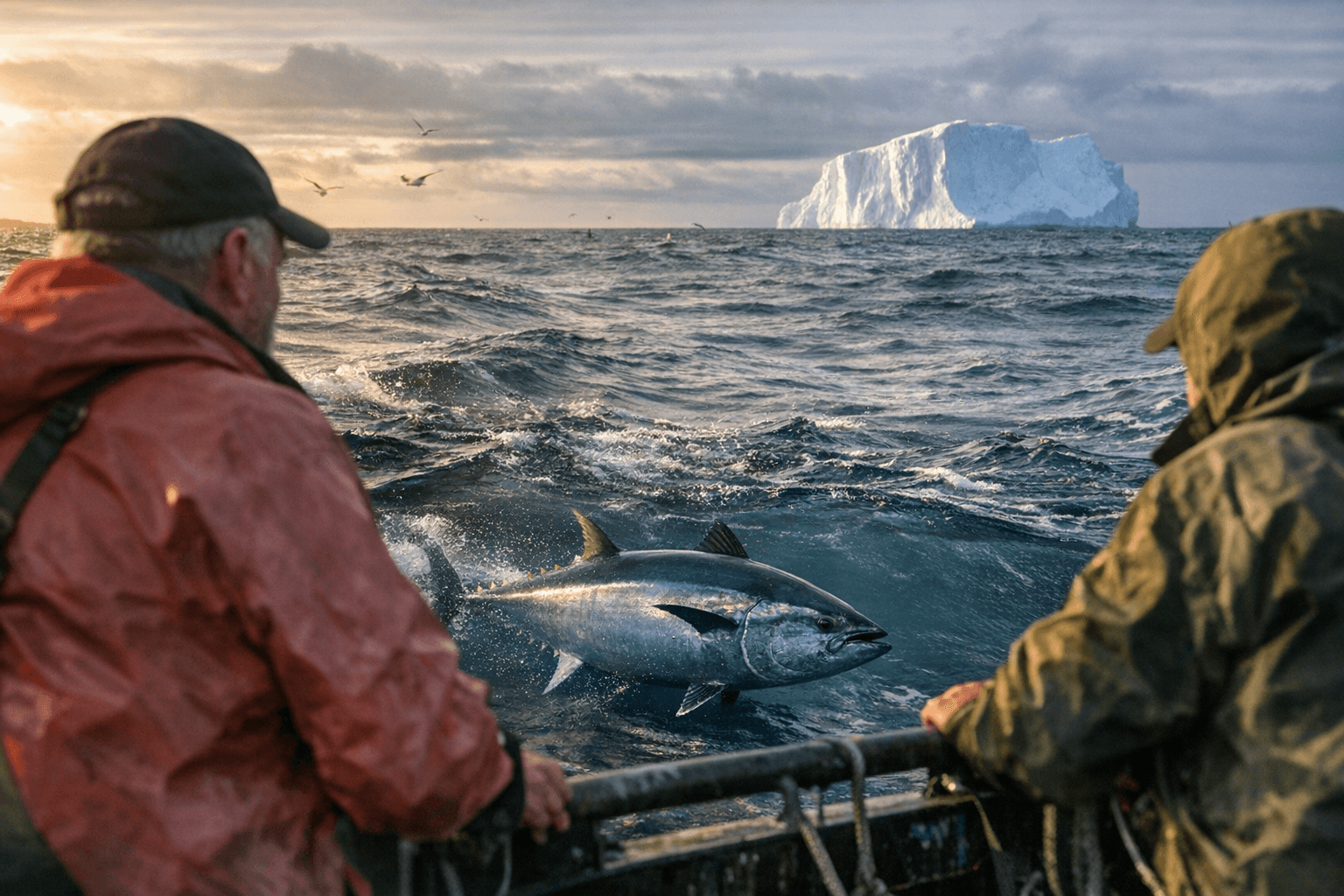
The redistribution is not, the researchers emphasize, a temporary fluctuation. It is, in the framing of Italian outlet Pesceinrete, "gradual and structural," with the potential to redraw global fisheries maps and challenge balances considered stable for decades. A highly mobile stock shifting distribution rapidly becomes difficult to govern under regulatory frameworks designed for a relatively static ocean, particularly when feeding areas, spawning grounds, and fishing zones no longer overlap as they historically have.
That governance problem sits at the center of the study's policy argument. The researchers stress that the findings underscore the urgent need for flexible, climate-adaptive fisheries management capable of responding to species that no longer conform to traditional boundaries. Given that Atlantic bluefin ranks among the world's most economically valuable marine species, the consequences extend well beyond ecosystems to quota systems and international fisheries agreements.
The research was supported by Spain's Ministry of Science and Innovation and five European projects: FutureMares, SusTunTech, Mission Atlantic, Biodiversa+, and SOMBEE. The full paper is available at bit.ly/4se9WGU.
This article was produced by Prism’s automated news system from verified source data, official records, and press releases, then run through automated quality and moderation checks before publishing. The system is built and supervised by the people who set the standards it runs under. Read our full AI policy.
Did this article answer your question?