Best Practices for Landing, Handling, and Releasing Tuna Safely
Keeping a tuna alive long enough to release, or table-quality enough to sell, comes down to decisions made in the first 60 seconds after the fish hits the cockpit.
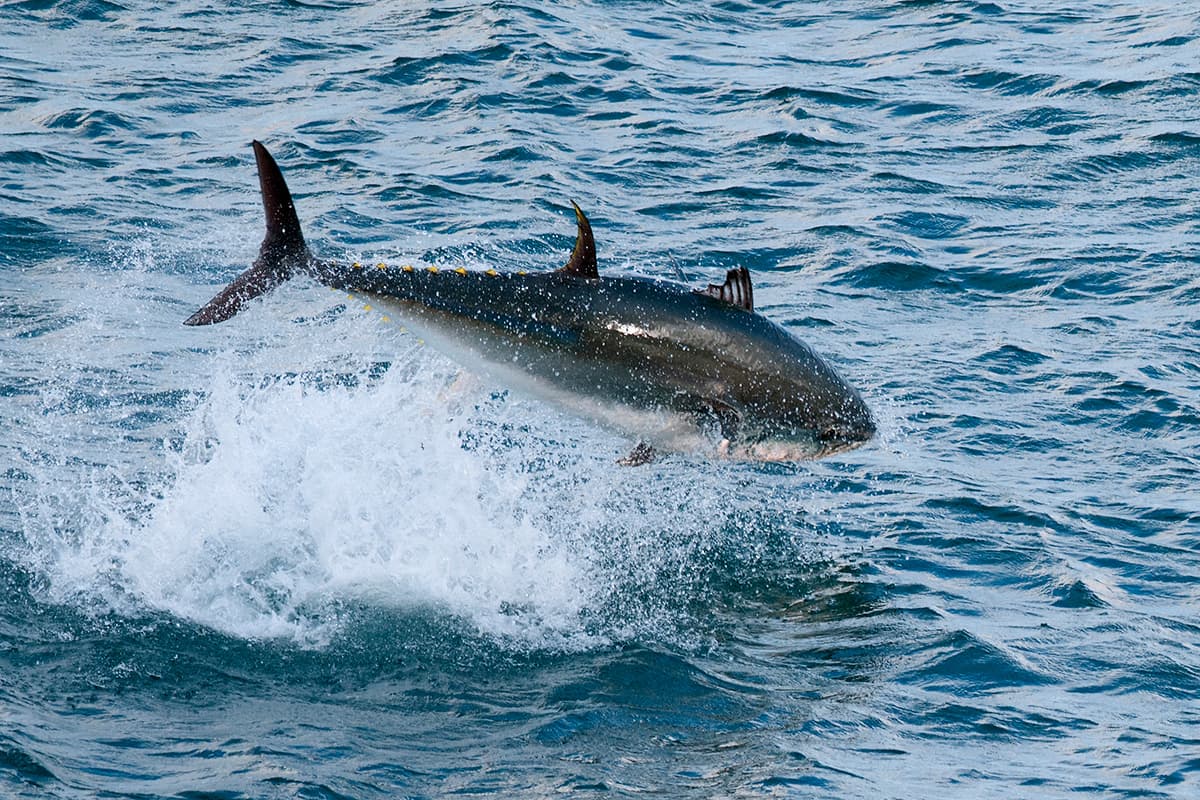
Every serious tuna angler knows the fight is only half the battle. The moment that fish comes to color, a new clock starts, and every decision made in the next few minutes determines whether a released bluefin survives to run another day, or whether a keeper lands on the dock in prime condition. Getting those decisions right requires preparation long before you leave the ramp.
Gear Up Before You Leave the Dock
For catch-and-release fishing, the gear you bring dramatically affects how a fish survives after being let go. Circle hooks, barbless hooks, or hooks with crimped barbs can increase survival rates and make hook removal easier. For tuna, hooks should be corrosion-resistant and sized appropriately, typically 6/0 to 10/0 circle or J-hooks. Non-stainless steel hooks are also worth considering; they will corrode and fall out over time if a fish escapes before it can be de-hooked.
Use tackle heavy enough to bring the fish in quickly, and avoid multi-hook rigs or lures where possible. Braided lines are preferred for their strength-to-diameter ratio and sensitivity, usually ranging from 50 to 80 pounds test, paired with a fluorocarbon leader of 80 to 130 pounds test for abrasion resistance and low water visibility. On the deck side, clear the cockpit of unnecessary obstructions before the fight begins. Wash-down hoses, 5-gallon buckets, loose trolling lures, and extra rods should all be safely secured. The last thing you want is the angler or designated gaff man tripping during the final crucial moments of the fight.
Fighting the Fish: Speed Is Welfare
The most common causes of post-release mortality are physiological stress resulting from the struggle during capture, injuries caused by the hook, and mishandling of the fish by the angler. Fish that struggle intensely are usually exhausted and stressed from the accumulation of excessive amounts of lactic acid in their muscles and blood. The science is direct: bluefin tuna are known for high stress levels and physical exertion during capture, and prolonged fight times lead to greater mortality in released fish, specifically when released in warmer water.
On a cabin boat, fight your tuna with the boat positioned downwind with the angler in the aft corner. When a tuna begins doing death circles, the angler needs to keep the line away from the hull by reaching down and out over the gunwale as the fish disappears under the boat. Communication matters throughout: talk to each other. A clear line of communication is a key to success in the cockpit. The angler should announce when he or she sees the fish by shouting "color."
Landing: Gaff Selection and Placement
A flying gaff is necessary when dealing with large fish that are still green. The hook releases once the fish is hooked and remains attached by a connection rope, allowing the fish to continue to wear out without causing damage or danger to the boat and crew. A flying gaff should predominantly be used on giant fish like swordfish, tuna, and sharks. For huge fish including giant tuna, 4- to 5-inch hooks are needed to deeply penetrate and control these powerful fish.
Placement is everything. Bury the gaff in the forward shoulder of the fish. Always aim for the top of the fish toward the head for more control and to protect the meat. Too many tuna are gaffed in the shoulder, which ruins a lot of the best meat, and some in the throat latch where you may hit the heart and ruin the bleeding process. Once a fish is on the gaff, instruct the angler to back off the drag or disengage the reel with the clicker on. Crew coordination is critical here: a second crewman should stand by to place another gaff once the fish is close to the hull. A useful rule of thumb: one gaff for fish up to 100 pounds, two gaffs for fish around 150 pounds, and three gaffs (or a flying gaff) for anything over 200 pounds.
If You're Releasing: Work Fast and Stay in the Water
Federal Regulation 50 CFR 635.21(a)(1) requires that an Atlantic highly migratory species that is not retained must be released in a manner that will ensure the maximum probability of survival, without removing the fish from the water. That rule reflects the biology perfectly. Keep air exposure to a minimum if you must remove a fish from the water. Less than 60 seconds is the ideal maximum.
Never gaff a fish you plan to release. Dehook the fish in the water whenever possible. If a swallowed hook can't be easily removed, cut the line as close to the hook as possible. The best approach for release is to use a heavy ARC dehooker or to get the fish by the jaw with a lip gaff and work the hook out quickly.
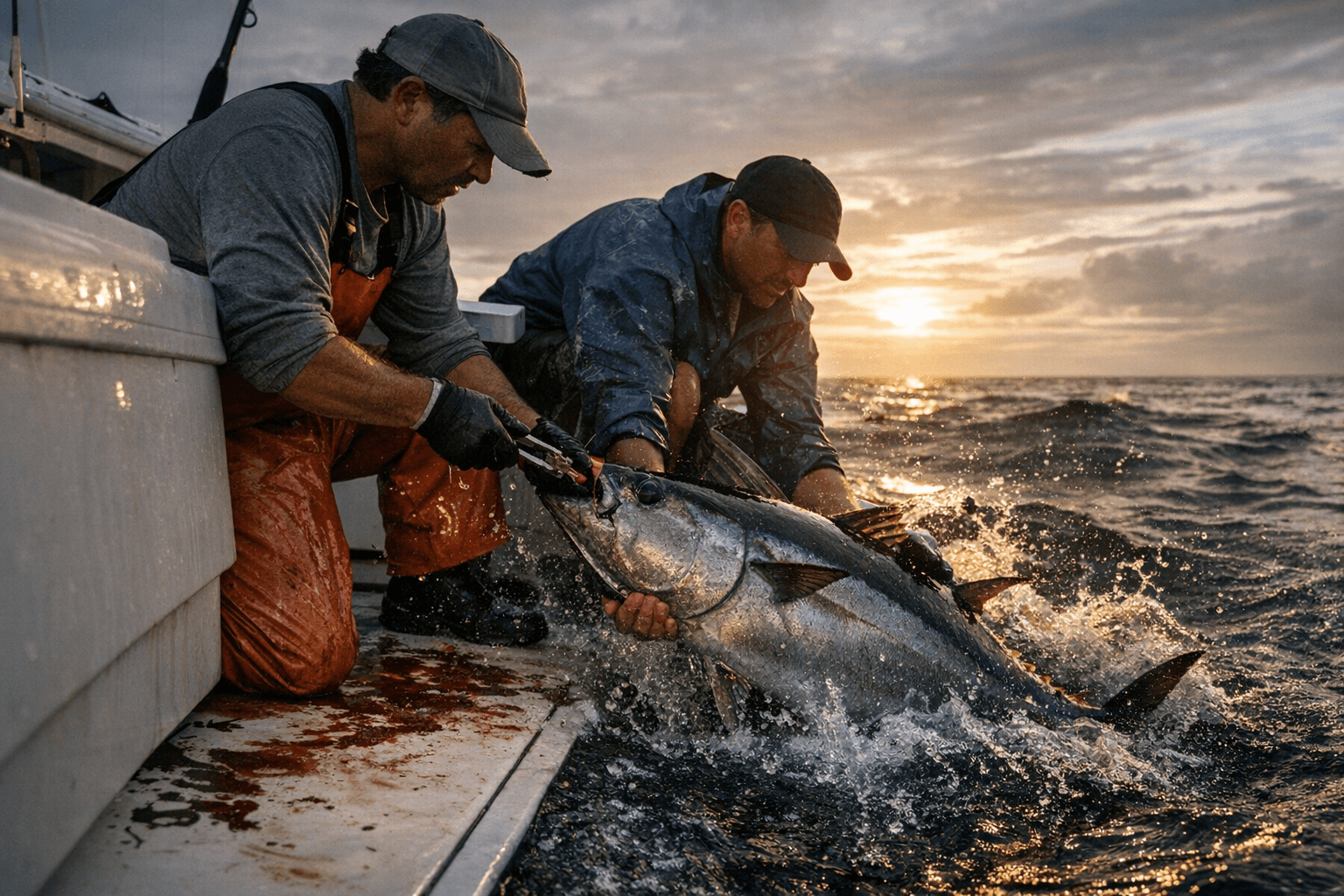
Once the hook is clear, the fish needs active recovery. Orient the fish headfirst into the current, then gently move it in a figure-eight pattern so that water flows through the mouth and over the gills. Do not let the fish go until it is able to swim strongly out of your grasp. Some anglers will "shoot" a tuna back into the water, almost like throwing an oversized spear downward, forcing saltwater across the gills. The post-release survival data supports taking all of this seriously: a study using pop-up archival satellite tags estimated the post-release mortality rate of bluefin tuna captured with bait on circle hooks and released without being brought onboard the boat. Tags reported from 2 to 246 days post-release, with two of 59 bluefin tuna dying after catch-and-release, yielding a mortality rate of just 3.4%. That low number is achievable precisely because the fish were handled correctly.
If You're Keeping It: Dispatch, Bleed, and Chill Immediately
For fish being retained, the decisions made in the first minutes after landing have the same urgency, just for different reasons. Ike jime is a traditional Japanese slaughter technique that involves instantaneously euthanizing a fish by inserting a spike into its brain cavity. The fish is then thoroughly bled and undergoes spinal cord destruction before being iced down.
Ike jime produces a biochemically superior product because it eliminates stress and the natural consequences of death. When a fish experiences stress, its brain floods the muscles with lactic acid, cortisol, and adrenaline; core body temperature also rises. The combination of hormones and elevated temperature turns muscle tissue to mush and negatively impacts taste. Ike jime prevents this from occurring.
The process breaks down into four linked steps:
1. Perform ike jime as soon as the tuna is on deck by inserting a spike into the brain. This quickly and humanely dispatches the fish, reducing stress and lactic acid buildup to preserve the quality and taste of the meat. Locate the kill spot in the middle of the head between the eyes and slightly back. Some tuna even have a slight indent which should be your entry point.
2. Bleed the tuna by making a clean incision behind the pectoral fins or at the tail. This allows the blood to drain, which is essential for preventing a metallic or fishy taste. Make sure to only make a shallow cut so the artery bleeds out, not back into the body cavity.
3. Perform the shinkei jime technique by running a wire through the spinal cord. This halts nerve impulses that can cause muscle twitching and rigor mortis, keeping the flesh smooth and preventing muscle deterioration.
4. After ike jime and bleeding, cool the fish immediately. Place the tuna in a slush ice bath, submerged in a mixture of crushed ice and seawater. The rapid cooling process locks in freshness and texture and prevents bacterial growth.
Bluefin tuna can be worth a lot of money, but only when properly handled to maintain quality and appearance. How you handle your fish will influence how much it's worth and how willing dealers are to buy your catch. The most important things are to minimize physical damage, bleed the fish, and keep it cool and moist.
Tournament Considerations
Charter captains and tournament crews carry an added layer of responsibility. Catch-and-release conditions that matter most include gear used, hook type and location, fight duration, handling method, general condition of the fish, and water temperature. Keeping a log of these variables is increasingly valuable as NOAA's research into giant Atlantic bluefin post-release mortality advances. Interest in Atlantic bluefin tuna has skyrocketed among recreational fishermen, with some vessels exceeding a catch-and-release rate of 10 or more commercial-sized fish per day, making standardized handling protocols on board more important than ever.
For any tournament where fish must be measured rather than weighed, use a lip gaff to hold the fish alongside the boat with a measuring device rigged and ready so the fish can be measured in the water. Never use scales that hang the fish by the jaw, as this can damage the jaw, gills, backbone, and internal organs.
The Standard Worth Keeping
Simply letting a fish go does not guarantee it will live. The actions taken before, during, and after landing a fish are what improve the chances of survival, keep fish populations healthy, and keep anglers fishing. Whether the tuna you're handling is destined for the sashimi plate or the open ocean, the same principle applies: every second of sloppy handling costs something, and none of it is recoverable once the fish is gone.
This article was produced by Prism’s automated news system from verified source data, official records, and press releases, then run through automated quality and moderation checks before publishing. The system is built and supervised by the people who set the standards it runs under. Read our full AI policy.
Did this article answer your question?