India Expands Deep-Sea Tuna Fishing Capacity With Major PMMSY Investment
India approved ₹2,416.92 crore in PMMSY funding for Andhra Pradesh's fisheries sector, with 50 deep-sea vessels sanctioned and tuna longlining training now underway.
India's Department of Fisheries approved ₹2,416.92 crore in proposals from the Andhra Pradesh government, directing a substantial share of that investment toward deep-sea fishing capacity and the kind of tuna-targeting infrastructure that could shift where Indian boats are catching fish.
The Department of Fisheries approved proposals worth ₹2,416.92 crore from the Andhra Pradesh government, with a central share of ₹569.86 crore aimed at developing fisheries infrastructure including fishing harbours, landing centers, cold storage facilities, and value addition units.
The vessel numbers tell the story of how serious this push has become. Under PMMSY, traditional fishermen are receiving financial aid to acquire Deep Sea Fishing Vessels, with subsidies of up to 60% for women and SC/ST beneficiaries. The initiative has already sanctioned 50 DSFVs for Andhra Pradesh, of which six are currently operational.
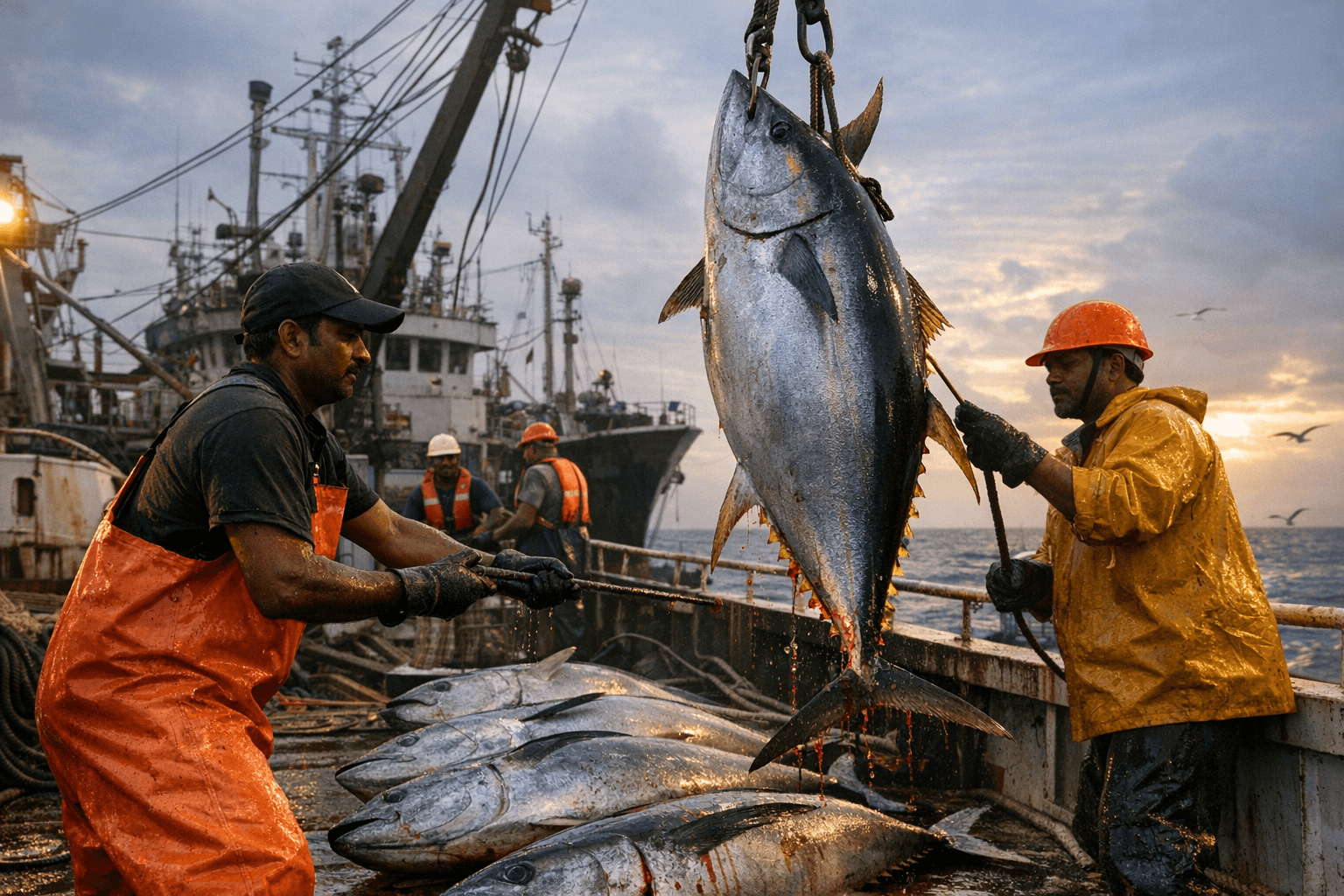
For tuna specifically, the training pipeline is already running. The Fishery Survey of India conducts onboard skill training programmes focusing on deep-sea tuna longlining and sashimi-grade tuna handling, crucial for export-oriented fisheries. The National Fisheries Development Board, in collaboration with the Central Institute of Fisheries Nautical and Engineering Training, has trained 8,040 marine fishermen in deep-sea fishing techniques and onboard fish handling practices, of which 874 fishermen belong to Andhra Pradesh.
The target markets are clear. Deep-sea fishing enhances high-value seafood exports, particularly tuna and sashimi-grade fish demanded in Japan, EU, and US markets. Andhra Pradesh's EEZ potential gives this investment real teeth: the Andhra Pradesh EEZ alone accounts for approximately 3.65 lakh tonnes of potential annual yield, highlighting the significant regional opportunity for expanding deep-sea fishing operations.
PMMSY, launched in 2020-21, aims to transform India's fisheries sector through infrastructure, productivity enhancement and value-chain development, and includes components such as support for acquisition of deep-sea fishing vessels and upgrading vessels for export competitiveness, targeting high-value international seafood markets. Since the scheme launched, India's overall fish production has surged. India's fish production has surged from 141.60 lakh tonnes in 2019-20 to around 197.75 lakh tonnes in 2024-25, a 38 percent increase since the launch of PMMSY in 2020.
The EEZ access framework has also expanded to support the new vessel capacity. Access passes are being issued to mechanized fishing vessels and motorized fishing boats engaged in tuna and tuna-like species to operate in India's EEZ, and as of early March 2026, 707 access passes have been issued from all coastal states and union territories including Andhra Pradesh.
Six operational DSFVs in Andhra Pradesh is a modest beginning against the backdrop of a 50-vessel sanction, but the cold storage buildout, harbour investment, and longlining training running in parallel suggest the bottleneck isn't intent. The infrastructure catching up to the ambition is where the next few years in Indian tuna fishing will be decided.
This article was produced by Prism’s automated news system from verified source data, official records, and press releases, then run through automated quality and moderation checks before publishing. The system is built and supervised by the people who set the standards it runs under. Read our full AI policy.
Did this article answer your question?