Jigging, Trolling, Popping, and Chunking: Choosing the Right Tuna Tactic
No single tuna tactic dominates every day on the water — knowing when to switch from trolling to chunking or drop jigs on stubborn deep fish is what separates consistent anglers from one-trip wonders.
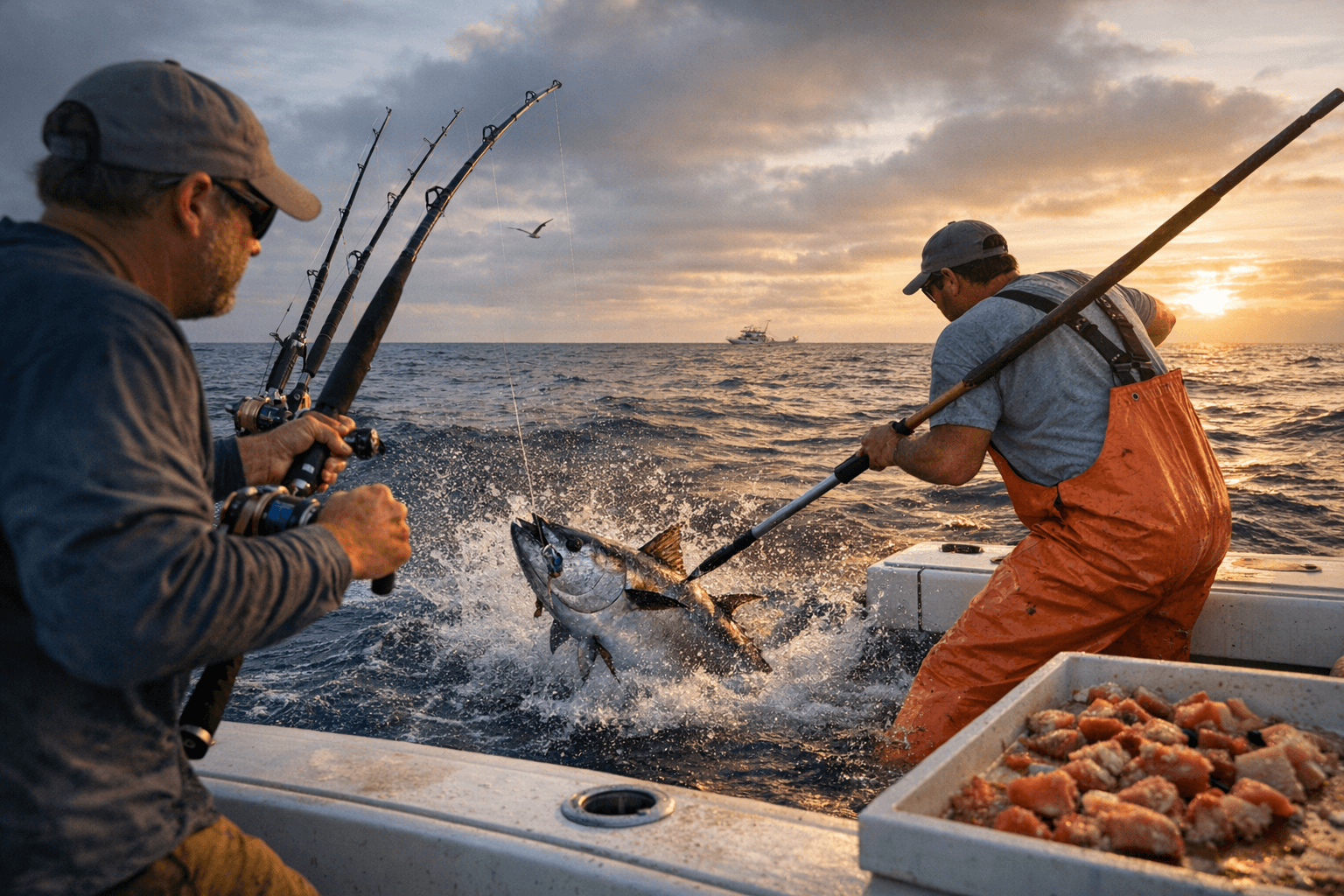
Most offshore trips leave the dock committed to one plan. That's a mistake. Trolling, chunking, and jigging are all effective methods for pursuing tuna — but not every day. The savvy tuna angler keeps options open when running offshore and prepares for whatever bite presents itself, because daily changing conditions require readiness for everything from old-school trolling to new-wave jigging. Popping into a surface blitz is its own animal entirely. Here's how each technique works, what gear it demands, and — most importantly — when to deploy it over the others.
Trolling: The Search Tool
Trolling covers water fast and is the best way to find tuna when you're not sure exactly where they are. It involves dragging artificial lures or rigged baits behind a moving boat at speeds of 6 to 10 knots. For tuna feeding on the surface, a typical spread includes Tuna Birds, squid spreader bars, daisy chains, cedar plugs, and ballyhoo rigged on blue-and-white Ilanders or black-and-purple Joe Shute skirts. The preferred trolling speed is 6.5 to 8 knots, but throttle down to 5.5 to 6.5 knots for deeper presentations.
Spread construction matters. For a typical spread, set flat lines at 25 and 35 feet, run a center flat line 50 to 60 feet off the transom, set short rigger lines at 75 and 100 feet respectively, long riggers at 150 and 200 feet, and run the shotgun 250 to 300 feet back. Two of the most popular charterboat baits are a blue/white Ilander skirted over medium ballyhoo, and the multi-colored spreader bar rigged with a green machine as the trailing bait. Color preference varies day to day, but green, pink, and blue/white are fairly consistent with yellowfin — on overcast days or early mornings, try a black/purple skirt.
When the first rod goes down, don't pull in the spread. Tuna are school feeders, so don't be content when the first rod goes down. Maintain trolling speed to trigger additional strikes; some captains actually speed up to entice more hits after the first strike. Be sure to zigzag and make frequent turns over contour lines to enable the baits to dip in the water column, a presentation tuna find irresistible.
For bluefin specifically, water temperature is your cue to adjust the trolling depth. Early and late in the season, when the water hovers in the 70- to 75-degree range, bluefins often feed on the surface. When the water temp rises to 77 degrees, they go down and tactics need to change.
Chunking: The Patient Approach
Chunking is the bread-and-butter technique for tuna fishing, especially for yellowfin and bluefin. It's a stationary technique where chunks of bait, usually sardines or butterfish, are thrown into the water to create a chum slick. This method is highly effective at attracting yellowfin when they are feeding near the surface, with anglers dropping their baited hooks into the slick and waiting for a bite.
Butterfish are the number one chunk bait and are readily available in frozen boxes called flats — usually three flats suffice for a full day of serious chunking. Fresh-cut oily baitfish, particularly menhaden, bonito, and sardines, are most effective. The oil content creates a scent dispersion that draws yellowfin from a distance, and freshness matters significantly, as fresh chum disperses scent far more efficiently than frozen.
The single biggest mistake crews make once the rods go down: they stop throwing chunks. No one wants to cut up chunks when the rods are screaming, but continuing to throw chunks is critical to keeping the school behind the boat. If you stop chunking, the crew will get to watch a nearby boat catch "your" school of fish.
Drop a hooked chunk into the slick and let it drift back naturally with the freebies. The trick that catches more fish: mix hooked baits in with unhooked chunks so the yellowfin can't tell which ones have metal in them. Chunking rewards patience. Sometimes it takes 30 minutes to build a productive slick, but once the bite starts, it can be nonstop.
For hooks, circle hooks are mandatory in most fisheries and far more effective anyway. For yellowfin and smaller bluefin, a Gamakatsu Tuned Tuna Hook gives you a premium Japanese-made hook with a perfect gap for chunk baits. When targeting giant bluefin, step up to the Mustad 7693S-SS, a stainless steel hook built for fish that can pull 100-plus pounds of drag.
Vertical Jigging: The Depth Weapon
Jigging got a major shot in the arm when Shimano developed their line of butterfly jigs in the 1990s to reach deep bluefin, and the jig's popularity has been growing with its reintroduction to tuna anglers ever since. The technique is physical but devastatingly effective on fish that refuse to come up. The technique consists of quickly sweeping the rod skyward and retrieving line as the rod is lowered before repeating, duplicating the erratic movement of baitfish fleeing toward the surface. Be prepared: the jig is often attacked as it falls due to its attractive flutter.
Speed jigging is deadly effective on yellowfin, especially on fish in the "unders" class under 47 inches. Jigs in the 100 to 300 gram range worked with an erratic, fast retrieve draw explosive strikes — the jig comes up quick on the lift and drops slightly on the down sweep, mimicking a wounded baitfish darting through the water column. Metal jigs in the 150 to 300 gram range are workhorses for vertical jigging. Blue, silver, chartreuse, and pink are proven color choices.
For tackle, jigging gear runs to a stout 5'6" to 6'6" rod rated for 60-100lb braid, paired with a 10000-14000 size spinning reel, spooled with 65-100lb braid and a 3 to 5 foot leader of 80-130lb fluorocarbon. Jigging can be performed with any type of outfit, but the best results come from a reel capable of retrieving line at high speed and a lightweight rod that won't wear out your arms.
Use your sonar to stay efficient. When fish show up on the sonar, drop the jig below them and work it up through the water column, repeating the process until hooking up. To maximize return for your effort, mark your line at 50-, 100-, 150-, and 200-foot intervals using permanent markers on braid or a piece of wax rigging line tied to the mainline. If fish are showing at 120 feet on the sonar, the jig can be quickly dropped to the 150-foot mark and worked up to 100.
In recent years, jig-and-pop techniques have taken many bluefin, especially the smaller 50-150 lb class fish in the Pacific.
Popping and Casting: The Surface Game
Casting large surface poppers is an exciting way to catch yellowfin tuna. This method works best when tuna are actively feeding on the surface, with anglers using heavy spinning rods to cast poppers and retrieve them with aggressive popping motions to create surface disturbances that mimic fleeing baitfish.
Poppers are a reaction-strike game, and you need the right hardware to pull it off. Top casting lures include the Shimano Orca, Williamson Popper Pro, Yo-Zuri Bull Popper, and Yo-Zuri Slider. For popping and jigging, spinning reels like the Shimano Stella and Daiwa Saltiga are top choices. Line up a surface blitz, make the cast ahead of the breaking fish, and work that popper hard — the explosion when a 50-pound yellowfin crushes a surface plug is something you don't forget.
When to Switch: Reading the Bite
This is where trips are won or lost. Leave the dock prepared to apply multiple techniques on the same day. There will be times when the fish are on a trolling bite, others when chunking is clearly the better way to hook up, and still others when jigging gets the job done.
Here's a practical decision framework:
- Troll when you don't know exactly where the fish are — it covers water fast.
- Jig while chunking: chunk lines are behind the boat, leaving room for crew members to jig. Keep jigging outfits ready while trolling too. Marking tuna deep that refuse to rise for trolled baits? Wind in the spread and send jigs down to their depth.
- Pop when tuna are visibly and actively feeding on the surface.
- Chunk for canyon fishing, particularly at night in the Atlantic.
- When the bite dies entirely, scale down. Dropping from 100lb to 60lb fluorocarbon leader can turn reluctant fish into biters, and the same goes for downsizing hook size on chunking rigs.
Tuna feed differently by time of day, and many species feed more aggressively during low light. At first light, tuna that spent the night deeper will often push bait to the surface, creating the classic dawn topwater bite. Similarly, the last hours of daylight can spark a frenzy. Dawn is prime time for surface popping and shallow trolling; midday is when jigging down deep earns its keep.
Bluefin can be selective feeders and at times gorge on sand eels or halfbeaks while ignoring other offerings. Matching the hatch helps — if bluefin are on halfbeaks, a slender soft-plastic lure trolled on the surface might work. Bluefin also have incredible eyesight, so use longer fluorocarbon leaders and try to fish during periods of lower light or choppy surface conditions.
The anglers who consistently put fish in the box aren't married to any single method. They troll until they find fish, chunk to hold them, jig down when the school goes deep, and cap it all off by throwing a popper into a surface melee if the conditions set up right. Carry the gear for all four, and you'll never be left watching another boat load up while yours stays empty.
This article was produced by Prism’s automated news system from verified source data, official records, and press releases, then run through automated quality and moderation checks before publishing. The system is built and supervised by the people who set the standards it runs under. Read our full AI policy.
Did this article answer your question?