Massive Tuna Hauled Ashore in Cuba Sparks Viral Social Media Frenzy
A million-view clip of men hauling a massive tuna ashore at Cuba's Playa Baracoa has tuna anglers worldwide debating species, weight, and what it takes to land a beast like that from the beach.
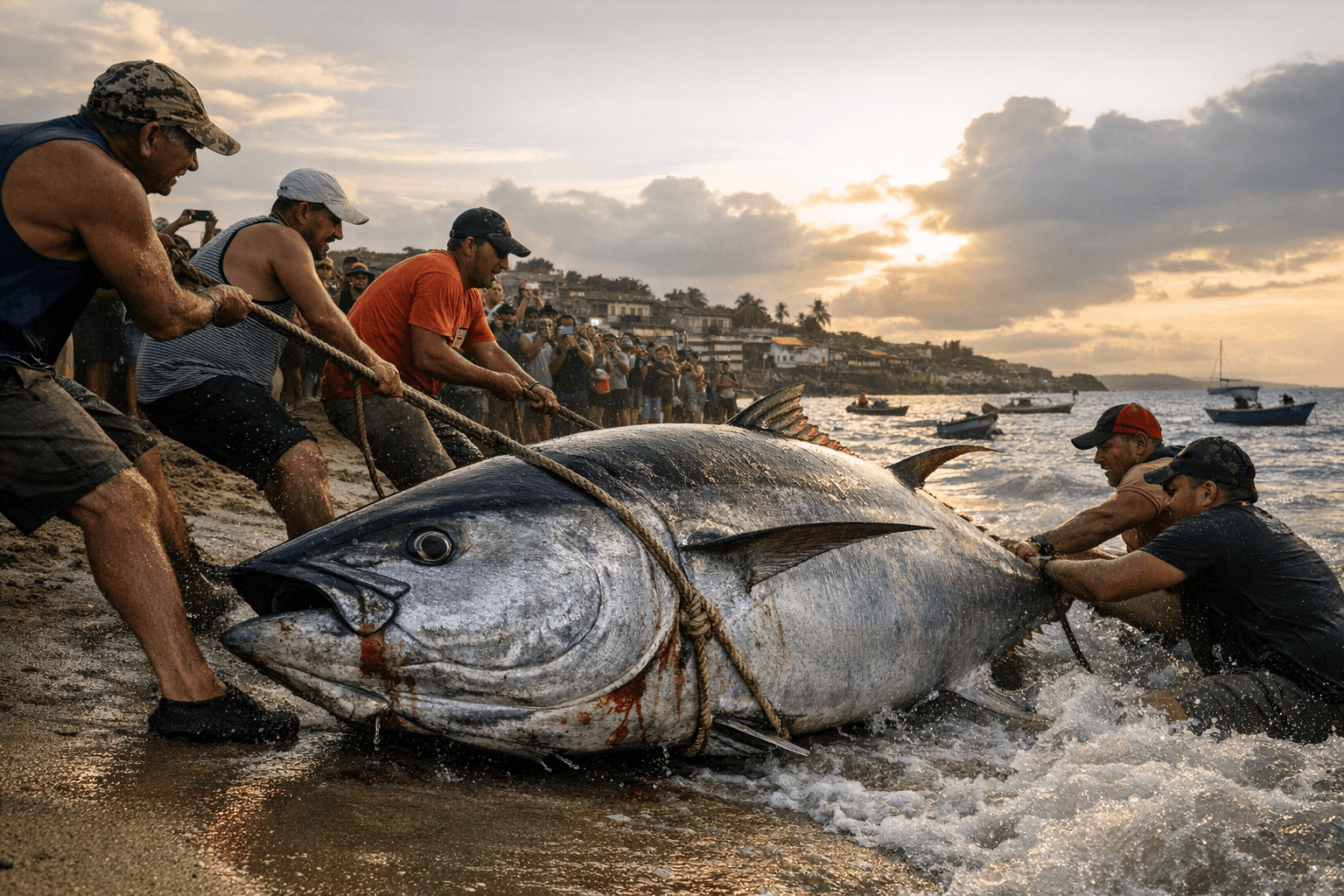
Come on, come on, lift it up!" The shouts carry through the surf at Playa Baracoa, a beach on Cuba's Artemisa coast facing the Florida Straits, where several men are straining against something that will not come easy. Remmer Maqueira posted the 15-second footage to Facebook under the caption "Today in Playa Baracoa," and within days it crossed one million views, lighting up Cuban social media and diaspora forums and igniting a debate that went well beyond fishing.
No weight slip, no measuring tape, and no species tag appear in the footage. But the physical resistance of the fish and the number of hands required to move it point toward something in the 150-to-300-pound range at minimum. Playa Baracoa sits on Cuba's north coast, directly on the migration corridor that both yellowfin and Atlantic bluefin follow on their way toward Gulf of Mexico spawning grounds in April and May. Water temperatures in the Florida Straits in March fall well within the preferred range for both species as they push through nearshore waters. A 2022 Cuban catch involved a yellowfin reportedly estimated at 710 pounds, taken on mackerel (locally called chicharro) bait, evidence that large yellowfin push to within striking distance of the island's northern shore when nearshore bait schools concentrate in early spring.
Landing a fish of that size from an open beach is a serious logistical problem, and the clip suggests the group solved it through sheer manpower rather than preparation. The correct sequence, when you want to preserve the meat, begins with working the fish into the shallows without grounding it on sand, then deploying a gaff or tail rope at the waterline. An immediate gill cut or brain spike (ike jime) has to follow before the fish overheats from the fight; then it goes into a slush ice bath as quickly as possible. A large tuna's core temperature can rise fast enough after a prolonged surf struggle to compromise the flesh in minutes, particularly on a warm Cuban March afternoon.
The crowd visible in Maqueira's clip adds its own complications. A 200-pound tuna thrashing in the shallows can injure anyone near its tail, and the social pressure of a public landing pushes toward speed over correctness. The visual impact of the event triggered an avalanche of comments blending humor, disbelief, and critique. Some urged dividing the meat immediately; others questioned how the fish was caught. One noted, with obvious irony, "Let Raul find out," a reference to the expectation that unusually large catches in Cuba attract state attention. Cuba's commercial fishing sector operates as a state enterprise, and the rules governing what an individual can legally retain from a catch of this scale are genuinely ambiguous, a tension the comment threads reflected in real time.
For shore-based and small-boat anglers, the practical takeaway is in the preparation. An 80- to 130-pound-class stand-up outfit, a pre-rigged gaff, and a handler at the waterline with a bleed knife ready are not optional for a fish in this weight class. Viral footage makes the beach landing look like the finish line. Anyone who has worked a large tuna knows it is closer to the starting gun.
This article was produced by Prism’s automated news system from verified source data, official records, and press releases, then run through automated quality and moderation checks before publishing. The system is built and supervised by the people who set the standards it runs under. Read our full AI policy.
Did this article answer your question?