San Diego Boats Log Heavy Bluefin Tuna Counts in Early 2026 Season
The Pacific Voyager put 68 bluefin tuna in the box for just 17 anglers on a 2-day trip out of Seaforth — an eye-popping 4-to-1 fish-per-angler ratio in March.
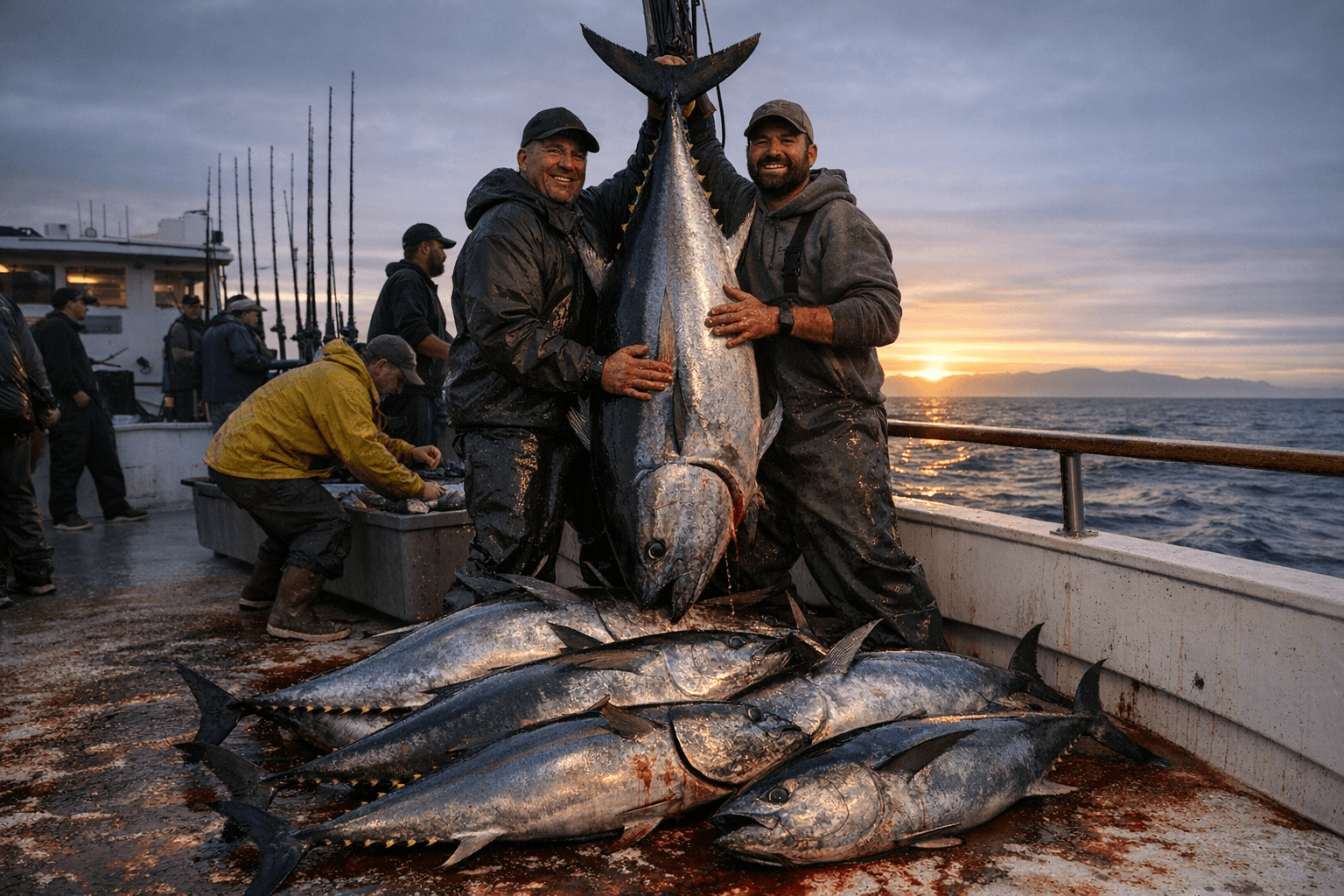
Sixty-eight bluefin tuna in the box for just 17 anglers. That was the top-line number when the Pacific Voyager tied up at Seaforth Sportfishing on March 22, completing a 2-day trip that also tallied 42 yellowtail, 47 lingcod, 12 bonito, and 31 vermilion rockfish. The haul works out to exactly 4 bluefin per angler before you even count the rest of the deck, a figure that stands out even against the broader picture of a San Diego fleet that is clearly finding fish in numbers well ahead of the traditional summer peak.
The first bluefin of the season typically appear in Southern California waters as temperatures warm past 60 degrees, with spring fish often running school-size and traveling in large pods. The Pacific Voyager is a vessel specializing in 1-6 day offshore trips fishing for tuna, dorado, and yellowtail, making it a natural pick for anglers looking to run hard and stay on fish. The March 22 trip delivered exactly that.
H&M Landing also had bluefin on the docks that day. The Patriot, running a 1.5-day trip out of H&M with just 8 anglers aboard, returned 16 bluefin tuna, a per-rod count that held its own considering the shorter time on the water. Together, the Pacific Voyager and Patriot accounted for 84 confirmed bluefin between 25 rods across two different landings on the same date.
The Coronado Islands runs told their own story in yellowtail. H&M Landing's Grande loaded 40 anglers on a full-day Coronado Islands trip and came back with 49 yellowtail alongside 30 rockfish and 3 lingcod. Out of Seaforth, the boat named San Diego ran 34 anglers to the same grounds and unloaded 30 yellowtail. At Fisherman's Landing, the Liberty covered a full-day trip with 41 anglers and put exactly 41 yellowtail on the dock, plus 5 lingcod. Three boats, three landings, and well over 100 yellowtail combined out of the Coronados in a single March day.
The shorter-range boats kept plenty of anglers busy closer to home. Fisherman's Landing's Dolphin ran back-to-back half-day trips, with 50 anglers on the AM run scoring 42 sand bass and 38 sculpin, and 58 anglers on the PM run adding 58 sand bass and 67 sculpin. H&M's Premier (21 anglers, half-day AM) boated 32 sculpin and 23 sand bass among a mixed bag that included a halibut. Up in Oceanside, the Southern Cal carried 30 anglers on a half-day AM run and delivered a clean 30 calico bass and 10 whitefish from Oceanside Sea Center.
A few entries in the count sheets warrant a second look: both the New Seaforth (PM half-day, 27 anglers) and the Sea Watch (19 anglers, three-quarter day) recorded more calico bass released than kept. The Sea Watch's sheet showed 6 calico bass retained against 29 released, while the New Seaforth PM tallied 13 kept alongside 25 released. That level of voluntary release on a three-quarter-day inshore trip signals a conservation-conscious fleet, and it reflects a broader pattern of anglers targeting bass without hammering the population.
San Diego sits at the epicenter of Pacific bluefin tuna fishing in the United States, with its proximity to the productive waters of northern Baja Mexico putting anglers in prime position to intercept bluefin as they migrate north through the Southern California Bight. The March 22 counts confirm that migration is already well underway, weeks before the season historically gets rolling in earnest. If the Pacific Voyager's 68-fish 2-day trip is any indication of what the local fleet has been finding offshore, the spring bite is shaping up to be worth watching closely.
This article was produced by Prism’s automated news system from verified source data, official records, and press releases, then run through automated quality and moderation checks before publishing. The system is built and supervised by the people who set the standards it runs under. Read our full AI policy.
Did this article answer your question?