EA Buyout Debt Raises $15 Billion, Rallying on Strong Investor Demand
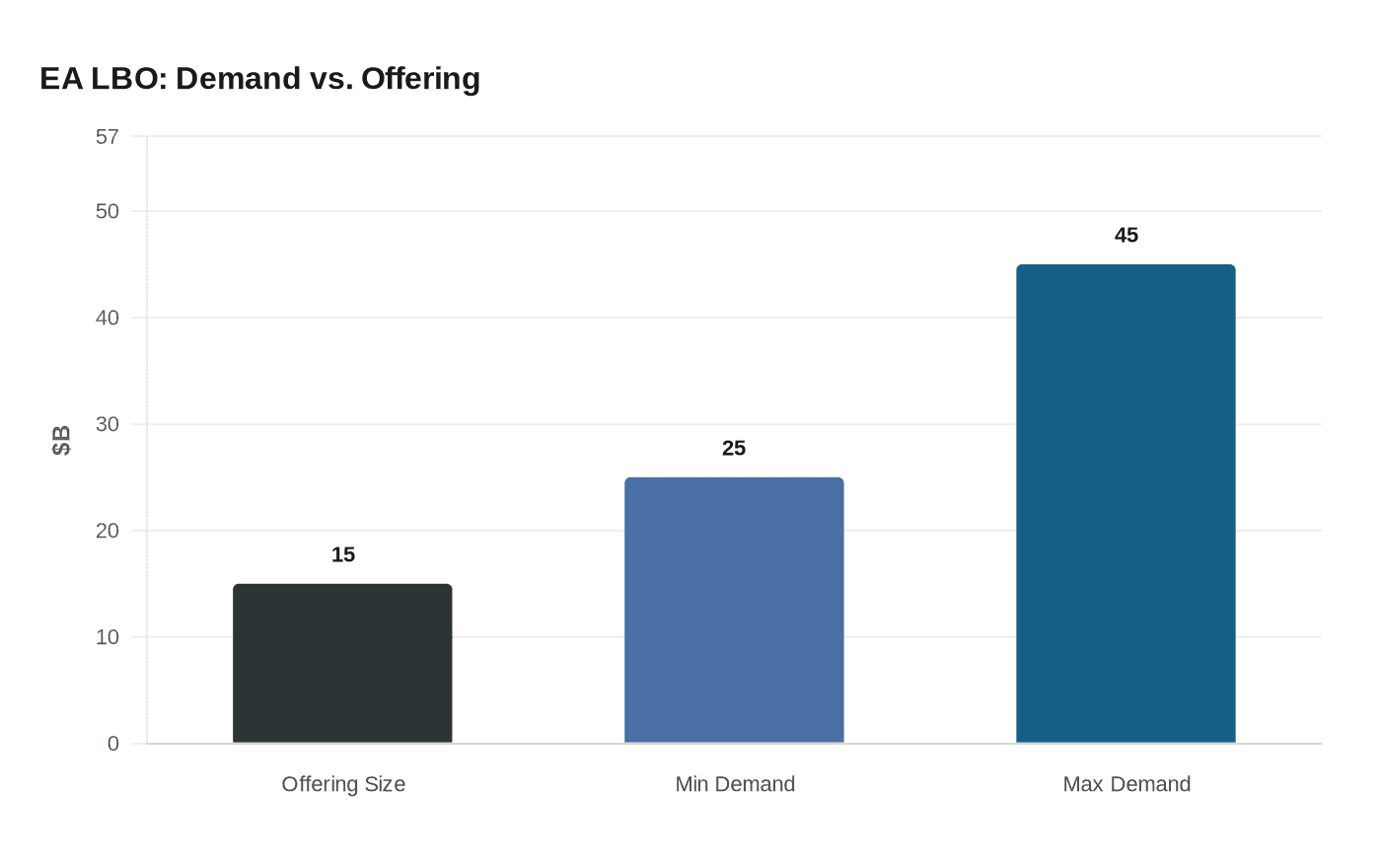
Investors demanded up to $45B for a $15B debt offering, revealing just how badly Wall Street wants a piece of EA's $55B buyout.

The banks running Electronic Arts' historic leveraged buyout didn't just find buyers for $15 billion in debt last week. They found buyers who wanted three times that much.
A JPMorgan Chase-led syndicate closed the dollar-denominated financing package tied to EA's $55 billion acquisition on March 25, with demand across tranches ranging from $25 billion to $45 billion for an offering sized at roughly $15 billion. The oversubscription, in a credit market rattled by geopolitical risk and anxiety over AI's long-term pressure on the software sector, signaled something the deal's skeptics hadn't fully priced in: that deep-pocketed investors still see EA's catalogue as a generational entertainment asset worth owning at almost any price.
The $55 billion buyout, agreed in 2025 between EA and a consortium comprising Saudi Arabia's Public Investment Fund, Silver Lake and Affinity Partners, is the largest leveraged buyout in history. Funding a transaction at that scale required structuring debt across multiple tranches: term loans, secured notes and high-yield bonds. JPMorgan's $8 billion bond placement sat at the center of that puzzle, alongside related loan syndication that the bank's team reportedly coordinated under the internal codename Project Eagle.
The day after pricing, Trace data showed the 8.75% unsecured bond and the 7.25% secured note both trading above par in secondary activity, a sign that institutional buyers weren't just absorbing the paper but actively competing for it. Notes clearing above par immediately after an LBO financing is the kind of signal that turns heads in credit markets; it means initial pricing left returns on the table for early buyers, which tends to generate its own momentum.
Analysts tracking the deal called it a bellwether for large private-equity financings in 2026. If a $15 billion debt sale can clear with that margin of demand in a turbulent macro environment, other sponsors sitting on large gaming or media assets will be watching closely.
For EA, the transition from public to private ownership, pending regulatory approvals already underway, removes the quarterly earnings pressure that has shaped product decisions at the company for years. The tradeoff is significant leverage on the franchise, with repayment obligations that compress the margin for error on titles like EA Sports FC, The Sims and Battlefield. Whether the consortium's long-term thesis holds depends on whether gaming revenues can service debt at this scale, a question that will define EA's next chapter under private ownership.
This article was produced by Prism’s automated news system from verified source data, official records, and press releases, then run through automated quality and moderation checks before publishing. The system is built and supervised by the people who set the standards it runs under. Read our full AI policy.
Did this article answer your question?