New Study Identifies Post-Game Depression, Finds RPGs Hit Players Hardest
RPG players experience the strongest post-game depression, a new study finds — with obsessive thoughts about a finished game being the most intense symptom, not loss of enjoyment.
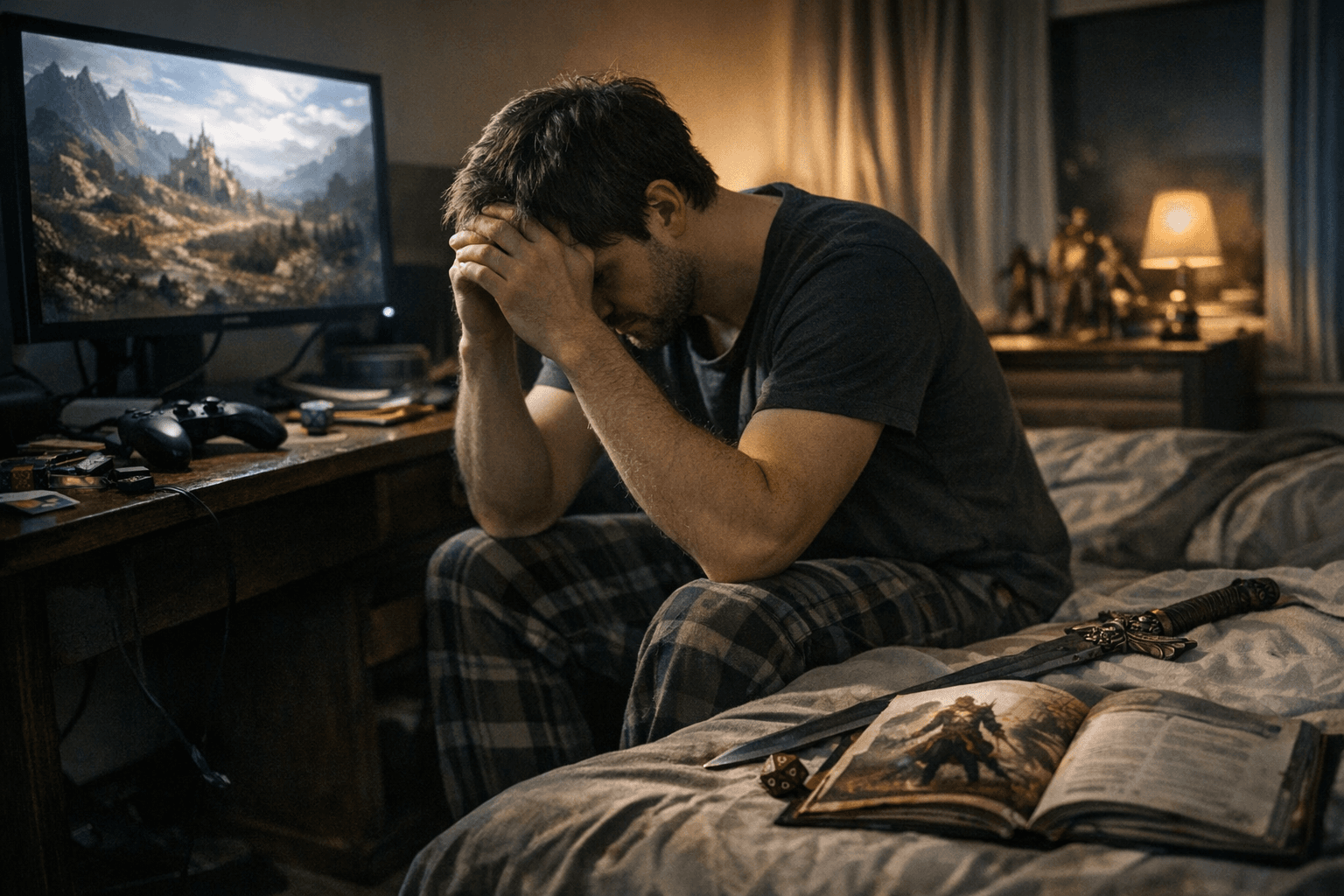
The credits roll, the controller goes down, and something quietly collapses. That hollow feeling has a name now, and Polish researchers have built the first scientific tool to measure it.
Psychologist Kamil Janowicz, from the Center for Research on Personality Development at the Institute of Psychology at SWPS University, and psychologist Piotr Klimczyk from the Stefan Batory Academy of Applied Sciences in Skierniewice created the Post-Game Depression Scale (P-GDS), designed to capture what the paper defines as "the sense of emptiness that arises after completing a deeply immersive game" — a phenomenon widely reported by players on social media but until now lacking any formal quantitative measure.
The researchers conducted two studies with a total of 373 players and used exploratory and confirmatory factor analyses to produce a 17-item version of the P-GDS built around four subscales: Game-related Ruminations, Challenging End of Experience, Necessity of Repeating the Game, and Media Anhedonia. Participants were recruited via social media announcements, Reddit, a curated mailing list, and Discord.
The headline finding is unambiguous for anyone who has ever lost 80 hours to a JRPG. "Our research shows that gamers playing role-playing games (RPGs) are most susceptible to post-game depression. It is in these games that players have the greatest influence on character development through their decisions, and build the strongest bonds with their characters. And the more engaging the game world and the closer the relationship with the character, the more difficult it is to return to reality once the game is over," said dr Janowicz.
The study also observed positive correlations between the intensity of post-game depression and stronger depressive symptoms, a tendency to rumination, disturbances in emotional processing, and lower well-being. Among the four subscales, the results were not evenly distributed: Media Anhedonia, the diminished enjoyment of all other media after finishing a game, turned out to be the least intense component, while Game-related Ruminations, the compulsive dwelling on the fact that the game is over, registered as the most intense.
The rumination finding carries a broader implication. Both studies confirmed that people who tend to be overwhelmed by repetitive and intrusive thoughts may also experience them in the context of playing and finishing video games, leading the researchers to conclude that the tendency to ruminate may be considered a risk factor for experiencing intense post-game depression. Individuals who experienced more intense sadness after finishing a game were also more likely to exhibit a general tendency to dwell on events pessimistically.
Janowicz frames the experience not as a quirk of gaming culture but as something structurally recognizable in psychology. "P-GD is a specific type of grief after loss, reminiscent of parting with a loved one or the end of an important life stage," he remarked, describing the phenomenon as a form of grief similar to losing an important connection.
The researchers note that for many players the virtual world becomes a significant source of emotions and that returning to everyday life requires time and appropriate psychological tools. They suggest the results could be useful in the game design process and raise questions about the ethical responsibilities developers carry when building deeply immersive worlds.
The paper, published in Current Psychology, is the first peer-reviewed work to give the phenomenon a validated measurement instrument, building on Klimczyk's earlier qualitative work from 2023 in Cyberpsychology: Journal of Psychosocial Research on Cyberspace and moving the conversation from anecdotal forum posts into measurable, peer-reviewed territory. Whether the P-GDS eventually informs how studios think about narrative endings, post-game content, or player support tools remains an open question, but the grief now at least has a scale.
This article was produced by Prism’s automated news system from verified source data, official records, and press releases, then run through automated quality and moderation checks before publishing. The system is built and supervised by the people who set the standards it runs under. Read our full AI policy.
Did this article answer your question?